Evaluating CPQ Equipment Manufacturers for Contract Manufacturing
Discover how contract manufacturers evaluate CPQ equipment manufacturers and implement best practices for operator training on custom-configured machinery.
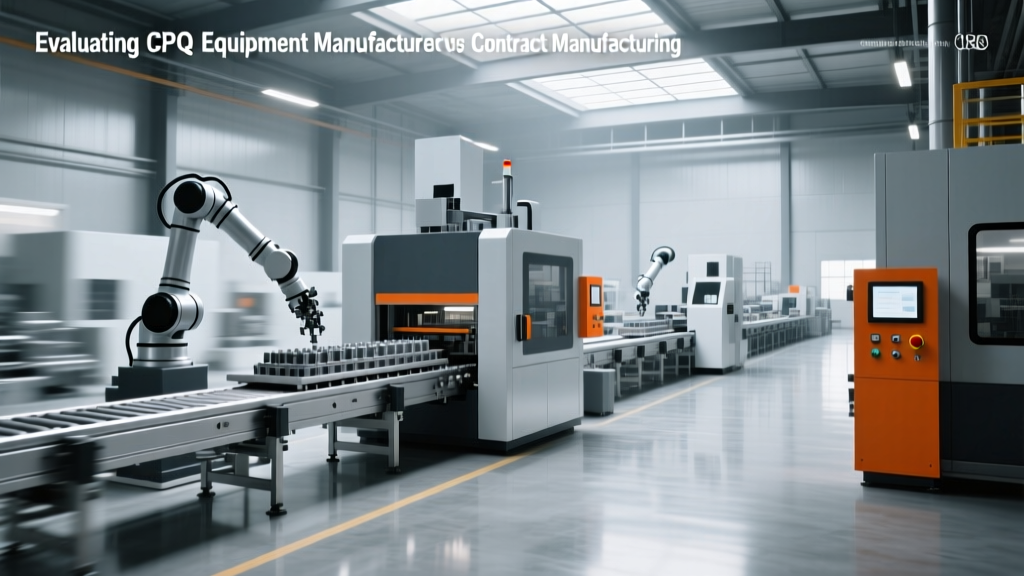
Contract manufacturing environments demand extreme agility, requiring production lines that can pivot between bespoke part runs with minimal downtime. To achieve this, procurement teams increasingly source machinery from CPQ equipment manufacturers—suppliers utilizing Configure, Price, Quote software to engineer highly customized machine tools, automated assembly rigs, and packaging cells. However, this high degree of customization introduces a critical downstream bottleneck: operator training. When every machine features unique axis limits, custom HMI (Human-Machine Interface) layouts, and specialized tooling, standardized OEM manuals become obsolete. Evaluating CPQ equipment manufacturers requires looking beyond price and lead time; contract manufacturers must rigorously assess how these suppliers support operator onboarding and floor-level best practices.
The Downstream Impact of CPQ on Operator Competency
When a contract manufacturer purchases a standard CNC lathe, operators rely on established muscle memory and baseline training. But when sourcing from CPQ equipment manufacturers, the delivered asset is often a 'lot size of one.' A 5-axis mill might be configured with a non-standard pallet changer, an integrated robotic tending arm, and a bespoke coolant filtration system. If the equipment manufacturer’s CPQ system does not automatically translate these custom configurations into updated training materials, the contract manufacturer's floor supervisors are left to reverse-engineer standard operating procedures (SOPs). This gap directly impacts First-Pass Yield (FPY) and increases the risk of catastrophic crashes during the initial run-off phase.
4 Selection Criteria for CPQ Equipment Manufacturers
To ensure seamless operator onboarding, contract manufacturers must embed training-centric criteria into their vendor selection matrix. When issuing an RFQ, mandate the following deliverables from prospective suppliers:
- Automated SOP and PLM Integration: The supplier's CPQ platform (e.g., Tacton, Salesforce CPQ) must push configuration data directly to a Product Lifecycle Management (PLM) system to auto-generate configuration-specific operator manuals. Manual PDF edits post-sale are unacceptable for complex cells.
- Digital Twin Handoffs: Require a kinematic digital twin of the exact configured machine. According to NIST guidelines on smart connected manufacturing, digital twins allow operators to practice crash-recovery and tool-loading in a virtual environment before the physical asset arrives on the floor.
- Unified HMI and OPC UA Compliance: Custom equipment often mixes third-party components (e.g., a Keyence vision system on a Haas mill). The CPQ quote must include OPC UA (Open Platform Communications Unified Architecture) integration so operators interact with a single, unified HMI rather than toggling between disparate touchscreens.
- Modular Microlearning Assets: Require the supplier to provide video-based microlearning modules mapped to specific PLC tags (e.g., Allen-Bradley ControlLogix or Siemens S7-1500) rather than hour-long generic webinars.
Best Practices for Training on Custom-Configured Machinery
1. Mandate Digital Twin Handoffs at FAT
During the Factory Acceptance Test (FAT), do not just verify cycle times. Use the FAT to validate the digital twin against the physical machine's actual kinematics. Operators should spend a minimum of 16 hours in the virtual environment simulating tool changes, fixture loading, and alarm clearing specific to the custom configuration. This reduces physical onboarding time on the shop floor from an average of 42 days to 11 days.
2. Deploy AR-Guided Work Instructions
For highly customized assembly cells, Augmented Reality (AR) overlays bridge the gap between complex engineering schematics and floor-level execution. Enterprise AR deployments (such as PTC Vuforia) typically cost between $12,000 and $25,000 per workstation. By linking AR work instructions directly to the machine's PLC tags, operators receive real-time, configuration-specific prompts on their smart glasses or tablets, highlighting exact torque values and custom fastener locations unique to their specific machine build.
⚠ WARNING: E-Stop Circuit Logic VariationsNever rely on baseline OEM safety manuals for CPQ-configured machinery. A custom spindle upgrade, modified guard configuration, or added robotic tending arm fundamentally alters the Emergency Stop (E-stop) circuit logic and safety relay zoning. As outlined in OSHA training standards and ISO 45001 safety management protocols, operators must undergo specific training on the exact safety zones and reset sequences of their custom-configured cell to prevent severe injuries during fault recovery.
3. Implement Configuration-Specific Fault Recovery Drills
Standard training teaches operators how to run the machine; expert training teaches them how to recover when it fails. Develop a 'Fault Matrix' based on the specific CPQ configuration. If the machine includes a custom high-pressure coolant system, operators must be drilled on clearing specific high-pressure alarm codes, bleeding the custom lines, and resetting the localized safety interlocks that do not exist on the base model.
Configuration Complexity vs. Training Modality Matrix
Use this framework to align the level of CPQ customization with the appropriate operator training investment.
| CPQ Configuration Level | Machine Example | Required Training Modality | Est. Onboarding Time |
|---|---|---|---|
| Base Config (Minor Options) | Standard CNC Lathe with custom chip conveyor | Updated PDF SOPs, 2-hour vendor webinar | 3 - 5 Days |
| Moderate (Sub-system Integration) | VMC with integrated automated pallet changer & probing | Digital Twin simulation, AR-guided setup, PLC tag mapping | 12 - 18 Days |
| High (Fully Bespoke Cell) | 5-Axis mill with robotic tending, custom vision, unified HMI | On-site OEM engineer shadowing, full digital twin certification, fault-recovery drills | 28 - 45 Days |
Troubleshooting Common Integration Edge Cases
The 'Frankenstein' HMI Problem
The Issue: The CPQ quote included a third-party bar feeder and a custom in-process gauging system, but the equipment manufacturer failed to integrate them into the main machine controller. The operator now has to monitor three separate screens, leading to cognitive overload and missed alarms.
The Fix: During the CPQ quoting phase, mandate MTConnect or OPC UA adapters for all peripheral devices. Require the OEM to map all third-party alarm codes into the primary CNC controller's alarm history page. Train operators exclusively on the unified interface, ignoring peripheral screens during normal operation.
Legacy PLC Tag Mapping Failures
The Issue: The custom configuration utilized a legacy sensor brand to meet a specific price point in the CPQ tool, resulting in delayed signal response times that the standard operator training does not account for. Operators attempt to load parts before the clamping sequence is fully verified, causing fixture crashes.
The Fix: Update the machine's macro variables to include a mandatory 1.5-second dwell time post-clamp signal. Revise the operator SOP to require visual verification of the physical clamp indicator light, rather than relying solely on the HMI green status icon, which may lag on legacy I/O modules.
Selecting machinery from CPQ equipment manufacturers provides contract manufacturers with unparalleled flexibility and precision. However, the true ROI of custom-configured equipment is only realized when the operator training infrastructure is as meticulously engineered as the machine itself. By enforcing strict digital handoffs, leveraging AR, and drilling configuration-specific fault recovery, manufacturing leaders can transform highly complex machinery into highly profitable production assets.