CPQ for Foodservice Equipment Manufacturers: Automated Line Costs
Analyze the true costs of CPQ for foodservice equipment manufacturers integrating with automated production lines, from PLC middleware to ROI payback.
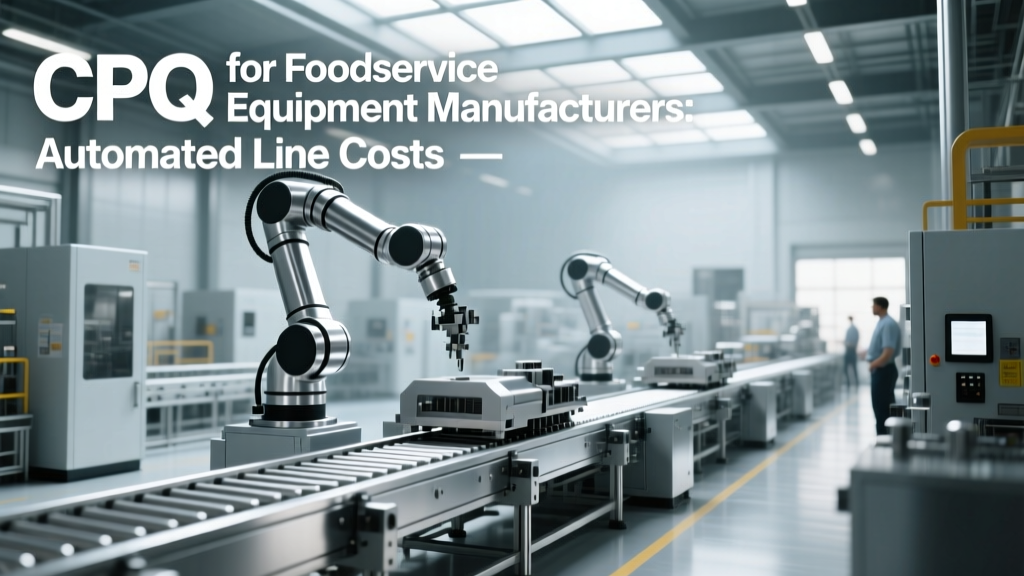
Commercial kitchen manufacturing operates on razor-thin margins and extreme customization. A single hospital contract might require 40 custom-width 304 stainless steel prep tables, while a hotel chain demands modular combi ovens with specific voltage and gas configurations. To manage this complexity, manufacturers are deploying advanced Configure, Price, Quote (CPQ) software. However, deploying CPQ for foodservice equipment manufacturers is no longer just a front-office sales exercise. In 2026, the true competitive advantage lies in automated production line equipment integration—pushing configured BOMs, CAD files, and machine code directly from the CPQ engine to the factory floor's CNC lasers, press brakes, and robotic welding cells.
2026 Integration Cost Snapshot
- Average CapEx for Full CPQ-to-PLC Integration: $420,000 - $780,000
- Middleware & IoT Gateway Licensing: $35,000 - $65,000 annually
- Legacy Machine Retrofitting: $8,000 - $14,000 per station
- Average Payback Period: 18 to 26 months via scrap reduction and quoting acceleration
The Architecture of CPQ-to-Factory Floor Integration
When a distributor configures a 100-gallon steam-jacketed kettle on a manufacturer's web portal, the CPQ system (such as Tacton, Epicor, or Salesforce CPQ) must execute a complex downstream cascade. It is not enough to generate a PDF quote and a static Bill of Materials (BOM). The CPQ must dynamically generate the DXF files for the Amada ENSIS fiber laser cutter, calculate the bend allowances for the Trumpf TruBend press brake, and output the specific jig coordinates to the FANUC ARC Mate robotic welding cell.
According to frameworks established by the NIST Manufacturing Extension Partnership (MEP), bridging the gap between commercial configuration logic and industrial control systems (ICS) requires a robust digital thread. This integration eliminates the 'engineering bottleneck'—the traditional 3-to-5 day delay where manufacturing engineers manually translate sales configurations into CAM (Computer-Aided Manufacturing) programs.
Integration Tiers and Budget Breakdown
Not every foodservice equipment manufacturer requires full bidirectional PLC integration. Budgeting must align with the facility's existing automation maturity. Below is a cost matrix for the three primary integration tiers.
| Integration Tier | Scope of Automation | Estimated CapEx (2026) | Best For |
|---|---|---|---|
| Tier 1: ERP-Only | CPQ pushes dynamic BOM and routing to ERP (e.g., SAP, Infor). Manual CAM programming on the floor. | $120,000 - $180,000 | High-mix, low-volume custom fabricators with manual welders. |
| Tier 2: ERP + CAM API | CPQ triggers automated CAD generation and nests parts for CNC punch/laser tables via API. | $280,000 - $410,000 | Mid-sized manufacturers producing standardized modular prep lines and refrigeration units. |
| Tier 3: Full Line PLC | End-to-end integration. CPQ dictates machine parameters, robotic weld paths, and automated conveyor sorting via OPC-UA. | $550,000 - $780,000+ | Tier-1 OEMs producing high-volume combi ovens, dishwashers, and automated cooking lines. |
Budgeting for Middleware and IoT Gateways
CPQ platforms do not natively speak the language of factory floor Programmable Logic Controllers (PLCs). To connect a cloud-based Salesforce or Tacton CPQ instance to an Allen-Bradley ControlLogix or Siemens S7-1500 PLC governing an automated assembly conveyor, manufacturers must budget for industrial middleware.
Software like PTC's KEPServerEX is the industry standard for translating IT protocols (REST/JSON) into OT (Operational Technology) protocols like Modbus TCP, EtherNet/IP, or PROFINET. Licensing for enterprise-grade OPC-UA servers and IoT gateways typically ranges from $15,000 to $30,000 upfront, with annual maintenance fees of 18%. Furthermore, aligning these data flows with the ISO 23247 Digital Twin framework ensures that the virtual configuration in the CPQ perfectly mirrors the physical state of the automated production line, a critical requirement for predictive maintenance on heavy stamping presses.
Edge Case: Legacy Stainless Steel Fabrication Equipment
A frequent budget overrun occurs when plant managers discover their existing automated equipment lacks modern connectivity. A 2014 Panasonic robotic welding cell used for sealing commercial refrigeration compressor housings may not support native MTConnect or OPC-UA protocols. Retrofitting these legacy machines with external IoT sensor kits and edge-computing gateways (such as Cisco IR1101 or Advantech ICR-3200) costs between $8,000 and $14,000 per machine. If a production line features 12 legacy automated stations, this adds $96,000 to $168,000 to the integration budget—a figure routinely omitted from initial software vendor proposals.
⚠️ WARNING: The 'Stainless Steel Scrap' Hidden CostFoodservice equipment relies heavily on 14-gauge and 16-gauge 304 and 316 stainless steel. If your CPQ-to-CAM integration does not include dynamic, AI-driven nesting algorithms for the automated laser cutters, you will generate massive offcuts. A poorly integrated CPQ that forces manual nesting post-configuration can increase stainless scrap rates by 12% to 18%. At 2026 commodity pricing, a 15% scrap increase on a $4M annual stainless budget destroys $600,000 in margin, entirely negating the ROI of the CPQ software.
Step-by-Step Budget Allocation Framework
For a mid-sized foodservice equipment manufacturer targeting Tier 2 or Tier 3 integration, allocate your capital expenditure using this proven framework to prevent scope creep:
- Core CPQ & 3D Visualization Engine (25%): Licensing the base software, building the product rules (e.g., preventing a 208V heating element configuration on a 480V chassis), and generating customer-facing 3D CAD renders.
- ERP & CAD/CAM Middleware (30%): Developing the custom APIs that push the configured BOM to the ERP and trigger the automated nesting software (like SigmaNEST) for the CNC punch presses.
- PLC Retrofitting & OT Security (20%): Upgrading legacy robotic welders with IoT gateways and implementing industrial DMZ firewalls to protect the production line from external cyber threats introduced by cloud CPQ connections.
- Custom Logic Development & UAT (25%): Paying systems integrators to map the complex engineering rules. Foodservice equipment has strict NSF and UL compliance requirements; the integration must automatically flag configurations that violate sanitation clearance rules before they reach the automated line.
ROI and Payback Period Analysis
The financial justification for integrating CPQ with automated production lines rests on three measurable metrics: quoting velocity, engineering hour reclamation, and material yield.
Historically, quoting a custom modular chef's line with integrated ventilation and specific gas manifolds required 14 to 21 days of back-and-forth between sales, engineering, and the shop floor estimator. With full CPQ-to-line integration, dynamic pricing and automated BOM generation reduce this to under 4 hours. More importantly, eliminating the manual translation of CAD files to CNC G-code saves an average of 3.5 engineering hours per custom order. For a facility processing 40 custom orders a month, this reclaims 140 engineering hours monthly, allowing the manufacturer to scale production volume without hiring additional CAM programmers. Factoring in the reduction of stainless steel scrap via automated CPQ-driven nesting, most Tier-1 and Tier-2 foodservice OEMs achieve full CapEx payback within 18 to 26 months.
Frequently Asked Questions (FAQ)
Can CPQ software directly generate G-code for foodservice manufacturing equipment?
No, CPQ platforms do not natively generate machine-specific G-code. Instead, the CPQ generates the parametric 3D CAD models and DXF geometries, which are then passed via API to dedicated CAM software (like Mastercam or SigmaNEST). The CAM software then generates the specific G-code or proprietary code required by the Amada or Trumpf laser cutters on the automated line.
How does MTConnect factor into CPQ integration?
MTConnect is an open-standard protocol used to extract real-time data from CNC machines and automated cells. While CPQ handles the 'front-end' configuration and order generation, MTConnect provides the 'back-end' feedback loop. It allows the ERP to verify that the automated press brake actually completed the configured bend sequence, triggering the next step in the assembly line and updating the customer's order status portal in real-time.
What are the NSF compliance risks of automated CPQ configurations?
The National Sanitation Foundation (NSF) mandates strict rules for commercial foodservice equipment, such as specific radii on welded corners and the elimination of harborage points for bacteria. If the CPQ rule tree is not perfectly synced with the robotic welding cell's pathing logic, the automated line might weld a joint with a sharp 90-degree internal angle instead of a continuous sanitary radius, resulting in a failed NSF audit and scrapped production runs.