Closed-Loop Powder Recirculation Systems: Top Manufacturers & Costs
Evaluate CapEx and integration costs for the best equipment manufacturers for closed-loop powder recirculation systems in automated production lines.
The True Cost of Automated Closed-Loop Powder Integration
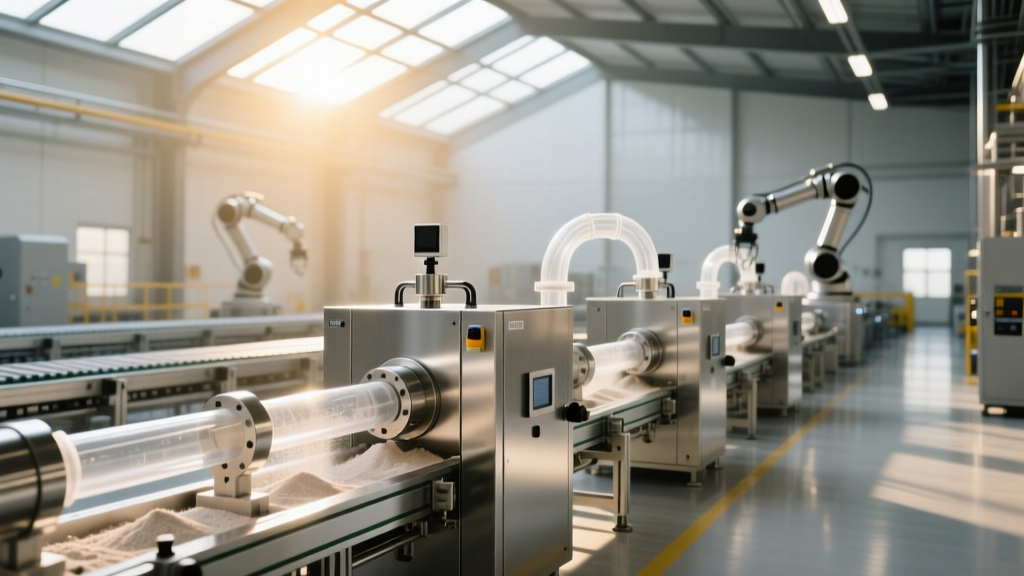
Transitioning from open-air powder handling to a fully automated, inert closed-loop recirculation system is a mandatory capital expenditure for modern battery electrode manufacturing, additive manufacturing (AM), and potent pharmaceutical processing. When evaluating the best equipment manufacturers for closed-loop powder recirculation systems, plant engineers must look beyond the base hardware price tag. The true cost lies in the automation handshake, inert gas generation, and compliance engineering required to seamlessly integrate these units into a continuous production line.
As of 2026, a fully integrated closed-loop vacuum conveying and sieving node typically requires a capital budget between $185,000 and $620,000, depending on throughput requirements and hazardous area classifications. Below is a technical breakdown of Tier 1 manufacturers, integration costs, and the hidden operational expenses that dictate long-term ROI.
⚠️ ATEX & NFPA 652 Compliance Warning: If your recirculated powder includes reactive metals (titanium, aluminum) or organic excipients, the system must comply with OSHA Combustible Dust Guidelines and NFPA 652. Budget an additional $45,000 to $85,000 for explosion venting, rotary airlock isolation valves, and ATEX Zone 20/21 certified motors and sensors.Tier 1 Manufacturer CapEx Comparison Matrix
Selecting the right OEM depends heavily on your specific industry vertical and the level of native automation provided out-of-the-box. The matrix below compares the leading manufacturers based on 2026 pricing for mid-to-high throughput automated nodes (500 kg/hr to 2,000 kg/hr).
| OEM / Manufacturer | Core Technology Focus | Base Hardware CapEx | Automation Readiness | Best Application Vertical |
|---|---|---|---|---|
| GEA Group | Continuous Processing (ConsiGma) | $420,000 - $650,000 | Native OPC UA, Pharma 4.0 ready | Pharmaceuticals, Potent APIs |
| Hosokawa Micron | Custom Pneumatic Conveying & Milling | $250,000 - $400,000 | High (Requires custom PLC mapping) | Battery Cathode (NMC/LFP), Advanced Ceramics |
| Volkmann | Modular Vacuum Conveyors (VS Series) | $85,000 - $160,000 | Modular (Needs 3rd-party integration) | Additive Manufacturing, Specialty Chemicals |
| Russell Finex | Closed-Loop Sieving & Filtration Nodes | $120,000 - $210,000 | High (Native Profinet/EtherNet/IP) | Food, Dairy, 3D Printing Powder Prep |
Decoding the Automation Handshake Costs
Purchasing the mechanical hardware is only step one. Integrating a closed-loop system into a master Siemens S7-1500 or Allen-Bradley ControlLogix PLC requires significant software engineering. A closed-loop system relies on precise pressure differentials and oxygen deprivation. The automation budget must account for:
- Oxygen Monitoring Interlocks: Integrating Servomex or Zirox trace oxygen analyzers ($12,000 - $18,000 per node) to ensure O2 levels remain below 2% before initiating powder transfer.
- Level Sensing: Standard capacitive sensors fail with low-dielectric powders. Budget for Berthold radiometric sensors ($8,500+) or Endress+Hauser Soliphant tuning fork switches ($2,800 each) for reliable hopper level control.
- SCADA Recipe Management: Developing automated clean-in-place (CIP) and product changeover recipes in Ignition or Wonderware typically adds $25,000 to $40,000 in systems integration labor.
Hidden OpEx: Inert Gas and Consumable Degradation
When planning the operational budget for closed-loop powder recirculation, facility managers frequently underestimate the cost of maintaining the inert atmosphere and managing filter media.
💡 Nitrogen Generation vs. Liquid Dewars: For systems requiring continuous inertization, relying on liquid N2 dewars will destroy your OpEx budget. Installing an on-site Parker Hannifin or Atlas Copco PSA Nitrogen Generator (CapEx: $22,000 - $35,000) reduces inert gas costs by up to 80% over a 3-year period, paying for itself within 14 months of continuous operation.Filter Blinding and Sintered Metal Media:
Closed-loop vacuum conveyors rely on sintered metal or PTFE-coated polyester filters to separate the powder from the conveying gas. In high-humidity environments or with hygroscopic powders (like certain lithium salts), these filters blind rapidly. Standard polyester filters ($150 each) may require weekly replacement. Upgrading to heated, reverse-pulse sintered stainless steel filters ($1,200 each) extends lifecycle to 18+ months, but requires integrating a heated compressed air loop into the system design.
Integration Failure Modes That Destroy ROI
Even when utilizing the best equipment manufacturers for closed-loop powder recirculation systems, poor line integration leads to catastrophic failure modes. Understanding these edge cases during the budgeting phase prevents costly post-commissioning change orders.
1. Triboelectric Charging and Micro-Arcing
As powder moves through pneumatic lines at high velocities, friction generates static electricity. In an inert environment, a sudden breach that introduces oxygen can turn a static spark into a deflagration. Standard polyurethane hoses are unacceptable. You must specify carbon-black infused, electrically conductive PU hoses (approx. $45/ft compared to $12/ft for standard) and ensure continuous grounding braids are bonded across every flange connection.
2. Particle Degradation via Saltation Velocity Miscalculation
If the automation system sets the vacuum pump RPM too high, the gas velocity exceeds the optimal saltation threshold, causing particle-on-particle collisions that degrade the powder's morphology. This is fatal in additive manufacturing, where spherical powder flowability is critical. Specify variable frequency drives (VFDs) with closed-loop mass flow sensors (e.g., KROHNE or Endress+Hauser Coriolis meters, $9,000+) to dynamically adjust conveying speed based on real-time powder density.
3. Validation Bottlenecks in Regulated Industries
For pharmaceutical applications, the mechanical installation is secondary to the software validation. Adhering to the FDA Process Analytical Technology (PAT) framework and GAMP 5 guidelines for automated systems requires extensive documentation, IQ/OQ/PQ testing, and source code audits. Budget a minimum of $60,000 and 4 to 6 months specifically for CSV (Computerized System Validation) when integrating closed-loop systems into GMP environments.
"The most common budget overrun in closed-loop powder integration isn't the vacuum pump or the sieve—it's the pneumatic valve actuators. Specifying standard actuators and later realizing they lack the partial-stroke testing capabilities required for SIL-2 safety integrity levels can force a complete teardown of the isolation manifold."
— Senior Process Automation Engineer, Tier 1 Battery Gigafactory Integration Team
Strategic Budget Allocation Framework
To ensure your capital request accurately reflects the reality of automated production line equipment integration, apply the following percentage breakdown to your total projected budget:
- Core Mechanical Hardware (OEM): 45% (Conveyors, sieves, hoppers, rotary valves)
- Automation, Sensors & PLC Programming: 25% (Safety PLCs, VFDs, O2 analyzers, SCADA)
- Auxiliary Systems: 15% (N2 generators, vacuum pumps, CIP skids)
- Installation, Piping & Electrical: 10% (Conductive hosing, grounding, physical rigging)
- Validation & Commissioning: 5% (FAT/SAT, CSV, ATEX certification audits)
By mapping your budget against these specific integration vectors, plant managers can avoid the sticker shock of auxiliary automation costs and ensure the selected OEM's hardware is fully supported by the facility's digital infrastructure.