Batch vs Continuous: A Steel Equipment Manufacturing Company Guide
Compare batch and continuous manufacturing equipment. A guide for a steel equipment manufacturing company on heat treatment, costs, and ROI.
The Architecture of Choice: CapEx vs. Operational Flexibility
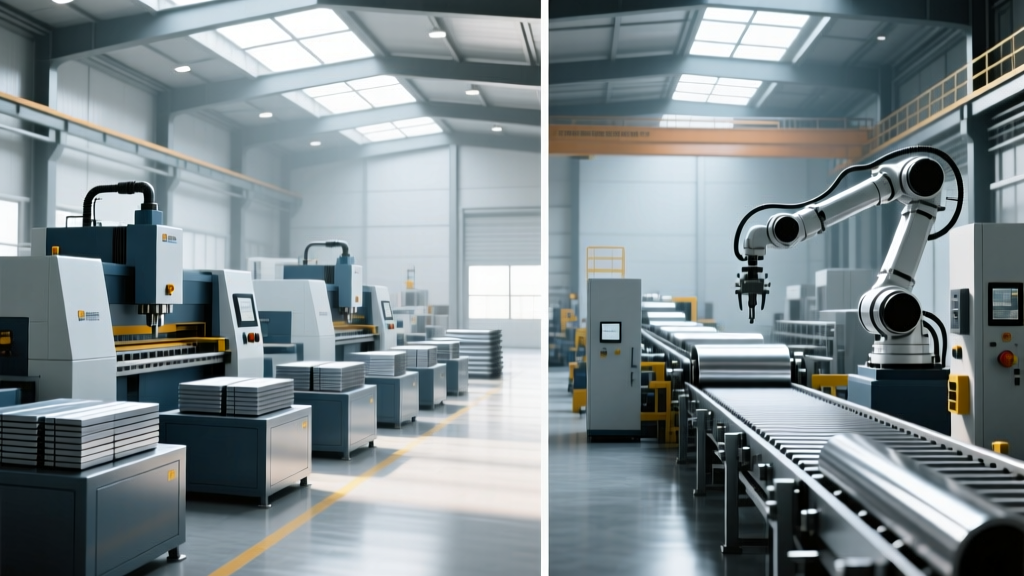
For a modern steel equipment manufacturing company, the decision between batch and continuous processing lines is rarely just about throughput. It is a fundamental architectural choice that dictates a facility's capital expenditure (CapEx), energy intensity, product mix agility, and scrap rates. While continuous lines dominate commodity-grade structural and automotive steel production, batch systems remain the undisputed standard for high-mix, low-volume specialty alloys and heavy forgings.
This analysis deconstructs the engineering and financial realities of both systems, utilizing heat treatment and surface coating as the primary operational benchmarks.
Decision Matrix: Batch vs. Continuous at a Glance
| Parameter | Batch Processing (e.g., Bell Furnaces) | Continuous Processing (e.g., CGL/CAL) |
|---|---|---|
| Baseline CapEx (2026) | $2.8M - $4.5M per stack | $45M - $85M per line |
| Thermal Efficiency | 45% - 55% | 75% - 88% (with recuperators) |
| Product Mix Agility | High (change alloys per base) | Low (transition scrap generated) |
| Footprint | Compact, modular expansion | Massive linear footprint (150m+) |
| Ideal Throughput | < 50,000 metric tons/year | > 150,000 metric tons/year |
Case Study A: Batch Bell Furnaces for High-Mix Specialty Alloys
When a steel equipment manufacturing company produces specialized electrical steels, high-carbon wire, or aerospace-grade forgings, batch bell annealing furnaces are the default engineering solution. Unlike continuous lines where the strip is pulled through a heated tunnel, batch systems lower a massive refractory-lined outer cover (OC) over an inner cover (IC) that encapsulates the steel coil.
Engineering Specifics and Atmosphere Control
The critical advantage of the batch bell furnace is atmosphere isolation. Modern stacks utilize an HNx (Hydrogen-Nitrogen) atmosphere with a strict dew point control of -40°C to -60°C. This ultra-dry environment prevents surface oxidation and decarburization, which is fatal to the magnetic properties of non-oriented electrical steel (NOES).
- Cycle Time: Typical full-cycle annealing (heating, soaking, and controlled cooling) takes 35 to 45 hours per stack.
- Stacking Limits: Coils are separated by convector plates to ensure gas circulation. A standard base can handle 3 to 4 coils, totaling up to 120 metric tons per batch.
- Energy Penalty: Because the entire refractory mass of the inner and outer covers must be heated and cooled, thermal efficiency rarely exceeds 55%. However, as noted in the Department of Energy's industrial heating guidelines, implementing regenerative burner systems on the outer covers can reclaim up to 30% of exhaust heat, narrowing the efficiency gap with continuous systems.
Case Study B: Continuous Galvanizing and Annealing Lines (CGL/CAL)
For high-volume commodity production—such as structural framing, automotive body panels, and standard fasteners—continuous lines are mandatory for survival. A Continuous Galvanizing Line (CGL) uncoils, welds, cleans, anneals, coats, and tensions-levels the strip in a single, uninterrupted pass.
The Economics of Speed and Tension
Modern CGLs operate at line speeds between 120 and 200 meters per minute. The strip is under constant, computer-controlled tension (ranging from 2 to 8 N/mm² depending on the yield strength), which prevents edge wave and ensures uniform zinc or zinc-aluminum (Galvalume) coating weights.
"The hidden cost of a continuous line isn't the initial $60 million CapEx; it's the transition scrap. Every time you change the coating weight or the substrate gauge on a CGL, you generate 200 to 400 meters of off-prime material. If your order book consists of 15-ton lots, a continuous line will bleed margin through transition scrap alone."
Emissions and Environmental Compliance
Continuous lines utilize radiant tube (RT) heating and induction heating, which localize combustion. According to the EPA's AP-42 Compilation of Air Emission Factors, continuous steel coating and annealing operations generally exhibit lower localized NOx and particulate emissions per ton of processed steel compared to the cyclic thermal shocks and combustion spikes inherent in batch furnace ramp-up phases. For a steel equipment manufacturing company operating in strict air quality management districts, this environmental predictability often accelerates the permitting process for continuous lines by 6 to 9 months.
The 150,000-Ton Tipping Point: A Financial Framework
Plant directors must rely on hard throughput metrics rather than theoretical maximums when selecting equipment. The financial crossover point where the lower OpEx of a continuous line overtakes the lower CapEx of a batch system is universally recognized in heavy manufacturing at approximately 150,000 metric tons per year.
ROI & Payback Scenario Analysis (Based on 2026 Energy Costs)
| Metric | 4-Stack Batch Facility | Single-Pass Continuous Line |
|---|---|---|
| Total Installed CapEx | $16.5 Million | $58.0 Million |
| Annual Natural Gas Cost (100k tons) | $4.2 Million | $2.8 Million |
| Labor Requirement (per shift) | 4 Operators + 2 Crane Techs | 5 Operators (Automated) |
| Maintenance Downtime | Modular (1 stack down = 25% loss) | Catastrophic (Line down = 100% loss) |
| Payback Period vs. Batch | N/A (Baseline) | 6.8 Years at >150k tons/yr |
Edge Cases: When Continuous Lines Fail in High-Mix Environments
A common strategic error occurs when a mid-sized steel equipment manufacturing company attempts to scale prematurely into continuous processing to capture a broader market, only to fail due to unmanageable edge cases.
1. Zinc Pot Dross Buildup in CGLs
When a continuous galvanizing line frequently switches between different steel substrates (e.g., moving from high-strength low-alloy (HSLA) to interstitial-free (IF) steels), the varying aluminum affinities cause rapid dross (intermetallic compound) buildup in the zinc pot. This requires mechanical drossing every 12 to 18 hours instead of the standard 48-hour interval, increasing surface defect rates by up to 4% and accelerating the wear on sinker rolls.
2. The Quenching Bottleneck in CALs
Continuous Annealing Lines (CAL) rely on rapid gas-jet or water quenching to achieve specific metallurgical phases (like martensite or bainite in advanced high-strength steels). If a plant's order book suddenly shifts toward thicker gauges (>2.5mm), the continuous quenching section may lack the thermal extraction capacity to hit the required cooling rate of 50°C to 100°C per second. The result is an improper microstructure, forcing the plant to downgrade the steel to a lower-yield commodity grade, destroying the profit margin.
Strategic Takeaways for Plant Managers
The choice between batch and continuous is not a matter of which technology is "better," but which technology aligns with the company's specific metallurgical and commercial reality.
- Choose Batch If: Your average order size is under 50 tons, you process gauges thicker than 4.0mm, or your metallurgical recipes require highly specific, prolonged soaking times (e.g., spheroidize annealing for bearing steels).
- Choose Continuous If: You have secured long-term contracts (3+ years) for commodity or standardized automotive grades, your throughput exceeds 150,000 tons annually, and your facility can accommodate a 200-meter linear footprint with heavy foundation requirements for tension levelers.
- The Hybrid Approach: Tier-1 manufacturers increasingly deploy a hybrid model. They utilize a single, high-speed continuous line for 80% of their baseline volume to absorb fixed overhead, while maintaining two or three batch bell furnaces to handle the high-margin, low-volume specialty alloys that continuous lines cannot process without generating excessive scrap.