Automated Line Guide for a Sports Equipment Manufacturer
Discover how a sports equipment manufacturer can integrate automated production lines in 2026, covering robotics, CNC selection, vision systems, and ROI.
The 2026 Automation Imperative for Sporting Goods
Transitioning from manual fabrication to automated production line equipment integration is no longer optional for a modern sports equipment manufacturer. With global supply chain volatility and a severe shortage of skilled composite layup technicians and CNC machinists, factories producing high-performance gear must adopt automated cells. In 2026, the integration of industrial robotics, multi-axis CNC machining, and AI-driven machine vision dictates the margin between profitable scaling and operational stagnation. This guide provides a technical blueprint for plant managers and manufacturing engineers tasked with selecting and integrating automated machinery for composite, forged, and machined sporting goods.
Selecting Robotic Arms for Composite and Forged Lines
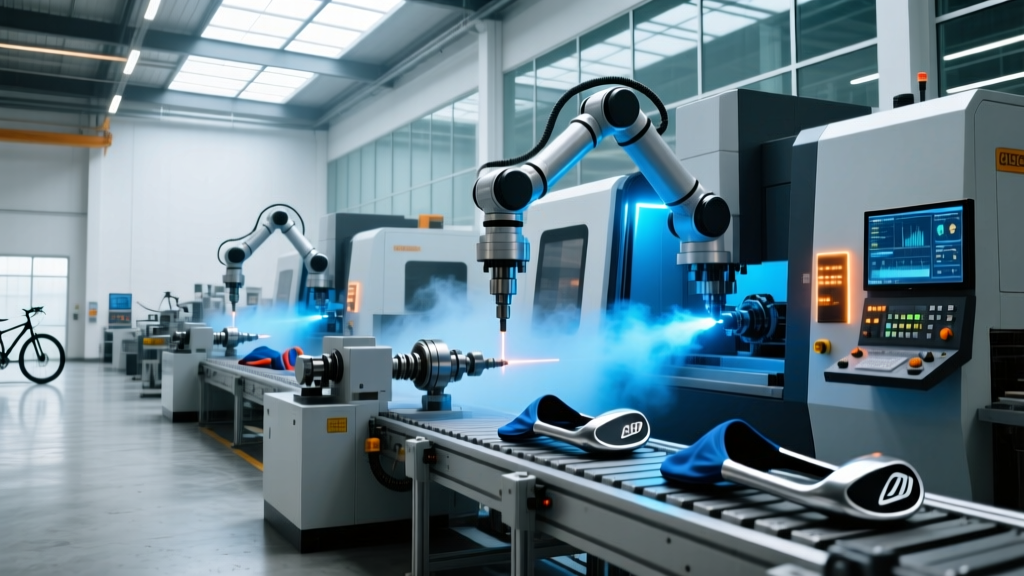
The foundation of any automated sports gear line is the robotic manipulator. For handling carbon fiber prepreg rolls, tennis racket molds, or forged titanium golf club heads, payload capacity and repeatability are paramount. The FANUC M-710iC/50 remains the industry workhorse for mid-weight forging handling, offering a 50 kg payload and a 2,050 mm reach. Its IP67 rating is critical for environments where carbon fiber dust or forging scale can infiltrate and destroy standard servo motors.
For heavier tasks, such as moving large injection molds for polycarbonate football helmets, the KUKA KR QUANTEC series (specifically the KR 120 R3200 PA) provides the necessary reach and palletizing speed. According to OSHA's robotics safety guidelines, integrating these heavy-payload robots requires rigorous risk assessment, mandatory light curtains (e.g., SICK microScan4), and physical caging to protect operators from high-velocity kinetic hazards.
End-of-Arm Tooling (EOAT) for Curved Geometries
Standard parallel grippers fail when handling curved, delicate sporting goods. When automating the extraction of cured carbon fiber hockey sticks or racket frames from autoclaves, manufacturers must utilize custom vacuum EOAT. A 3D-printed TPU-lined vacuum cup array, such as those engineered around Piab piGRIP technology, operating at a negative pressure of -60 kPa, ensures secure lifting without marring the glossy composite surface. For forged aluminum baseball bats, magnetic or custom-contour pneumatic grippers with polyurethane jaw pads are required to prevent cosmetic denting during transfer to the CNC lathe.
CNC Machining Integration for Metal Bats and Club Heads
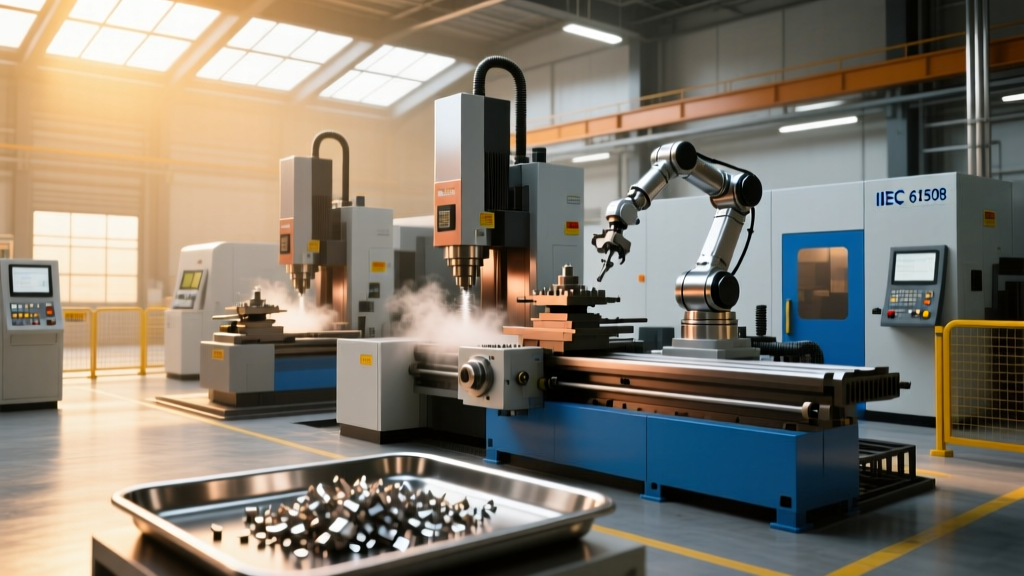
Automated CNC integration goes beyond the machine tool; it requires seamless material handling. For high-volume turning of 7050-T7451 aluminum alloy baseball bats, a dual-spindle lathe like the Haas DS-30-2 is optimal. Equipped with a 1.75-inch bar feeder and an automated gantry loader, this setup enables continuous, lights-out machining.
The critical engineering challenge in automating bat turning is managing the thin-wall taper. Maintaining a constant surface speed (CSS) of 800 SFM while utilizing high-pressure coolant (minimum 1,000 PSI) through the spindle is mandatory. This specific coolant pressure prevents chip welding on the aluminum and dampens harmonic vibration. Without automated chip conveyors and high-pressure coolant integration, the automated cell will experience a 14% scrap rate due to surface chatter and tool deflection.
Machine Vision: Overcoming Glare and Matte Defect Detection
Quality assurance in sports equipment requires detecting micro-fractures in injection-molded helmets and surface voids in forged metals. The NIST Advanced Manufacturing portal emphasizes that deploying AI-trained vision systems reduces physical line inspection bottlenecks by up to 40%. However, lighting reflective forged metals versus matte carbon fiber requires entirely different hardware approaches.
| Feature | Keyence IV3-500CA | Cognex In-Sight 3800 |
|---|---|---|
| Best Application | Matte composites, carbon fiber weave alignment, helmet shell cracks | Highly reflective forged metals, golf club face grooves, machined aluminum |
| Lighting Integration | Built-in polarized ring light eliminates glare on curved plastics | Requires external diffuse dome lighting to flatten metallic reflections |
| AI Processing Speed | Up to 1,200 parts per minute (simple defect detection) | Up to 900 parts per minute (complex 3D groove measurement) |
| Approx. Cost per Node | $4,500 - $6,200 USD | $7,800 - $11,500 USD |
Line Orchestration: PLCs and PROFINET Architecture
A collection of isolated robots and CNC machines does not constitute an automated line; it requires centralized orchestration. The Siemens SIMATIC S7-1500 PLC is the standard for orchestrating multi-vendor sports equipment lines. Utilizing PROFINET IRT (Isochronous Real-Time), the PLC synchronizes the FANUC robot's tool center point (TCP) with the Haas CNC's automatic part catcher within a 1-millisecond tolerance. This tight synchronization prevents the robot from colliding with the lathe chuck during high-speed part extraction, a common failure point in poorly integrated cells.
Capital Expenditure and ROI Timelines
Integrating a fully automated 5-cell production line for premium sporting goods requires significant upfront capital. Below is a realistic 2026 CapEx breakdown for a mid-sized sports equipment manufacturer scaling up composite racket and metal bat production.
| Integration Phase & Equipment | Estimated CapEx (USD) | Commissioning Timeline |
|---|---|---|
| Robotic Layup & Transfer Cell (2x FANUC M-710iC, custom EOAT) | $380,000 - $450,000 | 8 - 10 weeks |
| CNC Machining Cell (Haas DS-30-2, bar feeder, gantry, high-PSI coolant) | $520,000 - $610,000 | 6 - 8 weeks |
| Vision QA Tunnel (Cognex In-Sight 3800 array, dome lighting, reject actuator) | $140,000 - $180,000 | 3 - 4 weeks |
| PLC Orchestration (Siemens S7-1500, PROFINET network, safety caging) | $210,000 - $260,000 | 4 - 6 weeks |
| System Integration, Digital Twin Simulation, and On-Site Commissioning | $250,000 - $350,000 | 10 - 14 weeks |
| Total Estimated Line Integration | $1,500,000 - $1,850,000 | 6 - 9 months total |
Note: ROI timelines typically range from 28 to 36 months, heavily dependent on local labor costs, scrap reduction rates, and the ability to run the line in a 'lights-out' third shift.
Critical Failure Modes and Mitigation Strategies
Automated lines in sports manufacturing face unique physical challenges that do not exist in standard automotive or electronics assembly. Plant managers must engineer mitigations for the following specific failure modes:
Warning: Harmonic Chatter in Thin-Wall Turning
When automating the turning of aluminum or composite-core baseball bats, the extended overhang of the cutting tool often induces harmonic chatter, ruining the surface finish and triggering automated vision rejects. Mitigation: Integrate active damping boring bars (e.g., Sandvik Coromant Silent Tools) and program the CNC to vary the spindle speed dynamically (Spindle Speed Variation, or SSV) to break the chatter frequency loop.
- Gripper Slippage on Cured Composites: Carbon fiber resin surfaces can be highly slippery, especially if mold release agents are over-applied. Standard vacuum cups will drop a $400 racket frame. Mitigation: Implement vacuum sensors (e.g., Piab piCOMPACT) that monitor pressure decay in real-time. If pressure drops below -55 kPa during transit, the PLC halts the robot before a catastrophic drop occurs.
- Vision System Blinding: Forged titanium driver faces are highly reflective. A standard ring light will create a specular highlight that blinds the camera, masking micro-cracks. Mitigation: Use polarized filters on both the light source and the camera lens, paired with a diffuse dome light to scatter illumination evenly across the metallic grain.
- Carbon Fiber Dust Infiltration: Machining or trimming carbon fiber generates conductive, abrasive dust that destroys standard PLC I/O modules and robot joint encoders. Mitigation: Specify IP67-rated washdown motors for all robotics and install positive-pressure clean air enclosures for the PLC cabinets and vision controllers.
Strategic Integration Checklist for Plant Managers
Before issuing purchase orders for automated equipment, manufacturing leaders must complete this technical validation checklist:
- Digital Twin Simulation: Run a virtual commissioning model (using Siemens Process Simulate or Rockwell Arena) to verify robot reach, cycle times, and collision zones before physical installation.
- Utility Audit: Verify that the facility can support 1,000 PSI high-pressure coolant pumps and 480V/3-phase power drops at each CNC cell without voltage sag.
- EOAT Prototyping: 3D print and test vacuum gripper jaws on actual cured parts to verify holding force against the robot's maximum deceleration torque.
- Safety Matrix: Map all human-robot interaction points and specify the exact safety relay logic, light curtain resolutions (e.g., 14mm finger detection), and physical guard interlocks.
By prioritizing precise equipment selection, rigorous EOAT engineering, and robust PLC orchestration, a sports equipment manufacturer can successfully deploy an automated line that yields consistent, tournament-grade quality while drastically reducing per-unit labor costs.