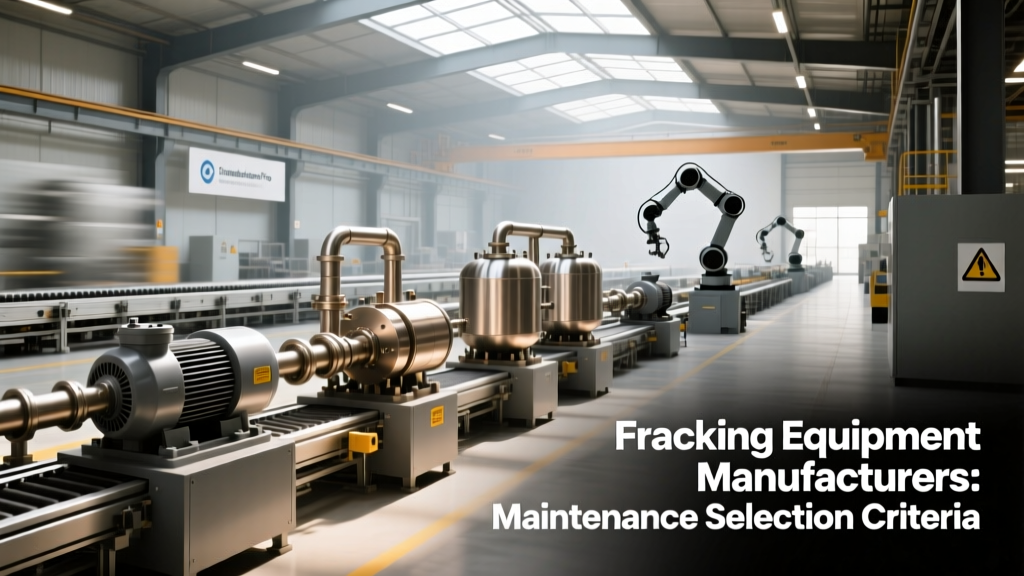
Fracking Equipment Manufacturers: Maintenance Selection Criteria
Evaluate fracking equipment manufacturers using maintenance-driven selection criteria. Compare fluid end intervals, IoT telemetry, and TCO.
The Shift from CapEx to Maintenance-Driven OpEx in Contract Manufacturing
When contract manufacturers and oilfield service companies procure high-pressure pumping fleets, the initial capital expenditure (CapEx) is only a fraction of the total cost of ownership (TCO). In hydraulic fracturing operations, equipment operates under extreme cyclic loading, abrasive proppant exposure, and corrosive fluid chemistries. Consequently, the selection criteria for evaluating fracking equipment manufacturers must pivot heavily toward maintenance architectures, mean time between failures (MTBF), and service schedule predictability.
As of 2026, leading contract manufacturers no longer evaluate quintuplex pumps and high-pressure iron solely on maximum discharge pressure or hydraulic horsepower. Instead, procurement teams utilize maintenance-driven scoring matrices to determine how a manufacturer's design minimizes non-productive time (NPT). According to industry safety and operational guidelines outlined by OSHA's Hydraulic Fracturing Safety portal, predictable maintenance schedules are also critical for reducing worker exposure to high-pressure hazards during mid-job repairs.
The 600-Hour Fluid End ThresholdStandard alloy steel fluid ends in 10,000+ psi fracking applications typically suffer washouts or fatigue cracking between 400 and 600 pumping hours. Upgrading to tungsten-carbide-coated 17-4 PH stainless steel fluid ends extends this interval to 1,500+ hours. Contract manufacturers must mandate advanced metallurgy from OEMs to eliminate mid-stage teardowns.
Core Equipment Selection Criteria: Maintenance Architectures
Evaluating the serviceability of fracking pumps requires a granular analysis of both the fluid end (the wetted, high-wear section) and the power end (the rotating, load-bearing section). Fracking equipment manufacturers that prioritize maintenance design integrate specific features that drastically reduce wrench time.
1. Fluid End Metallurgy and Quick-Change Modularity
The fluid end is the primary consumable in a frac pump. When selecting a manufacturer, contract buyers must scrutinize the valve cover retention system and stay rod tensioning mechanisms. Legacy designs require manual torqueing of up to 24 stay rod nuts per fluid end, a process that can take two technicians over 45 minutes. Modern selection criteria demand hydraulic tensioning systems or quick-release clamp covers that reduce valve and seat replacement time to under 12 minutes.
Furthermore, the internal geometry of the fluid end dictates flow velocity and subsequent erosive wear. Manufacturers utilizing computational fluid dynamics (CFD) to smooth internal bore transitions and eliminate dead zones reduce localized cavitation. Procurement specs should require fluid ends cast from 17-4 PH precipitation-hardening stainless steel, paired with sacrificial tungsten carbide wear sleeves that can be swapped without replacing the entire block.
2. Power End Telemetry and Predictive Maintenance Integration
The power end houses the bull gear, pinion shaft, and bearings. Catastrophic failure here results in total pump loss, not just a scheduled rebuild. In 2026, top-tier fracking equipment manufacturers embed edge-computing IoT nodes directly into the power end housing. Selection criteria must include native support for:
- Triaxial Accelerometers: Mounted on the pinion and bull gear bearings to detect early-stage spalling and misalignment via high-frequency vibration signatures.
- Inductive Oil Debris Sensors: Installed in the lube oil return line to quantify ferrous vs. non-ferrous particulate matter in real-time, triggering automated pump derating before a bearing seizes.
- Thermal Imaging Arrays: Monitoring crosshead and wrist pin temperatures to identify localized friction anomalies caused by lubrication starvation.
Contract manufacturers should reject OEMs that treat telemetry as an aftermarket add-on. Native, API-integrated sensor suites that feed directly into the fleet's centralized SCADA system are now the baseline requirement for equipment selection.
Comparative Analysis: Standard vs. Advanced Maintenance Intervals
The following matrix illustrates the operational impact of selecting premium maintenance-focused designs over baseline equipment offerings. Data reflects typical 2,500 HP quintuplex pump operations at 9,000 PSI discharge pressure.
| Component / System | Baseline OEM Design | Advanced Maintenance Design | TCO Impact (Per Pump/Year) |
|---|---|---|---|
| Fluid End Block Replacement | Every 500 hours | Every 1,800 hours (Coated 17-4 PH) | Saves ~$145,000 |
| Valve & Seat Changeover Time | 45 - 60 minutes | 10 - 15 minutes (Quick-clamp) | Saves ~$22,000 (NPT reduction) |
| Power End Lube Oil Drain | 500 hours (Mineral) | 2,500 hours (Synthetic PAO + Filtration) | Saves ~$8,500 |
| Crosshead & Liner Inspection | Manual teardown (8 hrs) | Endoscopic port / IoT vibration | Saves ~$12,000 |
Lubrication and Cooling System Serviceability
Maintenance schedules are heavily dictated by auxiliary systems. Fracking equipment manufacturers that design integrated, closed-loop cooling and filtration systems drastically extend power end life. When evaluating selection criteria, contract manufacturers must look for dual-pass centrifugal oil purifiers that remove water ingress and sub-micron particulates. Standard mesh filters only catch debris down to 40 microns; centrifugal purifiers maintain oil cleanliness to ISO 4406 standards of 16/14/11, allowing synthetic Polyalphaolefin (PAO) gear oils to remain in service for up to 2,500 hours.
Additionally, the cooling architecture for the fluid end must be assessed. High-pressure pumping generates immense thermal energy. OEMs that utilize targeted, high-velocity glycol cooling jackets around the discharge bores prevent thermal shock and micro-fracturing in the steel, directly extending the fluid end's fatigue life. The EPA's Hydraulic Fracturing guidelines also emphasize the importance of closed-loop fluid management, which extends to the capture and recycling of cooling system runoff and lubricants on the well pad.
Decision Matrix: Scoring Vendors on Serviceability
To systematize the procurement process, contract manufacturing engineering teams should apply a weighted scoring matrix when reviewing bids from fracking equipment manufacturers. This removes subjective bias and focuses strictly on lifecycle maintenance costs.
Procurement Weighting Framework (100 Points Total)
- Fluid End MTBF & Metallurgy (30 Points): Verified hours between block replacements; presence of sacrificial wear sleeves; material grade certification.
- IoT & Predictive Telemetry (25 Points): Native integration of vibration, thermal, and debris sensors; open API for fleet SCADA integration; edge-computing capabilities.
- Wrench Time Reduction (20 Points): Hydraulic tensioners, quick-release clamps, and modular sub-assemblies that allow single-technician servicing.
- OEM Parts Logistics & SLAs (15 Points): Guaranteed localized micro-warehousing within 50 miles of active basins; consignment inventory programs; guaranteed 12-hour delivery SLAs for critical spares.
- Lubrication & Auxiliary Systems (10 Points): Integrated centrifugal purifiers, extended-drain synthetic oil compatibility, and targeted thermal management jackets.
The Role of OEM Service Level Agreements (SLAs)
Hardware design is only half the equation. The selection criteria must include rigorous evaluation of the manufacturer's aftermarket support structure. In modern contract manufacturing, OEMs are expected to offer 'Power-by-the-Hour' or 'Pumped-Mile' SLAs. Under these agreements, the OEM assumes the risk of fluid end and power end failures, guaranteeing a specific cost per pumping hour. This aligns the OEM's engineering incentives with the contract manufacturer's uptime goals. If a manufacturer is unwilling to back their MTBF claims with a financial SLA, their equipment should be disqualified from the bidding process.
Sourcing Industry Data and Validation
Procurement teams should not rely solely on OEM-provided spec sheets. Validating MTBF claims requires cross-referencing with independent field data. Publications such as the Journal of Petroleum Technology frequently publish peer-reviewed case studies on frac pump reliability, metallurgy failures, and the real-world efficacy of predictive maintenance algorithms. Utilizing these independent datasets ensures that the selection criteria are grounded in operational reality rather than marketing claims.
Summary: Engineering for the Wrench
Selecting heavy-duty manufacturing and pumping equipment for hydraulic fracturing requires a fundamental shift in perspective. By prioritizing fluid end metallurgy, native IoT telemetry, rapid-changeover modularity, and aggressive OEM SLAs, contract manufacturers can insulate themselves from the devastating costs of unplanned downtime. The most advanced fracking equipment manufacturers are those that design not just for peak hydraulic performance, but for the technician holding the wrench on a dark, noisy well pad at 2:00 AM.