What Is Materials Handling Equipment? Ergonomic Lift Assists
Discover what is materials handling equipment for ergonomics. Explore technical specs, vacuum lifters, IADs, and pricing for lift assist devices.
When evaluating facility upgrades, understanding what is materials handling equipment extends far beyond heavy transport like forklifts or conveyor networks. In modern intralogistics, the most critical advancements are occurring at the micro-movement level—specifically through ergonomic material handling aids and lift assist devices. These systems bridge the gap between manual lifting and fully automated robotics, allowing human operators to manipulate loads ranging from 20 kg to 400 kg with less than 5 kg of applied physical force.
This technical guide deconstructs the engineering principles, precise specifications, and operational parameters of the two dominant lift assist technologies: vacuum tube lifters and Intelligent Assist Devices (IADs).
The Physics of Vacuum Tube Lifters: Fluid Dynamics and Suction
Vacuum tube lifters, such as the Schmalz JumboErgo series, operate on a continuous vacuum principle rather than a simple mechanical winch. The lifting tube itself acts as both the pneumatic cylinder and the structural support.
Core Technical Specifications
- Operating Pressure: Requires a continuous compressed air supply regulated to 4–6 bar (58–87 psi).
- Vacuum Generation: Multi-stage ejector nozzles generate a vacuum level of 60% to 80% (approx. -400 to -600 mbar) within milliseconds.
- Lifting Speed: Proportional to the air flow rate; standard units achieve vertical speeds up to 2.5 meters per second.
- Load Capacity: Ranges from 20 kg for high-speed parcel sorting to 300 kg for dense industrial components (e.g., glass panes, metal sheets).
The interface between the lifter and the load dictates system reliability. For rigid, non-porous surfaces like sheet metal or glass, specify nitrile rubber (NBR) suction cups with a Shore A hardness of 55–65 to ensure an airtight seal. For corrugated cardboard or slightly textured plastics, utilize polyurethane (PU) cups with a Shore A hardness of 70–80, featuring integrated flex-lips to conform to surface irregularities and maintain the critical 60% vacuum threshold.
Intelligent Assist Devices (IADs) and Servo Control
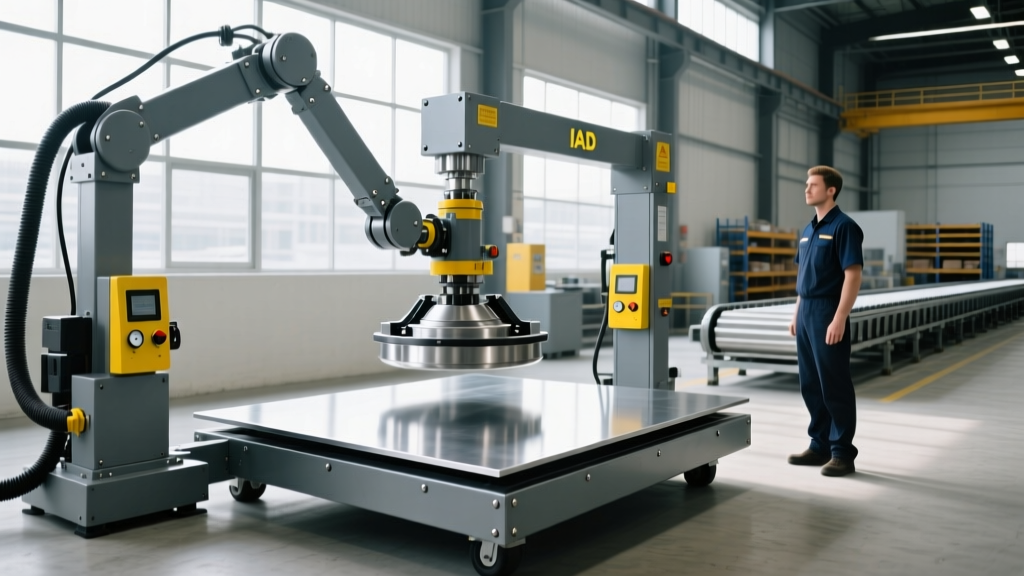
While vacuum lifters excel with uniform, non-porous loads, Intelligent Assist Devices (IADs) like the Gorbel G-Force utilize servo-motor technology and load-cell feedback to handle irregular, porous, or mechanically gripped payloads. IADs represent the cutting edge of what is materials handling equipment in human-robot collaborative environments.
Servo-Driven Mechanics and Drift Compensation
An IAD suspends the load via a carbon-fiber or wire-rope cable connected to a high-torque servo motor. The system's load cell continuously samples the weight of the payload at 1,000 Hz. When the operator applies a slight upward or downward force (typically less than 2 kg of input force), the control algorithm interprets this as a directional command and drives the servo motor accordingly.
The most critical technical feature of a modern IAD is drift compensation. If a load shifts, or if the operator releases the handle, the system's encoder locks the servo motor in place, preventing the load from drifting upward or downward. High-end models achieve a positioning accuracy of ±1 mm, which is essential for precision machine-tending or aerospace assembly.
Technical Specification Matrix: Vacuum vs. Pneumatic vs. IADs
Selecting the correct architecture requires matching the load profile to the drive mechanism. The following matrix outlines the operational boundaries for 2026 facility planning.
| Technology Type | Max Capacity | Vertical Speed | Precision / Repeatability | Estimated Capital Cost (USD) | Ideal Application |
|---|---|---|---|---|---|
| Vacuum Tube Lifter | 300 kg (660 lbs) | Up to 2.5 m/s | ± 10 mm | $8,000 – $16,000 | High-cycle bag palletizing, glass handling, uniform boxes. |
| Pneumatic Balancer | 150 kg (330 lbs) | 0.5 m/s | ± 5 mm (float mode) | $6,000 – $12,000 | Machine loading, suspended tool balancing, low-cycle heavy parts. |
| Intelligent Assist Device (IAD) | 180 kg (400 lbs) | 1.0 m/s (200 fpm) | ± 1 mm | $25,000 – $45,000 | Aerospace assembly, precision die-casting extraction, automotive sub-assemblies. |
Edge Cases, Failure Modes, and Mitigation
Deploying ergonomic lift aids without accounting for environmental and material variables leads to catastrophic downtime. Facility engineers must design around these specific failure modes:
- Vacuum Leakage on Porous Loads: When lifting uncoated corrugated cardboard, micro-leaks at the suction cup boundary can cause the vacuum generator to run at 100% duty cycle, overheating the ejector. Mitigation: Install a vacuum reservoir tank (minimum 20 liters) and specify multi-pad gripping arrays with independent check valves to isolate leaking zones.
- Pneumatic Sag During Compressor Drops: Pneumatic balancers rely on constant air pressure to maintain "float mode." If the facility's main air compressor experiences a pressure drop below 5 bar, the balancer will lose its counterbalance force, causing the load to drop. Mitigation: Equip the balancer with a localized, dedicated air receiver tank and a pilot-operated check valve that mechanically locks the cable if pressure drops below 4.5 bar.
- IAD Servo Overcurrent Faults: In high-temperature environments (e.g., near forging presses), the servo motor in an IAD can overheat, triggering an overcurrent fault and dropping the load. Mitigation: Specify IP65-rated servo enclosures with integrated liquid-cooling jackets or forced-air cooling ducts routed from the facility's HVAC system.
ROI and the NIOSH Lifting Equation
The financial justification for advanced lift assists is rooted in the reduction of Musculoskeletal Disorders (MSDs). According to the Occupational Safety and Health Administration (OSHA), MSDs account for a significant percentage of all lost-workday injuries, with an average direct cost exceeding $30,000 per claim.
"Ergonomic interventions that eliminate manual lifting and reduce exertion forces are the most effective method for controlling workplace MSD risks." — National Institute for Occupational Safety and Health (NIOSH)
When applying the NIOSH Lifting Equation, manual handling of a 25 kg load at a horizontal distance of 60 cm yields a Recommended Weight Limit (RWL) that is often exceeded in high-frequency tasks, resulting in a Lifting Index (LI) > 1.0 (indicating high risk). By introducing a zero-gravity IAD or vacuum lifter, the horizontal multiplier (HM) and vertical multiplier (VM) are effectively neutralized, as the operator is no longer bearing the load's mass. The equipment's $35,000 capital expenditure is typically recouped within 8 to 14 months through the prevention of a single severe lower-back injury claim and a 15–20% increase in cycle times due to reduced operator fatigue.
Implementation Checklist for Facility Engineers
Before issuing a purchase order for ergonomic lift equipment, verify the following site conditions:
- Air Quality Standards: For pneumatic and vacuum systems, ensure the compressed air supply meets ISO 8573-1 Class 3 for particulate matter and Class 4 for moisture. Unfiltered air will destroy Venturi valves within 6 months.
- Clearance Envelopes: Map the 3D kinematic envelope of the jib crane or bridge crane. Ensure a minimum 300 mm clearance from overhead sprinkler heads and lighting arrays.
- Power Supply: IADs require clean, stable 3-phase power (400V/50Hz or 480V/60Hz). Install dedicated line reactors to protect the servo drives from voltage spikes generated by nearby heavy machinery.
- Operator Training: Do not assume intuitive use. Mandate a 4-hour certification program focusing on load-center-of-gravity identification and emergency stop procedures.
By aligning precise technical specifications with the physiological limits of human operators, facilities can drastically reduce injury rates while simultaneously accelerating throughput. Understanding the granular mechanics of what is materials handling equipment at the ergonomic level is no longer optional for competitive manufacturing and distribution operations.