Storeroom Fully Automated Material Handling Equipment Consultants: Food & Pharma
Discover how storeroom fully automated material handling equipment consultants design FDA-compliant, IP69K-rated AS/RS and AMR systems for food and pharma.
The Intersection of MRO Automation and Sanitary Compliance
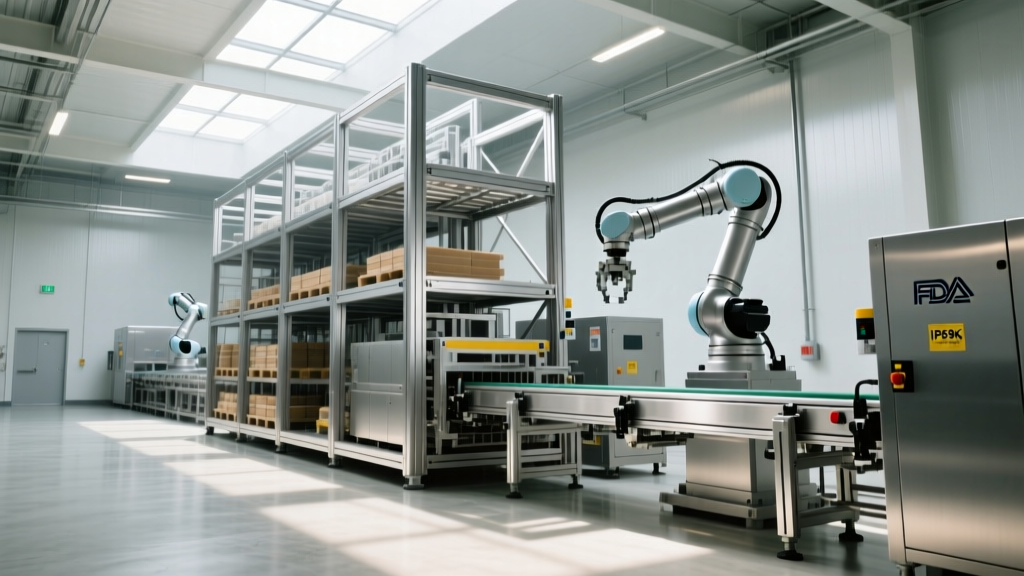
Designing a maintenance, repair, and operations (MRO) storeroom for food and pharmaceutical manufacturing requires navigating a minefield of regulatory constraints. Unlike standard industrial warehouses, these environments demand strict adherence to FDA 21 CFR Part 11 for electronic traceability, USDA sanitary design principles, and ISO 14644 cleanroom protocols. When facility managers seek out storeroom fully automated material handling equipment consultants, they are not merely looking for robotics integrators; they need regulatory-literate engineers who can bridge the gap between high-density automated storage and retrieval systems (AS/RS) and Good Manufacturing Practices (GMP).
⚠ Critical Compliance Trap: Standard AS/RS systems often utilize lubricated chains and exposed carbon steel components that harbor Listeria or compromise sterile APIs (Active Pharmaceutical Ingredients). Consultants must specify food-grade lubricants (NSF H1) and 316L stainless steel enclosures to pass USDA and FDA audits.Core Automation Technologies for Sanitary Storerooms
The selection of automated hardware hinges on the facility's hygiene zoning. A pharmaceutical packaging line storeroom operates differently than a raw food processing wet-zone parts crib. Top-tier consultants evaluate the following platforms based on particulate generation, washdown survivability, and software validation capabilities.
| System Type | Model Example | IP Rating / Material | Best Application |
|---|---|---|---|
| Cube Storage AS/RS | AutoStore B1 | IP54 / Aluminum Grid | Dry pharma packaging parts, high-SKU MRO |
| Vertical Lift Module (VLM) | Kardex Remstar LR 35 | IP43 / Powder-coated Steel | Cleanroom-adjacent tool cribs, lab equipment |
| Mobile Robotics (AMR) | MiR250 with SS Top | IP52 Base / IP69K Top | Wet-zone food processing parts transport |
| Vertical Carousel | Hänel Rotomat | IP31 / Stainless Enclosure | Temperature-controlled API spare parts |
The Consultant's Scope: Beyond Hardware Selection
Engaging specialized storeroom fully automated material handling equipment consultants yields a comprehensive validation master plan (VMP). In regulated industries, purchasing a robot is only 20% of the project; the remaining 80% is software integration, material flow mapping, and regulatory qualification.
The IQ/OQ/PQ Validation Matrix
Pharma and food consultants structure the automation rollout using the GAMP 5 (Good Automated Manufacturing Practice) framework. This ensures the automated storeroom's Warehouse Management System (WMS) maintains an unbroken electronic chain of custody.
- Installation Qualification (IQ): Verifying that the AS/RS or AMR fleet is installed according to the manufacturer's specifications and that 316L stainless steel certifications and NSF H1 lubricant logs are documented.
- Operational Qualification (OQ): Testing the WMS edge cases. What happens to the electronic batch record if an AMR loses Wi-Fi connectivity in a Faraday-caged cleanroom corridor? Consultants design and test these fail-safes.
- Performance Qualification (PQ): Running the automated storeroom under peak maintenance demand (e.g., a planned bioreactor turnaround) to prove the system can deliver critical spare parts within the 15-minute SLA without generating particulate matter.
"In pharmaceutical MRO, an unvalidated automated storeroom is a liability. If the WMS cannot produce an audit trail proving that a specific replacement O-ring for a tablet press was stored in a humidity-controlled VLM, the FDA can flag the entire batch of medication."
— ISPE GAMP 5 Compliance Guidelines
2026 Financial Framework: Consultant Fees vs. System Integration
Budgeting for an automated sanitary storeroom requires distinguishing between hardware costs, software licensing, and the consulting engineering fees required for validation. Based on 2026 market rates for a mid-sized (5,000 sq. ft.) pharmaceutical packaging facility MRO upgrade, the capital expenditure breaks down as follows:
Estimated Project Costs (5,000 sq. ft. Pharma MRO)
- Hardware (AS/RS & AMRs): $850,000 – $1,100,000
- WMS Integration & 21 CFR Part 11 Software: $220,000 – $350,000
- Consultant Design & Flow Mapping: $85,000 – $120,000 (Billed at $175–$250/hr)
- IQ/OQ/PQ Validation Execution: $90,000 – $140,000
- Total Estimated CAPEX: $1,245,000 – $1,710,000
While the consulting and validation fees represent roughly 15% of the total CAPEX, they prevent catastrophic regulatory fines and production downtime. A single FDA Form 483 observation related to improper spare part traceability can halt a production line, costing upwards of $150,000 per day in lost revenue.
Vetting Your Consultant: 4 Non-Negotiable Criteria
Not all material handling integrators understand the nuances of sanitary design. When issuing an RFP for storeroom fully automated material handling equipment consultants, mandate the following qualifications:
- Demonstrable GAMP 5 Expertise: The firm must have dedicated validation engineers on staff, not just mechanical engineers. They should provide redacted examples of previous IQ/OQ/PQ protocols executed for FDA-regulated clients.
- Sanitary Design Certification: Look for engineers certified by the FDA's Part 11 electronic records guidelines or familiar with the American Meat Institute (AMI) 10 Principles of Sanitary Design, adapting them for automated hardware.
- AMR Safety Standards: If the scope includes mobile robots, the consultant must design traffic management systems compliant with ANSI/RIA R15.08 safety requirements for industrial mobile robots, specifically addressing human-robot interaction in narrow cleanroom airlocks.
- WMS Audit Trail Architecture: The proposed software must feature unalterable, time-stamped electronic signatures for every part withdrawal, ensuring compliance with FDA process validation standards.
Frequently Asked Questions (FAQ)
Can standard AutoStore robots be used in food processing wet zones?
No. Standard AutoStore robots are rated for dry, indoor environments (typically IP20 to IP42). For wet zones requiring daily caustic washdowns, consultants will specify IP69K-rated shuttle systems or enclosed VLMs with automated CIP (Clean-in-Place) capabilities. AutoStore is best reserved for dry packaging or raw material staging areas.
How do consultants handle static electricity (ESD) in automated pharma storerooms?
ESD is a major risk when handling electronic components for bioreactor sensors or automated inspection cameras. Consultants specify dissipative bin plastics (surface resistance of 10^6 to 10^9 ohms), ionizing blowers at the VLM pick windows, and grounded stainless steel shelving to prevent static discharge from damaging sensitive MRO inventory.
What is the typical ROI timeline for an automated sanitary storeroom?
In food and pharma, ROI is calculated differently than in standard e-commerce. While labor reduction in the MRO crib saves roughly $120,000 annually, the primary financial drivers are the reduction of line-down events (averaging $10,000 to $50,000 per hour in pharma) and the elimination of expired or contaminated spare parts. Most validated automated storerooms achieve payback within 28 to 36 months based on uptime preservation rather than pure headcount reduction.