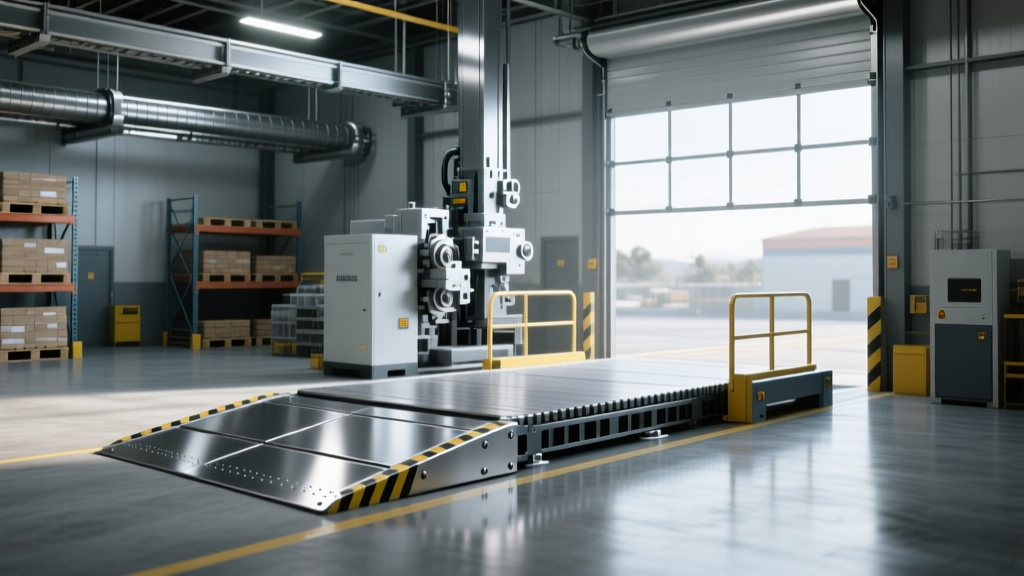
Storeroom Bulk Material Handling Equipment Installations San Jose: Dock Levelers
Technical specs and installation frameworks for dock levelers in San Jose bulk material storerooms, including seismic pit requirements and load capacities.
Engineering Dock Levelers for Silicon Valley Bulk Storerooms
When planning storeroom bulk material handling equipment installations San Jose facilities require specialized loading bay engineering. Unlike standard e-commerce distribution centers that move lightweight, uniform pallets, industrial storerooms in the Santa Clara Valley handle extreme bulk loads: 4,000-pound polymer super sacks for semiconductor manufacturing, palletized metal ingots, and high-density aerospace composites. Transitioning raw bulk materials from a 53-foot dry van into an MRO (Maintenance, Repair, and Operations) storeroom demands dock levelers capable of withstanding severe dynamic impact forces and continuous heavy-axle forklift traffic.
This technical guide breaks down the mechanical specifications, seismic pit requirements, and installation frameworks necessary for heavy-duty dock levelers in bulk material environments, reflecting current 2026 building codes and material handling standards.
San Jose Bulk Loading Bay Baseline Metrics (2026)
- Average Dynamic Load Requirement: 45,000 to 55,000 lbs (based on 12,000 lb forklifts carrying 4,000 lb bulk loads)
- Standard Pit Dimensions: 8' W x 10' L x 36" D
- Seismic Zone: Zone 4 (Requires specialized pit embedment and edge-slab reinforcement)
- 2026 Average Installed Cost: $6,800 - $11,500 per hydraulic unit (including pit demo, pour, and electrical)
Technical Specifications: Hydraulic vs. Mechanical Levelers for Bulk Loads
For bulk material handling, the choice between hydraulic and mechanical dock levelers dictates the lifespan of the bay. Mechanical levelers rely on spring tension and manual walk-down operation, which introduces operator fatigue and inconsistent lip placement. Hydraulic levelers utilize a two-cylinder system (one for the main platform, one for the lip) providing precise, push-button control essential for aligning with uneven bulk-load trailers.
| Specification | Heavy-Duty Hydraulic (e.g., McGuire 8x10 45K) | Standard Mechanical (e.g., Kelley K-Series) | Air-Powered (e.g., Pentalift) |
|---|---|---|---|
| Dynamic Capacity | 45,000 - 55,000 lbs | 30,000 - 40,000 lbs | 35,000 - 45,000 lbs |
| Lip Thickness | 1.25" (31.7mm) Steel | 0.75" (19mm) Steel | 1.0" (25.4mm) Steel |
| Hinge Design d> | Continuous 1" pin, open-back | Interlocking finger hinges | Continuous piano hinge |
| Cycle Time | 12-15 seconds (full extension) | 20-30 seconds (manual walk-down) | 15-20 seconds (air bag inflation) |
| Best Application | High-frequency bulk super sacks, metal coils | Low-frequency, lighter palletized goods | Wash-down environments, food grade |
According to guidelines published by the National Institute for Occupational Safety and Health (NIOSH), minimizing manual exertion during material transfer phases significantly reduces lower back and shoulder injuries. Hydraulic levelers eliminate the physical walk-down requirement, keeping operators in the forklift cab and maintaining continuous bulk flow.
Seismic Pit Engineering and Concrete Specifications
Santa Clara County enforces rigorous seismic building codes. A standard dock pit pour will fail under the vibrational stress of heavy bulk forklifts combined with seismic activity if not engineered correctly. The pit must act as a monolithic block anchored to the existing foundation.
Pit Pour Material Requirements
- Concrete Mix: Minimum 4,000 PSI compressive strength at 28 days, utilizing a low water-cement ratio (0.45) to prevent shrinkage cracking.
- Rebar Grid: #5 (5/8-inch) epoxy-coated rebar tied on 12-inch centers, both horizontally and vertically within the pit walls.
- Embedment Plates: 1/2-inch hot-rolled steel plates with J-bolts cast directly into the concrete to receive the leveler frame, rather than relying on post-cure wedge anchors which can loosen under dynamic forklift impact.
Step-by-Step Installation Framework: Pit to Calibration
Executing storeroom bulk material handling equipment installations San Jose contractors follow a strict 5-phase sequence to ensure compliance with OSHA 1910.176 standards for material handling clearances and structural integrity.
- Phase 1: Core Drilling and Demolition (Days 1-2)
Saw-cut the 8'x10' perimeter. Use a hydraulic breaker to excavate to a depth of 42 inches (allowing 6 inches for a compacted gravel base beneath the 36-inch pit depth). - Phase 2: Forming and Rebar Tying (Days 3-4)
Install structural forming. Tie the #5 rebar grid and position the J-bolt embedment plates using laser levels to ensure the frame will sit perfectly flush with the warehouse floor (+/- 1/16th of an inch tolerance). - Phase 3: Pouring and Curing (Days 5-12)
Pour the 4,000 PSI concrete. Apply a liquid curing compound. The pit must cure for a minimum of 7 days before the 1,800-lb steel dock leveler frame is lowered into place to prevent micro-fracturing. - Phase 4: Frame Setting and Welding (Days 13-14)
Crane-lift the leveler into the pit. Plug-weld the leveler's structural base channels to the cast-in embedment plates. Apply a continuous 3/16-inch fillet weld to prevent water infiltration into the pit sub-base. - Phase 5: Hydraulic Calibration and Restraint Integration (Day 15)
Fill the hydraulic power unit with AW32 hydraulic fluid. Calibrate the lip extension to overlap the truck bed by exactly 12 inches. Wire the leveler's control panel into the facility's dock lock interlock system.
Loading Bay Restraints for Bulk Material Flow
Dock levelers cannot operate safely without vehicle restraints. When a 12,000-lb forklift drives onto a trailer carrying bulk materials, the trailer suspension compresses and the landing gear can fail, causing 'trailer separation.' For bulk storerooms, standard wheel chocks are insufficient.
Restraint Comparison Matrix
| Restraint Type | Mechanism | Holding Force | Bulk Storeroom Suitability |
|---|---|---|---|
| Vertical Barrier (Dok-Lok style) | Steel hook rotates upward to capture the truck's rear impact guard (ICC bar) | 32,000 lbs | Excellent for standard 53' dry vans delivering super sacks. |
| Global Wheel Chock | Heavy-duty steel barrier locks against the front tires of the trailer | 22,000 lbs | Required for lift-gate trucks, missing ICC bars, or specialized bulk tankers. |
| Manual Poly Chocks | Friction-based polymer wedges placed by hand | N/A (Friction dependent) | Unacceptable for heavy bulk handling; high risk of trailer creep. |
Troubleshooting Common Bulk Bay Failure Modes
Heavy bulk loads accelerate wear on dock equipment. Below is a diagnostic framework for the most frequent failure modes encountered in high-capacity San Jose loading bays.
| Symptom | Root Cause Analysis | Engineering Fix |
|---|---|---|
| Lip fails to extend fully onto the truck bed; stalls halfway. | Hydraulic flow control valve clogged with debris, or lip assist spring tension is too low for the heavy 1.25" steel lip. | Flush hydraulic lines, replace AW32 fluid, and recalibrate the lip assist spring tension to match the specific lip mass. |
| Audible 'popping' from the rear hinge during forklift crossover. | Open-back hinge tubes are packed with hardened debris (pallet wood, shrink wrap), preventing the 1-inch hinge pin from rotating freely. | Cut away debris, install UHMW polyethylene hinge bearings, and implement a weekly high-pressure washout protocol. |
| Leveler platform drops slowly when a loaded forklift is stationary on it. | Internal bypass in the main lift cylinder seals, or check valve failure in the hydraulic manifold. | Replace the cylinder piston seals (U-cups) and install a hydraulic velocity fuse to instantly lock fluid if a drop exceeds 2 inches per second. |
Proper specification and rigorous installation protocols ensure that dock levelers in bulk material storerooms maintain operational uptime, protect high-value semiconductor and aerospace raw materials, and comply with California's stringent industrial safety mandates.
Related reading
Ergonomic Warehouse Materials Handling Equipment: Lift Assists Compared
Storeroom Semi-Automated Material Handling Equipment Fulfillment Solutions: Sortation Training