AMR vs AGV: What Palletizing Equipment Manufacturers Recommend
Discover how leading palletizing equipment manufacturers integrate AMRs vs traditional AGVs for end-of-line automation, including costs, specs, and ROI.
The End-of-Line Automation Bottleneck
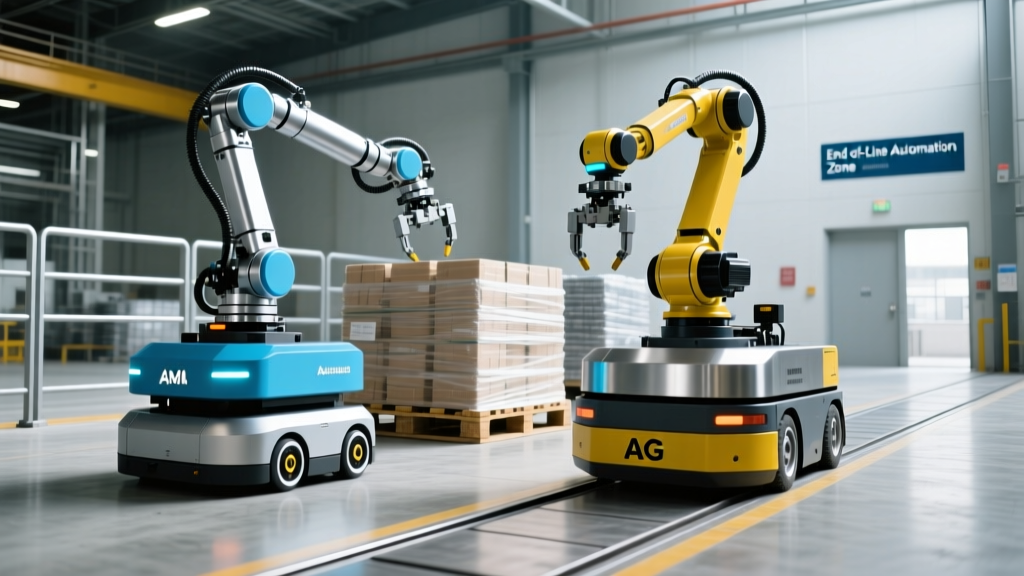
For decades, the primary focus of warehouse automation was the palletizer itself—optimizing layer patterns, maximizing cycles per minute, and ensuring tight load containment. However, as we navigate the industrial landscape of 2026, the bottleneck has shifted downstream. The challenge is no longer just building the pallet; it is transporting the finished, stretch-wrapped load to the shipping dock without relying on manual forklift traffic. This is where palletizing equipment manufacturers are forcing a critical architectural decision: integrate traditional Automated Guided Vehicles (AGVs) or deploy next-generation Autonomous Mobile Robots (AMRs)?
The choice between AGVs and AMRs fundamentally alters facility design, software infrastructure, and long-term operational expenditure. While both technologies automate horizontal material transport, their underlying navigation paradigms dictate how they interface with modern end-of-line conveyor systems and robotic palletizers.
Navigation Architecture: Magnetic Tape vs. LiDAR SLAM
The most glaring differentiator between legacy AGVs and modern AMRs is navigation. Traditional AGVs rely on physical infrastructure—typically magnetic tape, QR codes embedded in the floor, or inductive wire guidance. If a facility needs to reroute an AGV to accommodate a new stretch wrapper or a reconfigured staging lane, maintenance crews must physically rip up and relay the guidance tape.
Conversely, AMRs utilize LiDAR-based Simultaneous Localization and Mapping (SLAM). Sensors like the SICK TiM781 or Ouster OS1 scan the facility's architectural features (walls, columns, racking) to create a dynamic digital twin. If a palletizer is relocated, the AMR's route is updated via a drag-and-drop interface on the fleet management software in minutes, with zero physical floor modifications required.
Expert Insight: According to technical whitepapers published by Mobile Industrial Robots (MiR), the shift toward SLAM navigation has reduced deployment times for end-of-line transport systems from an average of 14 weeks (for AGV infrastructure installation) to under 3 weeks for AMR mapping and fleet commissioning.The Handshake Protocol: PLC to Fleet Manager
One of the most significant innovations driven by top-tier palletizing equipment manufacturers is the native integration between the palletizer's Programmable Logic Controller (PLC) and the mobile robot's fleet management software. In older setups, an AGV required a physical photoelectric sensor or a hardwired floor loop to trigger a pickup.
In 2026, systems from leaders like FANUC America's palletizing division and Columbia Machine utilize MQTT (Message Queuing Telemetry Transport) protocols over secure 5G or Wi-Fi 6 networks. When the robotic arm places the final layer and the turntable rotates the pallet into the discharge zone, the PLC publishes a JSON payload directly to the AMR fleet manager. This payload includes the exact XY coordinates of the discharge conveyor, the payload weight, and the destination dock door. The fleet manager then dynamically assigns the closest available AMR, optimizing traffic flow and eliminating conveyor accumulation jams.
Typical MQTT Payload Structure for AMR Dispatch
{
  "task_id": "PLT-99482",
  "origin": { "zone": "EndOfLine_04", "x": 145.2, "y": 88.1 },
  "destination": { "zone": "DockDoor_12", "x": 310.5, "y": 42.0 },
  "payload_kg": 1150,
  "priority": "high",
  "required_attachment": "forklift_mast"
}
AGV vs AMR Specification Matrix for Palletized Loads
When evaluating mobile robotics for heavy, palletized goods, facility managers must look beyond marketing brochures and examine the hard engineering limits. Below is a comparative matrix based on current 2026 enterprise-grade mobile robots designed for 1,000+ kg pallet transport.
| Feature | Traditional AGV (e.g., KUKA KMP series) | Autonomous AMR (e.g., MiR1350 / Locus Ranger) |
|---|---|---|
| Max Payload Capacity | Up to 3,000 kg (Heavy-duty models) | Typically 1,000 kg - 1,500 kg |
| Navigation Method | Magnetic tape, QR, Inductive wire | LiDAR SLAM, vSLAM, Sensor Fusion |
| Obstacle Avoidance | Stop-only (E-stop upon barrier breach) | Dynamic rerouting around obstacles |
| Infrastructure Cost | High ($15,000 - $30,000+ for floor prep) | Near Zero (Software mapping only) |
| Top Speed (Loaded) | 1.0 - 1.5 m/s | 0.8 - 1.2 m/s (Speed limited by safety algorithms) |
2026 Total Cost of Ownership (TCO) Breakdown
A common misconception is that AMRs are prohibitively expensive compared to AGVs. While the base unit price of an AMR is higher, evaluating the 3-year Total Cost of Ownership (TCO) reveals a different financial reality, particularly when factoring in the hidden costs of AGV infrastructure maintenance.
Scenario: Deploying 3 Mobile Robots for End-of-Line Pallet Transport
- Traditional AGV Fleet (3 Units):
- Hardware Cost: $105,000 ($35,000 per unit)
- Infrastructure (Tape, magnets, floor cutting): $22,000
- Annual Maintenance (Tape replacement, sensor recalibration): $5,500/year ($16,500 over 3 years)
- 3-Year TCO: $143,500
- AMR Fleet (3 Units):
- Hardware Cost: $156,000 ($52,000 per unit)
- Infrastructure (Wi-Fi 6 access point upgrades): $4,000
- Annual Software Licensing & Support: $3,500/year ($10,500 over 3 years)
- 3-Year TCO: $170,500
While the AMR fleet carries a higher 3-year TCO on paper, the ROI calculation shifts dramatically when factoring in downtime. If a facility changes its palletizer layout twice a year, an AGV system requires 48 hours of rerouting downtime per change. An AMR system requires 30 minutes of software remapping. For high-throughput consumer packaged goods (CPG) facilities, the recovered production hours easily offset the $27,000 hardware premium within the first 18 months.
Edge Cases: Where AGVs Still Dominate
Despite the industry's pivot toward AMRs, palletizing equipment manufacturers still recommend traditional AGVs for specific, harsh environments. The most prominent example is cold storage and freezer facilities.
In environments operating at -20°C (-4°F), LiDAR sensors on AMRs frequently suffer from lens condensation and thermal shock, leading to SLAM localization failures and phantom obstacle detection. Furthermore, the physical traction required to move 1,500 kg pallets over icy floor transitions is better handled by the heavy, low-center-of-gravity chassis of a traditional AGV following an inductive wire buried beneath the concrete. In these specific sub-zero scenarios, the reliability of fixed-path AGVs outweighs the flexibility of AMRs.
Safety Compliance and ISO 3691-4
Regardless of whether a facility chooses an AGV or an AMR, integration with heavy palletizing equipment requires strict adherence to safety standards. The governing standard for driverless industrial trucks is the ISO 3691-4:2020 standard.
When palletizing equipment manufacturers design end-of-line transfer stations, they must incorporate ISO-compliant safety zones. For AMRs, this typically involves configuring the robot's safety laser scanners to create a 'slowdown zone' (reducing speed to 0.3 m/s) when entering the palletizer's perimeter, and an 'e-stop zone' if a human operator breaches the physical light curtain of the robotic cell. Ensuring that the AMR's safety PLC communicates seamlessly with the palletizer's safety relay is a non-negotiable requirement for facility commissioning in 2026.
Final Procurement Advice: Do not purchase a palletizer and a mobile robot fleet as isolated silos. Mandate that your palletizing equipment manufacturer provides a pre-configured API handshake module (MQTT or REST) compatible with your chosen AMR fleet manager. This eliminates the need for expensive third-party systems integrators during the commissioning phase and ensures seamless end-of-line throughput from day one.