Smart Forklift Attachments for Mining Material Handling Equipment
Discover how IoT-enabled forklift attachments are transforming mining material handling equipment, reducing downtime, and improving safety in 2026.
The Shift from Dumb Iron to Smart Attachments
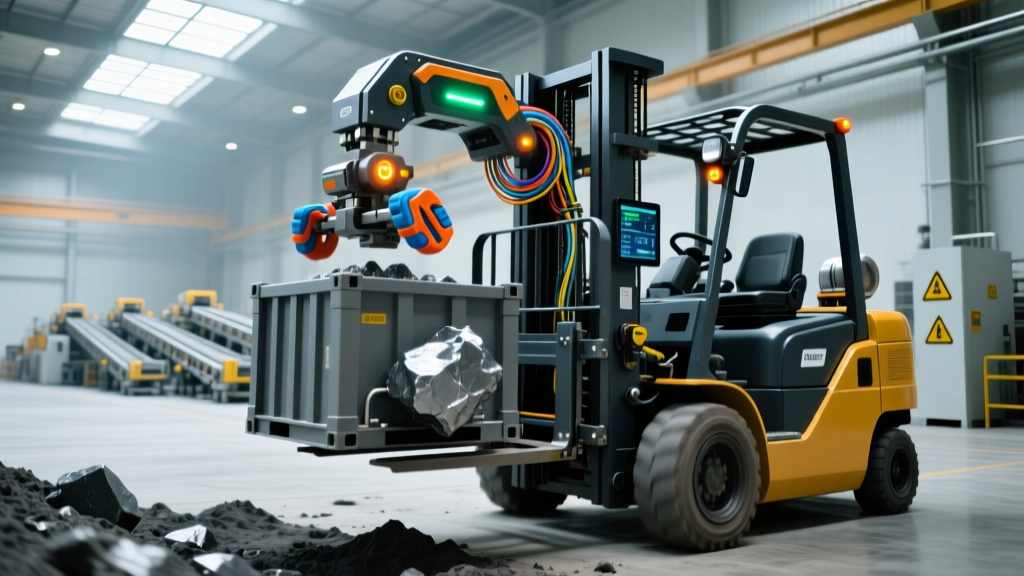
Surface and subterranean mining operations subject machinery to extreme particulate matter, high-impact shock loads, and severe temperature fluctuations. While prime movers have seen incremental powertrain upgrades, the most significant technological leap in mining material handling equipment is occurring at the mast. Modern forklift attachments are no longer passive hydraulic end-effectors; they are active, sensor-laden IoT nodes capable of real-time load telemetry, automated pressure adjustments, and predictive maintenance alerts.
According to NIOSH research on mobile equipment safety, load-shifting and improper material engagement remain primary catalysts for mine-site mobile equipment incidents. By integrating smart attachments into the material handling workflow, operators eliminate the guesswork from load securement, directly addressing these safety vulnerabilities while optimizing cycle times.
Data Highlight: The Cost of Mishandling
Unplanned downtime for a 300-ton class mining haul truck due to a delayed tire change costs approximately $1,200 to $1,800 per hour in lost production. Smart tire manipulator attachments reduce tire-swapping cycle times by 34%, paying for their $65,000 capital expenditure within 14 weeks of deployment on a high-utilization site.
4 Tech-Driven Forklift Attachments Redefining Mine Sites
1. Sensor-Integrated Drill Rod Grapples
Handling 20-foot steel drill rods requires precise clamping force. Too little pressure results in load slippage; excessive pressure crushes the rod threads or deforms the steel casing. Modern smart grapples, such as the Cascade X-Class series, utilize integrated pressure transducers and Time-of-Flight (ToF) LiDAR sensors to measure the exact diameter of the pipe bundle before engagement.
- Hydraulic Specs: Requires 18-22 GPM auxiliary flow at a baseline 2,500 PSI.
- Tech Feature: Auto-bleed valves reduce clamping pressure by 14% once the load is lifted and the center of gravity stabilizes, preventing structural fatigue on the rods.
- Pricing: $28,000 - $36,500 depending on mast carriage class (Class III vs. Class IV).
2. Heavy-Duty OTR Tire Manipulators with Telematics
Off-the-road (OTR) tires for mining haul trucks, such as the 59/80R63 size, weigh upwards of 11,000 lbs and possess massive diameters. Bolzoni Auramo and similar manufacturers now equip heavy-duty tire handlers with CAN bus-connected telematics. These attachments monitor the hydraulic cylinder stroke length and clamp pad wear in real-time.
When the urethane clamp pads degrade to within 4mm of the steel backing plate, the attachment sends an automated alert via the mine's LTE network to the maintenance planner, preventing catastrophic steel-on-rubber scoring that destroys $80,000 tires.
3. Automated Fork Positioners for Explosive Magazines
Handling palletized ANFO (Ammonium Nitrate/Fuel Oil) explosives demands strict adherence to OSHA powered industrial truck standards regarding spark prevention and load stability. New generation automated fork positioners feature intrinsically safe, sealed linear actuators that adjust fork width from the cab. The 2026 iterations include laser-guided pallet alignment overlays projected directly onto the load, ensuring the operator maintains a safe 15-foot standoff distance while perfectly centering the forks without manual intervention.
4. 360-Degree Hydraulic Rotators with Load-Moment Indicators
Used extensively in mill maintenance for moving irregular ore-crusher mantles and concaves, continuous rotators now feature integrated Load-Moment Indicators (LMI). If the operator attempts to rotate a 14,000 lb asymmetrical load past its safe lateral center of gravity, the LMI restricts hydraulic flow to the rotation motor, preventing a tip-over event. These units interface directly with the forklift's digital dashboard, displaying real-time torque metrics.
Attachment Specification & Procurement Matrix
Procurement teams must evaluate attachments not just on payload capacity, but on digital integration capabilities and hydraulic compatibility. The following matrix outlines current market offerings for heavy-duty mining applications.
| Attachment Type | Primary Application | Max Payload | Integrated Technology | 2026 Est. Price |
|---|---|---|---|---|
| Smart Drill Rod Grapple | Blast hole drill pipe transport | 12,500 lbs | ToF LiDAR, Auto-bleed pressure valves | $32,000 |
| Telemetric Tire Manipulator | Haul truck OTR tire changes | 16,000 lbs | Pad-wear sensors, CAN bus telemetry | $68,500 |
| Intrinsically Safe Fork Positioner | ANFO explosive magazine loading | 8,000 lbs | Sealed actuators, laser-guided alignment | $24,000 |
| LMI Continuous Rotator | Mill crusher component maintenance | 18,000 lbs | Load-Moment Indicator, flow restriction | $41,000 |
Integration with Fleet Telematics and Mine IoT
The true value of specialized mining material handling equipment emerges when the attachment communicates with the site's central Fleet Management System (FMS). Modern attachments utilize the SAE J1939 CAN bus protocol to transmit data directly through the forklift's telematics gateway.
'When a smart clamp registers a micro-slip event—where hydraulic pressure drops momentarily due to a load shift—the attachment logs the GPS coordinate and timestamp. Over a 90-day period, mine engineers can map these micro-slip events to identify specific potholes or uneven grades on the haul road that are degrading load stability.'
— Fleet Systems Engineering Report, 2026 Mining Automation Symposium
Edge Cases and Failure Modes in Subterranean Environments
Deploying sensor-rich attachments in underground hard-rock mining introduces unique failure modes that surface operations do not encounter. Procurement and maintenance teams must account for the following environmental edge cases:
- Particulate Blinding of Optical Sensors: LiDAR and optical cameras used for load-sizing will fail when coated in fine muck dust or diesel soot. Solution: Specify attachments with integrated pneumatic air-purge nozzles that automatically blast the sensor lenses with compressed air prior to every engagement cycle.
- Hydraulic Hose Abrasion in Narrow Drifts: Subterranean forklifts operate in tight drifts where walls scrape external hoses. Solution: Mandate Kevlar-reinforced, fire-resistant (MSHA-approved) hydraulic hosing with integrated wire-mesh abrasion guards for all external attachment plumbing.
- Electromagnetic Interference (EMI): Proximity to high-voltage underground substations and heavy electrical cabling can induce noise in unshielded sensor wiring, causing false load-readings. Solution: Ensure all attachment data cables utilize shielded twisted-pair (STP) wiring with IP68-rated Deutsch connectors.
Strategic Procurement: Validating Total Cost of Ownership
When upgrading your fleet's material handling capabilities, base purchasing decisions on the Total Cost of Ownership (TCO) rather than initial capital expenditure. A standard mechanical tire handler may cost $35,000 less than a telemetric model. However, if the standard model results in a single ruined 59/80R63 tire due to clamp-pad failure, the financial loss instantly eclipses the initial savings.
Before issuing a purchase order, require OEMs to provide an API documentation packet proving their attachment's telemetry data can seamlessly ingest into your existing mine-site ERP or FMS platform. If the data remains trapped in a proprietary, closed-loop dashboard, the attachment fails to deliver its full operational ROI.