Hoist Training & Technical Support for Material Handling Equipment
Master hoist and winch operator training. Learn duty cycles, inspection limits, and when to escalate technical support for material handling equipment.
Vertical Transport Fundamentals: Hoists, Winches, and Operator Accountability
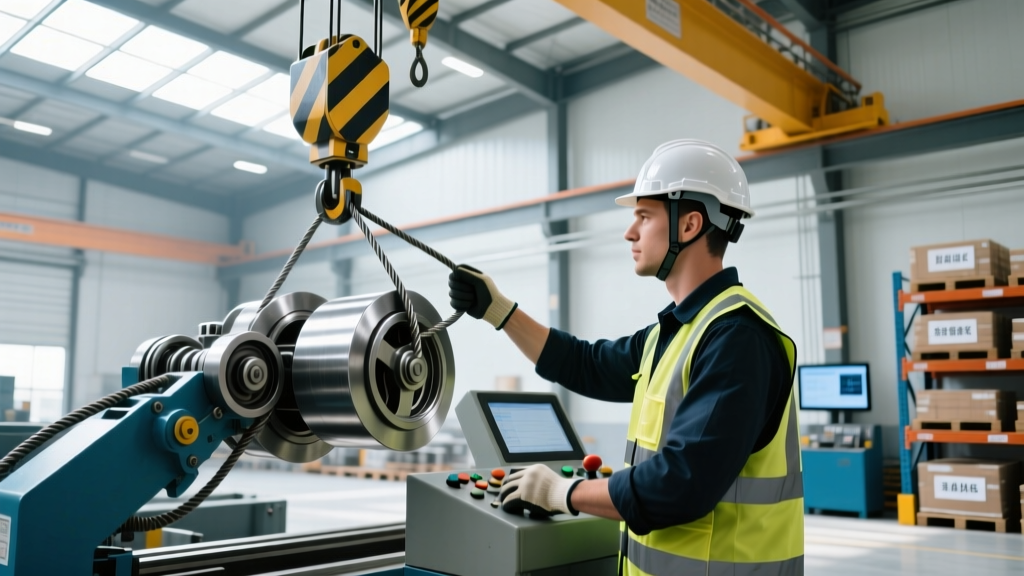
Vertical material transport relies on the precise interaction between mechanical braking systems, wire rope or alloy chain, and electrical control circuits. While hoists are engineered strictly for vertical lifting and lowering, winches are primarily designed for horizontal pulling or tensioning, though heavy-duty industrial winches are frequently adapted for vertical applications. The operational overlap often leads to catastrophic misuse if operators are not trained on the distinct braking architectures of each. Modern facilities utilizing Variable Frequency Drives (VFDs) and IoT-enabled load cells require a new tier of operator competency, shifting the focus from simple mechanical operation to digital fault interpretation and precise escalation protocols.
Regulatory Baseline: Under OSHA Standard 1910.179 and ASME B30.16, operators must be trained not only in load manipulation but in recognizing mechanical degradation. Facility managers who fail to document pre-shift inspections face severe liability in the event of a load-drop incident.Decoding Duty Cycles: Matching Equipment to Operational Reality
A primary failure mode in vertical transport occurs when a facility deploys an H3 (Standard) duty cycle hoist for an H5 (Heavy) production environment. This accelerates motor burnout and contactor pitting, leading to premature requests for technical support for material handling equipment. Operators and maintenance teams must understand the thermal limits of their specific units.
| Classification | Typical Application | Starts Per Hour | Example Model & Est. Cost (1-Ton) |
|---|---|---|---|
| H3 (Standard) | Maintenance shops, infrequent tooling changes | 75 - 150 | Harrington NER ($1,800 - $2,200) |
| H4 (Heavy) | Machine shops, fabrication, batching | 150 - 300 | CM Lodestar D ($2,800 - $3,400) |
| H5 (Severe) | Steel mills, continuous foundry operations | 300 - 600 | Ingersoll Rand Starlift ($4,500+) |
Pre-Shift Inspection: Quantifiable Wear Limits
Vague training directives like 'check the chain for damage' are insufficient. Operator training must mandate quantifiable rejection criteria. If an operator cannot measure and identify these specific thresholds, they are not qualified to operate the equipment.
Alloy Steel Chain Hoists
- Elongation Limit: Chain stretch exceeding 3% of the original nominal link length mandates immediate removal from service. A 1-inch link stretched to 1.03 inches is a failed component.
- Wear at Bearing Points: Inter-link wear exceeding 10% of the original chain diameter requires replacement.
- Hook Throat Opening: Any increase in the hook throat dimension greater than 15% from the manufacturer's baseline specification indicates plastic deformation and imminent failure.
Wire Rope Winches and Hoists
- Broken Wires: Discard the rope if there are 6 randomly distributed broken wires in one rope lay, or 3 broken wires in a single strand.
- Birdcaging: Any external protrusion of the core or strand displacement caused by sudden load releases or shock loading requires immediate scrapping.
- Diameter Reduction: A loss of more than 1/3 of the outer wire diameter due to abrasion or corrosion is a hard rejection metric.
The Escalation Framework: When to Call Technical Support
Knowing when to transition from in-house troubleshooting to engaging OEM technical support for material handling equipment is critical for minimizing downtime. Blindly replacing parts without diagnostic data voids warranties and delays resolution. Use this decision matrix to structure your maintenance response.
Fault Escalation Matrix
- Level 1: Operator Domain (Visual/Auditory)
Symptoms: Unusual grinding, sluggish braking, erratic pendant response.
Action: Lock out/Tag out (LOTO). Document the exact VFD error code on the hoist control panel. Do not attempt to reset a tripped thermal overload more than once. - Level 2: In-House Maintenance (Electrical/Mechanical)
Symptoms: Motor hums but won't lift, contactor arcing, limit switch failures.
Action: Check phase voltage imbalance (must be < 5%). Inspect contactor tips for pitting. Verify brake air gap (typically 0.010" to 0.020" depending on the model). If the VFD displays a 'Ground Fault' or 'IGBT Failure', escalate immediately. - Level 3: OEM Technical Support Escalation
Triggers: VFD firmware corruption, intermittent load-cell calibration drift, structural deformation of the hoist housing, or repeated failure of newly installed OEM components.
Action: Contact technical support for material handling equipment directly. Have the serial number, exact duty cycle application, and a log of voltage readings ready.
Braking Architectures: Hoist vs. Winch Training
A critical knowledge gap in operator training is the assumption that hoists and winches brake identically. This misunderstanding leads to severe load-drop incidents.
Engineering Distinction: Standard electric chain hoists utilize a mechanical, spring-applied, electrically-released automatic load brake. This brake physically holds the load if power is lost. Conversely, many industrial winches rely on dynamic braking (using the motor's electrical resistance to slow the load) or manual band brakes. Operators must be trained never to use a standard tensioning winch for vertical lifting unless it is explicitly rated and equipped with a mechanical automatic load brake compliant with CMAA and ASME standards.
Gathering Diagnostic Data Before Calling Support
When internal maintenance cannot resolve a fault, the quality of data provided to the manufacturer dictates the speed of the repair. Technical support engineers require specific parameters to diagnose issues remotely, especially for modern hoists equipped with smart sensors.
Required Data Points for Support Tickets
- VFD Fault Logs: Extract the exact alphanumeric code (e.g., 'Err-04' for overcurrent on a standard Yaskawa hoist drive) and the frequency of occurrence.
- Motor Amp Draw: Measure the FLA (Full Load Amps) on all three phases using a True RMS clamp meter while lifting 50% of the rated capacity. A variance greater than 10% between phases indicates a winding issue or phase imbalance.
- Brake Coil Resistance: Record the ohms reading across the DC brake coil. Compare this against the manufacturer's spec sheet (usually between 40 and 120 ohms for standard 1-ton hoists).
- Environmental Context: Note ambient temperature and the presence of particulate matter. Hoists operating in environments exceeding 104°F (40°C) require derating or specialized Class H insulation.
Load Testing and Certification Protocols
Following any major repair, component replacement, or when mandated by annual safety audits, hoists must undergo rigorous load testing. Operators and maintenance staff must understand the difference between static and dynamic testing to avoid structural damage to the facility.
Static Test: Apply a load equal to 125% of the hoist's rated capacity. Raise the load just enough to take up the slack (typically 2 to 4 inches off the floor). Hold for a minimum of 10 minutes. Measure the brake slippage; any downward drift indicates a failed brake spring or contaminated friction disc.
Dynamic Test: Operate the hoist with 110% of the rated capacity through its full range of motion, testing all limit switches and braking functions under momentum. This verifies that the VFD deceleration ramps and mechanical brakes can handle kinetic energy without dropping the load.
Proper documentation of these tests, combined with strict adherence to quantifiable wear limits, forms the foundation of a compliant vertical transport program. By training operators to recognize specific mechanical degradation and equipping maintenance teams with precise electrical diagnostic skills, facilities can drastically reduce unplanned downtime and ensure that when technical support for material handling equipment is required, the resolution is swift and definitive.