Material Handling Equipment News: 2026 Food & Pharma Budget Guide
Analyze the latest material handling equipment news to plan 2026 budgets for food and pharma. Compare washdown conveyor, AMR, and forklift costs.
Capital expenditure planning for food processing and pharmaceutical manufacturing requires navigating a minefield of regulatory compliance and specialized engineering. In 2026, tracking material handling equipment news is no longer just about spotting new automation trends; it is about understanding the shifting premiums on sanitary-grade materials, cleanroom-compatible robotics, and advanced washdown components. When a facility fails to budget accurately for USDA, FDA, or ISO-compliant equipment, the resulting retrofit costs and production downtime can obliterate annual margins.
Compliance Warning: Under the FDA's Food Safety Modernization Act (FSMA), facility managers are legally responsible for ensuring that equipment design does not harbor pathogens. Budgeting for standard industrial equipment in a high-moisture food zone is not just a maintenance risk; it is a federal compliance violation that can trigger immediate facility shutdowns.Decoding Sanitary Material Premiums: 304 vs. 316L Stainless Steel
The foundation of any food or pharma material handling budget is metallurgy. While standard industrial facilities utilize painted mild steel or aluminum, sanitary environments demand stainless steel. However, the choice between 304 and 316L stainless steel carries massive budget implications.
304 stainless steel is the baseline for dry goods handling (e.g., flour, sugar, powdered supplements). It resists standard cleaning agents but is highly susceptible to pitting and crevice corrosion when exposed to chlorine-based sanitizers or high-salinity products. 316L stainless steel contains molybdenum, which provides critical resistance to chloride-induced corrosion. In 2026, the raw material and fabrication premium for 316L over 304 sits between 22% and 28%. If your facility utilizes Clean-In-Place (CIP) systems with peracetic acid (PAA) or chlorine dioxide, 316L is mandatory. Budgeting for 304 in these zones will result in weld degradation and bacterial harborage within 14 to 18 months.
Furthermore, post-weld passivation and electropolishing are non-negotiable for sanitary conveyors and hoppers. Facility managers must budget an additional $2.50 to $4.00 per square foot for professional electropolishing to remove free iron and create a micro-smooth surface finish (Ra < 0.8 µm) that meets 3-A Sanitary Standards.
Washdown Conveyor Systems: CapEx vs. 5-Year TCO
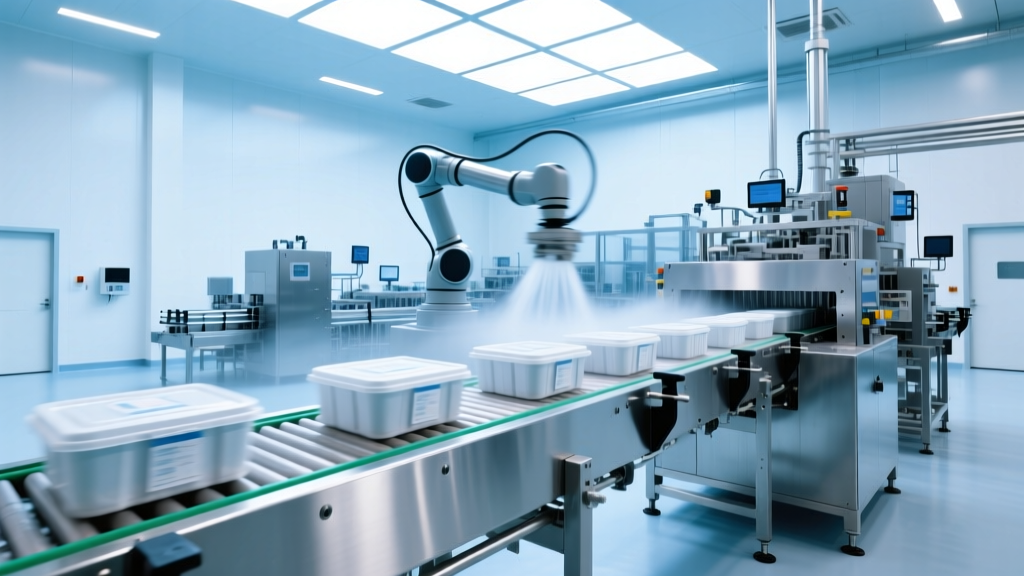
Conveyor systems in meat processing, dairy, and ready-to-eat (RTE) facilities require daily high-pressure, high-temperature washdowns. Standard Totally Enclosed Fan Cooled (TEFC) motors will fail almost immediately under these conditions. Budgets must account for IP69K-rated components, which are sealed to withstand 1,450 PSI washdowns at 176°F (80°C).
The table below breaks down the Capital Expenditure (CapEx) versus the 5-Year Total Cost of Ownership (TCO) for a 100-foot accumulation conveyor system, comparing standard industrial specs against sanitary washdown specs (e.g., Hytrol ProSort 100 with EZLogic 3.0 washdown modules).
| Cost Category | Standard Industrial (Mild Steel/TEFC) | Sanitary Washdown (316L/IP69K) |
|---|---|---|
| Initial Equipment CapEx | $42,000 | $88,500 |
| Motor Replacement (Years 1-5) | $18,000 (Frequent water ingress failures) | $0 |
| Downtime/Lost Production | $65,000 | $4,500 |
| Preventative Maintenance Labor | $22,000 | $8,000 |
| 5-Year TCO | $147,000 | $101,000 |
While the upfront CapEx for the sanitary system is more than double, the 5-year TCO is 31% lower. The primary driver of this savings is the elimination of micro-stoppages caused by corroded photo-eyes and shorted motor windings.
Pharmaceutical Cleanrooms: AGV and AMR Integration Costs
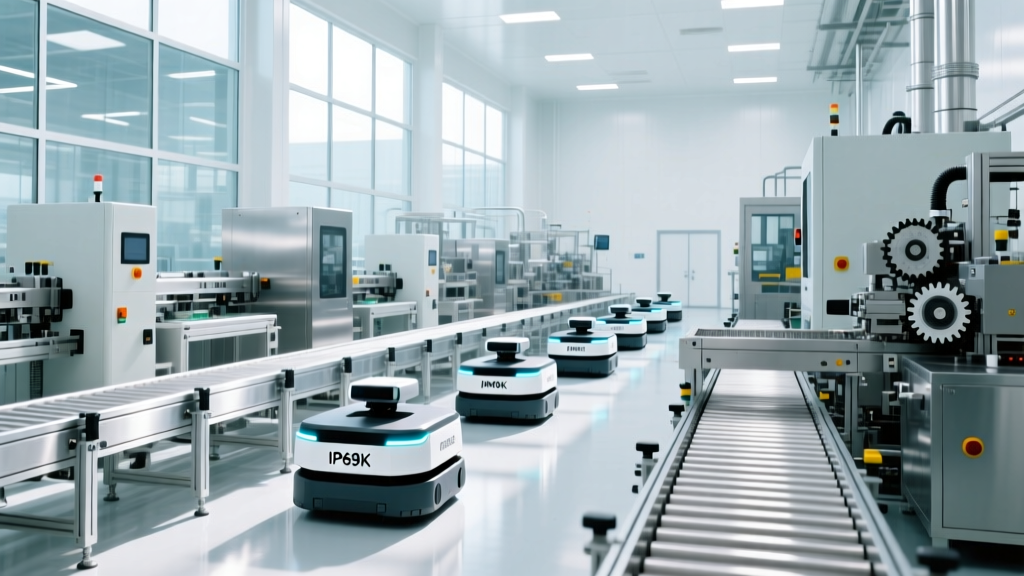
Automating material flow in pharmaceutical cleanrooms (ISO 14644-1 Class 5 through Class 8) introduces a unique set of budget variables. Standard Autonomous Mobile Robots (AMRs) are prohibited in these zones because their standard polyurethane wheels and internal cooling fans generate thousands of micro-particles per minute, violating strict particulate limits.
When budgeting for cleanroom AMRs, facility managers frequently overlook the cost of the validation documentation. The physical robot is only half the battle; the IQ/OQ/PQ (Installation, Operational, and Performance Qualification) paperwork required by quality assurance teams often adds $15,000 to $30,000 per unit to the final ledger.
To deploy an AMR like a customized MiR250 or Omron LD-250 in an ISO Class 7 environment, you must budget for specific cleanroom modifications:
- Non-Shedding Wheels: Upgrading to specialized composite or cleanroom-grade elastomer wheels adds $2,500 to $4,000 per robot.
- HEPA Filtration Top Modules: To ensure the robot's internal air exhaust does not contaminate the room, custom HEFA-filtered shrouds cost between $6,000 and $9,000.
- Stainless Steel Cladding: Plastic housings trap static and resist harsh VHP (Vaporized Hydrogen Peroxide) decontamination cycles. 316L cladding adds $8,000+.
- Automated Charging Stations: Must be sealed and flush-mounted to prevent dust accumulation, adding $3,500 per station.
Expect a fully validated, cleanroom-ready AMR deployment to cost between $65,000 and $85,000 per unit, compared to the $35,000 baseline for standard warehouse AMRs.
Forklifts and Pallet Jacks in Cold Storage and Washdown Zones
Material handling in food and pharma often intersects with extreme temperature environments, such as blast freezers (-20°F) or high-humidity coolers (34°F, 95% RH). Standard internal combustion forklifts are banned in indoor food facilities due to exhaust emissions, making electric forklifts the only viable option. However, budgeting for electric lift trucks in these environments requires precise battery chemistry planning.
Lead-acid batteries suffer a 30% to 40% capacity loss in sub-zero temperatures and require heated, ventilated charging rooms to off-gas safely. Lithium-ion (Li-ion) batteries maintain their voltage curve in the cold but require integrated battery heaters to accept a charge and prevent lithium plating. When spec'ing a 3-wheel electric forklift like the Toyota 8FBE15U with full stainless steel cladding and epoxy-coated mast channels, add $4,500 to $6,000 for the integrated Li-ion battery heating management system. While this increases the initial purchase price from roughly $45,000 to over $50,000, it eliminates the $12,000 annual cost of maintaining a heated battery charging room and swapping frozen batteries mid-shift.
For manual and powered pallet jacks, look for models featuring specialized corrosion-resistant coatings. The Crown WP 3000 series walkie pallet jacks, for example, offer an x10 corrosion-resistant coating package that provides 10 times the protection of standard paint. Budget an additional 15-20% premium for these coated units, which is easily justified by preventing the $3,000+ cost of replacing rusted hydraulic pump housings annually.
The Hidden Costs of Automated Storage and Retrieval Systems (AS/RS)
Implementing AS/RS in pharmaceutical or high-value food ingredient storage brings massive spatial efficiency, but the software and compliance costs are frequently underestimated in early budget drafts. According to the FDA's Final Rule on Preventive Controls for Human Food, automated systems must integrate seamlessly with traceability and sanitation protocols.
When budgeting for an AS/RS shuttle system in a pharma environment, you must allocate capital for 21 CFR Part 11 compliance. This regulation governs electronic records and electronic signatures. The Warehouse Execution System (WES) software must feature rigorous audit trails, role-based access controls, and automated lockout mechanisms if temperature or humidity sensors detect an excursion. Customizing standard WMS/WES software to meet 21 CFR Part 11 standards typically requires specialized integration consultants, adding $40,000 to $75,000 in software licensing and validation services to the project budget.
2026 Budget Planning Framework for Facility Managers
To ensure your capital requests are fully funded and accurate, apply this 5-step framework before finalizing your material handling equipment purchases:
- Map the Chemical Environment: Document every CIP chemical, sanitizer, and cleaning agent used in the zone. Match the metal spec (304 vs 316L) and elastomer seals (Viton vs EPDM) to the harshest chemical, not the most common one.
- Audit the IP Rating Requirements: Differentiate between IP65 (low-pressure washdown) and IP69K (high-pressure, high-temperature steam). Spec'ing IP69K where IP65 suffices wastes up to 30% of the motor budget.
- Factor in Validation and Commissioning: For pharma and strict food safety zones, allocate 15% to 20% of the hardware CapEx strictly for IQ/OQ/PQ validation, third-party auditing, and software compliance mapping.
- Calculate the Energy and Utility Delta: Sanitary equipment often requires specialized compressed air purges for load cells and photo-eyes to prevent water ingress. Ensure your facility's compressed air generation budget can handle the increased CFM demand.
- Leverage Tax Incentives: Consult with your finance team regarding Section 179 deductions and bonus depreciation for automated sanitary equipment, which can offset up to 20-30% of the net CapEx in the year of installation.
By shifting the focus from initial purchase price to total lifecycle compliance and operational uptime, facility managers can build resilient budgets that protect both their margins and their end consumers.
Related reading
Bulk Mining & Ag Systems vs Material Handling Equipment in Warehouse
AS/RS & Material Handling Automation Equipment Cost Guide 2026