Ergonomic Aids vs Heavy-Duty Material Handling Equipment Services
Compare ergonomic lift assist devices with heavy-duty material handling equipment services. Find the best ROI and safety solution for your warehouse.
The Core Dilemma: CapEx Ergonomics vs. OpEx Heavy-Duty Services
Facility managers constantly face a critical operational fork in the road when addressing load movement: invest capital in permanent ergonomic material handling aids, or outsource the workload to heavy-duty material handling equipment services. While both pathways mitigate workplace injuries and improve throughput, their financial models, load capacities, and optimal use cases are fundamentally incompatible. Misallocating budget here results in either underutilized six-figure robotic arms or exorbitant monthly rigging invoices for loads that a simple pneumatic balancer could manage.
This analysis dissects the technical specifications, cost structures, and operational limits of in-house lift assist devices compared to contracted heavy-duty material handling equipment services, providing a concrete framework for 2026 facility planning.
Evaluating Ergonomic Lift Assist Devices (In-House CapEx)
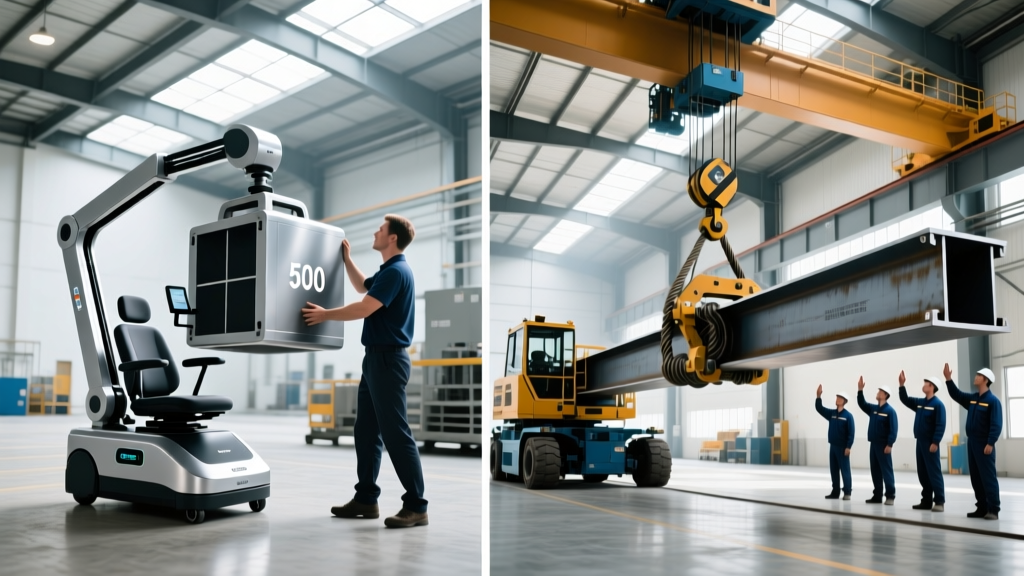
Ergonomic material handling aids are engineered for high-frequency, repetitive lifting of sub-2,000 lb loads. The primary objective is to keep the operator's physical exertion below the NIOSH Recommended Weight Limit (RWL) of 51 lbs, effectively eliminating lumbar shear force during repetitive cycles.
Primary Technologies and Specifications
- Intelligent Assist Devices (IADs): Systems like the Gorbel G-Force utilize a 1-horsepower servo motor and load cell to float loads up to 350 lbs in a zero-gravity state. Operators guide the load with less than 1 lb of horizontal force. These require 110V single-phase power and overhead gantry or bridge crane infrastructure.
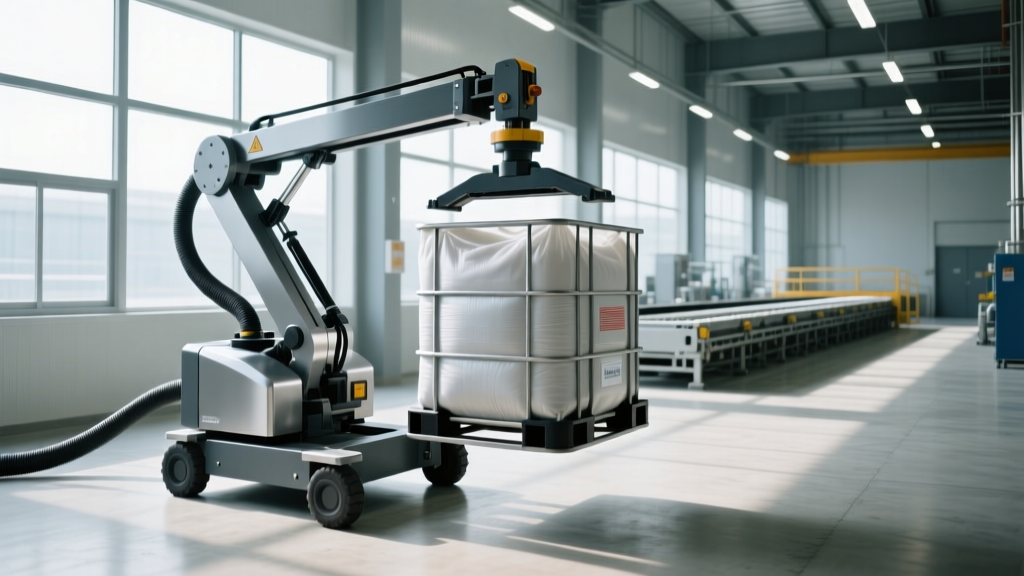
- Vacuum Tube Lifters: The Schmalz JumboErgo series uses a regenerative blower (0.75 kW to 3.0 kW) to create a vacuum. Ideal for porous or semi-porous materials like corrugated cardboard or rough-sawn timber, these units handle up to 660 lbs. The lifting tube itself acts as the hoist, expanding and contracting vertically.
- Pneumatic Balancers: Devices like the Ingersoll Rand Air Balancer use compressed air (typically 80-100 PSI) to achieve precise load flotation. They are preferred in explosive or washdown environments where electrical servo motors pose a hazard.
A fully installed Gorbel G-Force system with a 12-foot span aluminum enclosed track typically ranges from $28,000 to $42,000. Vacuum lifters are more accessible, averaging $9,000 to $16,000 including the jib crane and festooned power supply. ROI is generally realized within 14 to 18 months through reduced musculoskeletal disorder (MSD) claims and a 20-30% increase in pick-and-place cycle times.
Analyzing Heavy-Duty Material Handling Equipment Services (Outsourced OpEx)
When loads exceed the physical limits of standard warehouse ergonomics—typically crossing the 2,000 lb threshold, or requiring complex multi-axis rigging—facilities turn to heavy-duty material handling equipment services. These are specialized third-party contractors providing industrial rigging, machinery moving, and heavy crane services.
Service Scope and Equipment Arsenal
Unlike permanent lift assists, these services bring mobile, extreme-capacity equipment to your facility on an as-needed basis. Key assets deployed by these providers include:
- Hydraulic Gantry Systems: Used for precision placement of heavy machinery (e.g., 40,000 lb CNC horizontal boring mills or stamping presses) in facilities with low overhead clearance where traditional cranes cannot operate. Systems like the Engineered Rigging Hydra-Slide can push/pull loads exceeding 1,000 tons.
- Articulating Boom Cranes: For outdoor-to-indoor transfer of heavy fabrication materials, contractors deploy all-terrain cranes (e.g., Liebherr LTM series) with capacities ranging from 50 to 500 tons.
- Specialized Below-the-Hook Rigging: Custom-engineered lifting beams, spreader bars, and heavy-duty synthetic slings rated for specific center-of-gravity offsets.
According to OSHA's material handling standards, any lifting operation involving heavy machinery placement requires strict adherence to load-rating certifications and rigging plans. Contracting these services transfers the liability of rigging failures and equipment maintenance to the provider, provided they carry adequate riggers' liability insurance (typically a minimum of $5 million for heavy industrial work).
Head-to-Head Comparison Matrix
| Feature | Ergonomic Lift Assists (In-House) | Heavy-Duty Handling Services (Outsourced) |
|---|---|---|
| Optimal Load Range | 10 lbs – 2,000 lbs | 2,000 lbs – 1,000+ tons |
| Financial Model | High CapEx / Low marginal OpEx | Zero CapEx / High episodic OpEx |
| Frequency of Use | Continuous, high-cycle (shifts/daily) | Infrequent, project-based (quarterly/annually) |
| Operator Requirement | Standard warehouse staff (minimal training) | Certified riggers and crane operators |
| Primary Safety Focus | Ergonomics, preventing repetitive strain | Load stability, crush hazards, structural limits |
| Infrastructure Needs | Overhead track, jib crane, 110V/air supply | Clear floor space, reinforced concrete, access roads |
The 2026 Decision Framework: When to Deploy Which
Choosing between purchasing ergonomic aids and hiring heavy-duty material handling equipment services requires a diagnostic approach based on load frequency and mass. Use this four-step logic model to allocate your budget:
- Calculate the Daily Lift Mass: If the cumulative weight moved per shift exceeds 5,000 lbs, but individual unit loads are under 500 lbs, invest immediately in vacuum lifters or pneumatic balancers. Outsourcing this volume is financially impossible.
- Assess the Precision Requirement: If a 15,000 lb load requires placement within a 1/8-inch tolerance (e.g., setting a precision granite surface plate or aligning a turbine rotor), ergonomic aids are useless. You must contract a heavy-duty service utilizing a hydraulic gantry with synchronous PLC control.
- Evaluate Facility Infrastructure: Lift assists require overhead clearance and structural steel capable of supporting dynamic point loads (typically 1,500 lbs minimum for light crane tracks). If your facility is a tilt-up concrete warehouse with a lightweight bar-joist roof, installing overhead ergonomic aids may require $50,000+ in structural reinforcement, making floor-based heavy-duty service equipment (like telehandlers) more viable for periodic heavy moves.
- Analyze the Liability Profile: For loads exceeding OSHA's standard rigging thresholds or involving hazardous materials, the cost of in-house insurance premiums and certified rigger salaries often eclipses the daily rate of a specialized heavy-duty service contractor.
Hidden Failure Modes and Edge Cases
Both approaches harbor non-obvious operational traps that can derail productivity and safety.
Vacuum Lifter Edge Cases
A common failure mode in deploying ergonomic vacuum lifters is ignoring surface permeability. Attempting to lift raw MDF (medium-density fiberboard) or heavily corrugated, damaged cardboard with standard polyurethane vacuum cups will result in vacuum bleed-off and dropped loads. Solution: Specify high-flow vacuum generators (minimum 300 SCFM) and nitrile rubber foam-lip cups that compress into surface irregularities to maintain the required 80% vacuum threshold.
Heavy-Duty Service Contract Gaps
When hiring heavy-duty material handling equipment services, a critical edge case is the 'below-the-hook' insurance gap. Many general crane providers insure the crane and the hook, but exclude liability for the custom rigging gear (slings, shackles, spreader bars) used to attach the load. If a synthetic sling snaps and drops a $500,000 CNC machine, the facility may be left holding the liability. Solution: Mandate that the service provider's certificate of insurance (COI) explicitly includes 'riggers liability' and 'care, custody, and control' coverage for the specific duration of the lift.
Compliance Warning: Regardless of whether you use internal ergonomic aids or external heavy services, all lifting equipment must undergo documented periodic inspections. OSHA standard 1910.176 mandates that material handling equipment must be inspected prior to each shift, and below-the-hook lifting devices require annual documented inspections by a qualified person.Strategic Synthesis for Facility Managers
The most optimized facilities in 2026 do not view this as a binary choice, but as a layered material handling strategy. Deploy ergonomic material handling aids (like articulating jib cranes with vacuum end-effectors) at receiving docks and assembly stations to handle the high-frequency, sub-1,000 lb daily throughput. Simultaneously, establish a master service agreement (MSA) with a heavy-duty material handling equipment service provider to manage the quarterly installation of new capital machinery, facility reconfigurations, and out-of-gauge outbound shipments. This hybrid approach minimizes CapEx depreciation while ensuring absolute safety compliance across the entire load spectrum.