Smart Warehouse Equipment Material Handling for Semiconductor Fabs
Explore 2026 cleanroom warehouse equipment material handling innovations for semiconductor fabs, from ISO Class 1 AMRs to anti-static OHT systems.
The Paradigm Shift: From Standard Logistics to ISO-Certified Fabs
Applying standard warehouse equipment material handling principles to semiconductor fabrication facilities (fabs) is a recipe for yield destruction. In sub-2nm node manufacturing, a single microscopic particulate or a minor electrostatic discharge (ESD) event can compromise millions of dollars in silicon wafers. While traditional distribution centers prioritize cubic volume throughput and pallet velocity, semiconductor fabs demand an entirely different engineering discipline. Cleanroom material handling requires strict adherence to ISO 14644-1 classifications (typically ISO Class 1 through 3 for lithography and etching bays), rigorous outgassing limits, and advanced ESD mitigation.
In 2026, the integration of smart warehouse equipment material handling systems into fabs has moved beyond basic motorized conveyors. Today’s facilities rely on a hybrid ecosystem of Overhead Hoist Transports (OHT), magnetic levitation track systems, and ultra-low-particulate Autonomous Mobile Robots (AMRs). Understanding the precise technical specifications of these systems is critical for facility engineers and logistics managers tasked with maintaining yield rates above 95%.
Critical Cleanroom Thresholds (2026 Baseline)
- Particulate Limit (ISO Class 1): Maximum 10 particles per cubic meter (≥0.1 µm size).
- ESD Safety Threshold: Surface resistivity must strictly fall between 1.0 x 10⁵ and 1.0 x 10⁹ ohms/sq to prevent static buildup without creating a short-circuit risk.
- Outgassing Limit (ASTM E595): Total Mass Loss (TML) must be < 1.0%, and Collected Volatile Condensable Materials (CVCM) must be < 0.10%.
Overhead Hoist Transport (OHT) vs. Cleanroom AMRs
For the primary transport of 300mm Front Opening Unified Pods (FOUPs) between process tools, Overhead Hoist Transport (OHT) systems remain the undisputed backbone of the modern fab. Companies like Muratec and Daifuku dominate this space, utilizing ceiling-mounted rail networks that keep floor space clear for personnel and secondary equipment. However, OHT systems are inflexible; altering a track layout to accommodate a new lithography machine requires weeks of downtime and massive capital expenditure.
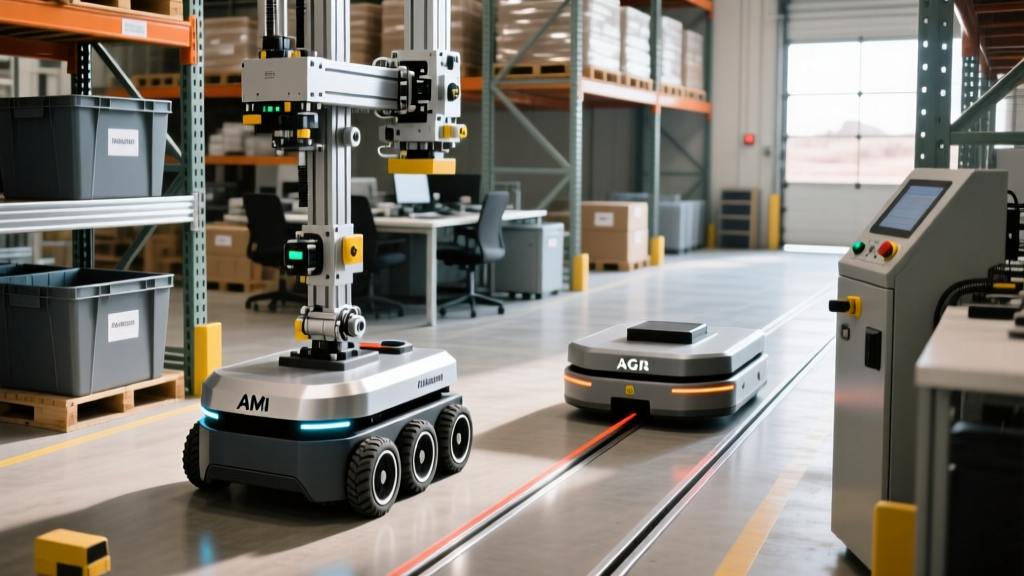
This inflexibility has driven the 2026 surge in cleanroom-rated AMRs for secondary logistics—specifically for reticle transport, spare parts delivery, and chemical canister movement. Unlike standard warehouse AMRs that use rubber tires and exposed gears, cleanroom AMRs utilize sealed magnetic levitation (maglev) drive systems or specialized perfluoroelastomer (FFKM) wheels to eliminate friction-based particle generation.
| Feature | OHT Systems (e.g., Muratec Sky RAV) | Cleanroom AMRs (Maglev/Sealed) | Manual Cleanroom Bridge Cranes |
|---|---|---|---|
| Primary Use Case | 300mm FOUP tool-to-tool transfer | Reticles, spare parts, chemical pods | Heavy maintenance, pump replacement |
| Particle Generation | Extremely Low (Non-contact rail) | Low (Requires HEPA-filtered chassis) | Moderate (Requires manual wiping protocols) |
| Flexibility / Routing | Fixed (Ceiling track network) | Dynamic (AI-driven pathfinding) | Fixed (X-Y axis bay coverage) |
| Approx. CapEx (2026) | $1,800 - $2,500 per linear meter | $90,000 - $140,000 per unit | $25,000 - $45,000 per workstation |
The Navigation Problem: Why Standard LiDAR Fails in Fabs
A critical point of failure when deploying standard warehouse equipment material handling robots into a fab is the navigation stack. Traditional 2D LiDAR and optical sensors struggle in ISO Class 1-3 environments for three distinct reasons:
- Air Shower Interference: High-velocity HEPA-filtered air showers create particulate noise that blinds optical sensors.
- Reflective Garments: Cleanroom 'bunny suits' and metallic ESD-smocks reflect LiDAR beams unpredictably, causing phantom obstacle detection.
- Glass and Polycarbonate: Fabs are lined with transparent polycarbonate partitions that allow LiDAR beams to pass through, mapping adjacent rooms instead of the immediate hallway.
To solve this, 2026 cleanroom AMRs utilize Ultra-Wideband (UWB) Real-Time Location Systems (RTLS) combined with 3D stereoscopic vision. UWB anchors mounted on the cleanroom ceiling provide millimeter-level positioning that is entirely immune to optical interference, ensuring that a reticle transport AMR never collides with a technician carrying a silicon wafer cassette.
Manual Handling: ESD and Outgassing Constraints
Despite heavy automation, human intervention is required for tool maintenance, pump replacements, and calibration. When facility managers search for standard warehouse equipment, material handling for semiconductor fabs requires a radically different approach to manual lifting gear. Standard steel chains and carbon-steel bearings are strictly prohibited due to oxidation and micro-flaking.
Specifying Cleanroom Hoists and Casters
For manual bridge cranes and jib cranes (such as those engineered by Gorbel or Spanco for cleanrooms), the structural components must be anodized aluminum or 316L stainless steel, coated with electrostatic dissipative (ESD) polyurethane. The trolley wheels must utilize precision-sealed, ESD-safe nylon or specialized PEEK (Polyether ether ketone) polymers.
Furthermore, all lubricants used in the hoist gears and caster bearings must be vacuum-rated and tested against ASTM E595-21 Standard Test Method for Total Mass Loss and Collected Volatile Condensable Materials. If a lubricant outgasses in the vacuum chambers adjacent to the handling area, it will deposit a microscopic hydrocarbon film on the wafers, ruining the photolithography process.
"The biggest mistake logistics managers make when outfitting a new fab bay is assuming that 'stainless steel' automatically equals 'cleanroom safe'. If the caster bearing grease isn't certified to ASTM E595 outgassing limits, that $30,000 material handling cart is essentially a mobile contamination vector."
— Senior Facilities Engineer, Tier-1 Foundry Operations
Integration & Software: The Digital Twin in Fab Logistics
The physical hardware is only half the equation. Modern smart warehouse equipment material handling relies on deep integration with the fab’s Manufacturing Execution System (MES). In 2026, leading facilities deploy Digital Twin simulations to model AMR traffic flows before a single robot is deployed. Because cleanroom hallways are exceptionally narrow (often designed to maximize clean air recirculation plenums), traffic bottlenecks can delay chemical deliveries, causing process tools to idle.
By integrating the SEMI International Standards (specifically SEMI E84 for automated load/unload handoffs and SEMI E82 for substrate tracker performance), AMRs can seamlessly communicate with tool load ports. This ensures the AMR's robotic end-effector aligns perfectly with the FOUP load port within a 0.5mm tolerance, eliminating the mechanical grinding that generates catastrophic particulate spikes.
Purchasing Framework: CapEx vs. OpEx for 2026 Expansions
When budgeting for cleanroom material handling, facility directors must evaluate the total cost of ownership (TCO) through a strict operational lens. Use the following decision framework to allocate capital:
- High-Volume, Fixed-Route (FOUPs): Invest heavily in OHT CapEx. The ROI is realized through continuous 24/7 throughput and zero floor-space consumption. Expect a 5-year depreciation cycle.
- Low-Volume, High-Mix (Reticles & Chemicals): Lease or purchase Cleanroom AMRs. The OpEx model allows you to scale the fleet up or down based on seasonal production ramps without altering ceiling infrastructure.
- Maintenance & Calibration (Heavy Gear): Specify manual ESD-safe bridge cranes. Do not automate maintenance lifting; the variability of replacement parts makes automated rigging economically unviable. Focus CapEx on ergonomic, zero-gravity balancers to reduce technician fatigue and drop-risks.
For deeper compliance metrics regarding airflow and particulate testing, facility engineers should continually reference the Institute of Environmental Sciences and Technology (IEST) recommended practices, which frequently update the baseline testing protocols for cleanroom logistics equipment. Ultimately, success in semiconductor material handling is not about moving the most weight; it is about moving critical assets with absolute environmental invisibility.