CNC Horizontal Machining Centers vs VMCs: Which Configuration Wins?
Compare CNC horizontal machining centers and VMCs. Analyze cost, throughput, pallet pools, and 5-axis alternatives to choose the right configuration.
The Capital Expenditure Reality: HMC vs. VMC
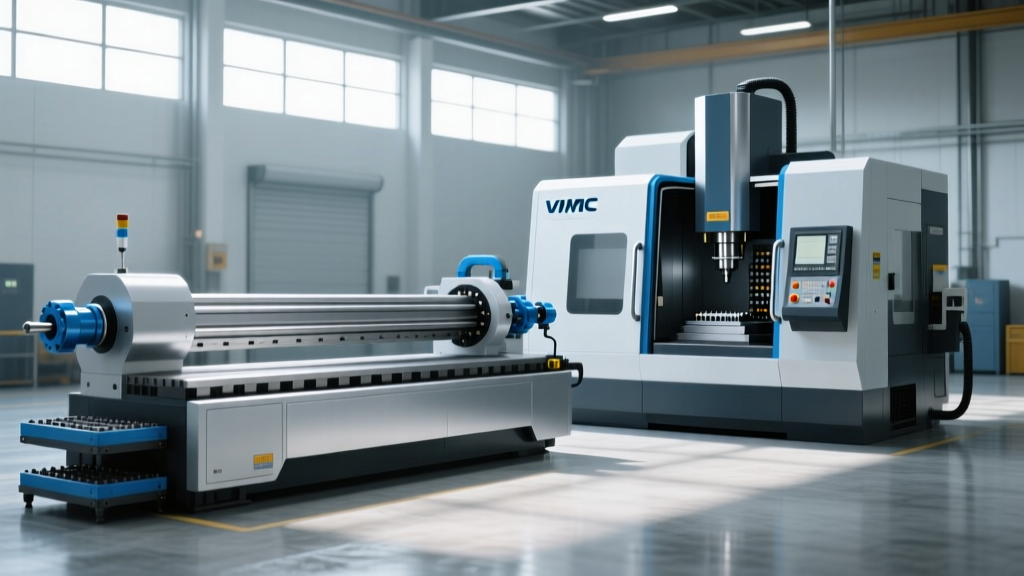
Choosing between CNC horizontal machining centers (HMCs) and vertical machining centers (VMCs) is rarely just a question of spindle orientation; it is a fundamental decision about shop floor economics, batch sizing, and unattended manufacturing capability. While a standard 40-taper VMC might cost between $75,000 and $130,000, a comparably sized HMC with a basic pallet changer starts around $220,000 and easily exceeds $500,000 when equipped with a multi-pallet pool. The justification for this premium relies entirely on cost-per-part reduction through spindle utilization and fixturing density.
Quick Decision Matrix
- Choose a VMC if: You run low-volume (1-50 pieces) prismatic parts, require 5-axis simultaneous contouring for complex aerospace structures, or have strict floor-space constraints.
- Choose an HMC if: You produce medium-to-high volumes (50-10,000+ pieces) of multi-sided parts, need to eliminate secondary operations via tombstone fixturing, or want to run unattended lights-out shifts.
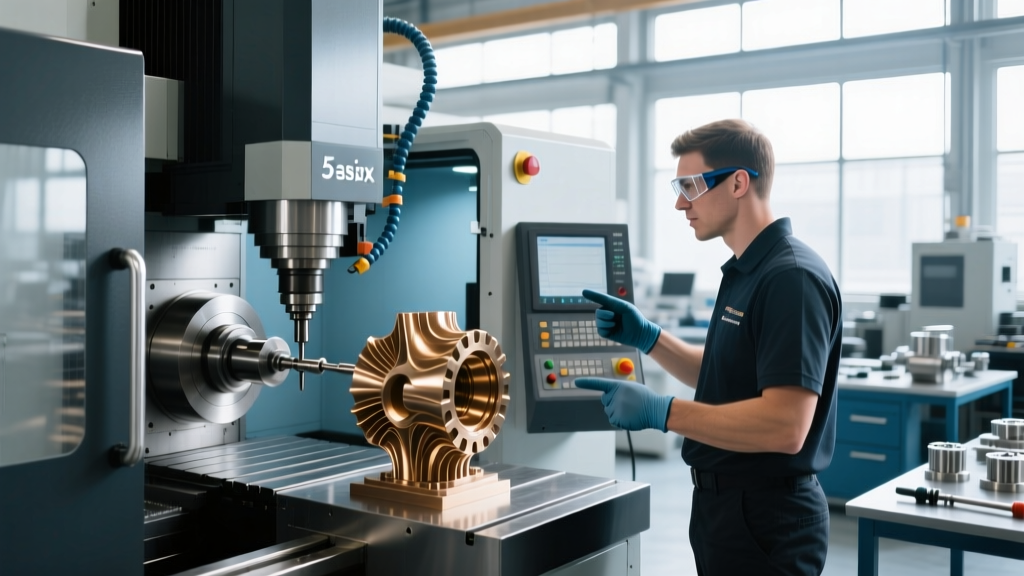
- Choose a 5-Axis VMC Alternative if: Your parts require complex organic geometries (impellers, blisks) where tombstone fixturing is physically impossible or cost-prohibitive.
Physics of Chip Evacuation and Tool Life
The most immediate mechanical advantage of CNC horizontal machining centers is gravity-assisted chip evacuation. In a VMC, chips fall directly onto the part, the vise, and the machine table. When machining deep cavities—such as hydraulic valve bodies or transmission cases—recutting chips is a primary cause of premature tool failure and poor surface finishes. High-pressure through-spindle coolant (often 1,000 PSI or more) is required to blast chips out of deep VMC pockets.
Conversely, an HMC’s horizontal spindle and vertical table mean chips fall naturally away from the cutting zone and into the conveyor below. According to SME Machining Resources, this natural evacuation allows HMCs to maintain higher material removal rates (MRR) in deep-cavity milling without the need for extreme coolant pressures, extending insert life by 15% to 30% in stringy materials like stainless steel and Inconel.
The Pallet Pool and Spindle Utilization Math
The true ROI of an HMC is unlocked via pallet pools. A VMC is a batch-processing machine: the spindle stops while the operator unloads finished parts and loads raw material. In a typical job shop, a VMC’s spindle utilization hovers between 30% and 45% during a standard shift.
An HMC equipped with a 10-pallet pool decouples the loading process from the cutting process. While the machine cuts Pallet 1, the operator loads Pallets 2 through 10. Spindle utilization routinely jumps to 85%–95%.
Tombstone Density: A Real-World Calculation
Consider a 500mm pallet HMC (like the Makino a61nx or Okuma MA-500HIII). By mounting a 4-sided tombstone, a shop can fixture 16 parts (4 per side). If the total cycle time for all 16 parts is 45 minutes, the machine is producing one part every 2.8 minutes. To match this output on a VMC using a standard dual-vise setup (2 parts per cycle, 8-minute cycle time), you would need to run three separate VMCs and employ three operators. The HMC requires one operator and occupies roughly the same floor space as two VMCs.
"The mistake many shops make is pricing an HMC against a single VMC. You must price the HMC against the three VMCs, three operators, and three workholding setups it replaces. When viewed through the lens of cost-per-part, the HMC is almost always the cheaper machine." — Manufacturing Engineering Lead, Modern Machine Shop HMC Coverage.
5-Axis Alternatives: When to Skip the HMC
While CNC horizontal machining centers dominate multi-sided prismatic parts (like pump housings and gearboxes), they are poorly suited for complex 5-axis simultaneous contouring. Fixturing an airfoil or a turbine blade on a tombstone introduces severe tool-access interference and limits the B-axis tilt.
For low-volume, high-complexity aerospace and medical parts, a 5-axis VMC (such as the DMG MORI DMU 50 3rd Gen or Haas UMC-500) is the superior alternative. These machines offer full 5-sided access in a single setup without the massive fixturing footprint of an HMC tombstone. Furthermore, 5-axis VMCs typically feature direct-drive torque tables that provide the dynamic responsiveness required for tight-tolerance aerospace contours, whereas HMC rotary tables are generally optimized for heavy-duty indexing rather than high-speed simultaneous interpolation.
Total Cost of Ownership (TCO) Breakdown
When evaluating configurations, look beyond the base machine price. The hidden costs of workholding and labor drastically alter the financial landscape.
| Cost Factor | Standard 40-Taper VMC | 500mm HMC (Pallet Pool) |
|---|---|---|
| Base Machine Cost | $85,000 - $120,000 | $350,000 - $650,000 |
| Initial Workholding | $2,000 (Vises/Clamps) | $15,000 - $30,000 (Tombstones/Pallets) |
| Operator Requirement (per shift) | 1 Dedicated Operator | 1 Operator per 3-4 Machines |
| Spindle Utilization | 35% - 45% | 85% - 95% |
| Lights-Out Capability | Poor (Requires robot tending) | Excellent (Built-in pallet pool) |
Market Leaders and 2026 Model Recommendations
The HMC market is segmented by duty cycle, speed, and precision. Selecting the right tier is critical to avoiding overcapitalization.
1. The Budget-Conscious Entry: Haas EC-500
Priced in the $180,000 to $220,000 range (depending on options and pallet configuration), the Haas EC-500 remains the gateway machine for job shops transitioning from VMCs. It offers a 500mm pallet and 40-taper spindle but lacks the extreme thermal stability and rapid traverse rates of Japanese or German counterparts. It is ideal for aluminum and mild steel production runs where cycle times are not measured in single seconds.
2. The High-Volume Production Standard: Makino a61nx
For high-volume automotive and hydraulic components, the Makino a61nx is the industry benchmark. Featuring a 14,000 RPM spindle and ultra-fast axis accelerations, it drastically reduces non-cutting time. When paired with Makino’s MMC2 multi-pallet pool, it is capable of running weeks of unattended production. Expect capital investments between $350,000 and $450,000.
3. Heavy-Duty and Hard Metals: DMG MORI DMC 80 H duoBLOCK
When machining titanium, Inconel, or large cast iron gearboxes, rigidity and damping are paramount. The DMG MORI DMC 80 H duoBLOCK utilizes a unique bed design that provides exceptional vibration absorption. With an 800mm pallet and high-torque spindles, this machine is engineered for aerospace structural parts and heavy equipment components, with pricing frequently exceeding $750,000.
Final Verdict: Matching Machine to Part Family
CNC horizontal machining centers are not inherently "better" than VMCs; they are highly specialized tools for specific production paradigms. If your shop thrives on quick-turnaround prototypes, 5-axis contouring, and low-volume jobbing, the VMC remains the undisputed king of flexibility. However, if your order book is filled with repeatable, multi-sided prismatic parts in batches of 100 or more, the HMC’s tombstone density and pallet pool architecture will slash your cost-per-part, reduce labor dependency, and pay for the capital premium within 18 to 24 months.