5-Axis CNC Machining Services: Aerospace & Medical Case Studies
Explore real-world case studies showing how 5-axis CNC machining services reduce lead times and improve tolerances in aerospace and medical manufacturing.
The Economics and Engineering of 5-Axis CNC Machining Services
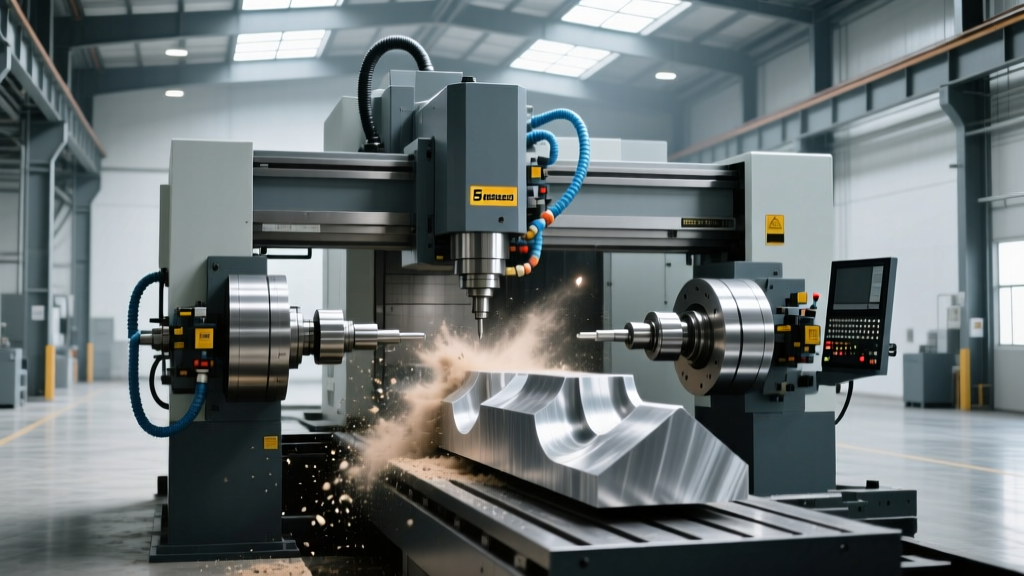
Manufacturing monolithic aerospace structures and organic medical implants demands geometric complexity that exceeds the physical limits of 3-axis mills. While 3-axis machining requires multiple fixture setups to access different part faces, 5-axis CNC machining services utilize simultaneous X, Y, Z, A, and B (or C) axis movements to machine complex contours in a single clamping. This capability eliminates cumulative tolerance stacking, reduces non-cut time, and allows for optimal tool orientation to maintain constant chip thickness.
The decision to leverage 5-axis capabilities is rarely about simple convenience; it is an economic and metallurgical necessity for high-value alloys. When machining work-hardening materials like Inconel 718 or galling-prone titanium alloys, maintaining continuous tool engagement via 5-axis kinematics prevents the dwell times that lead to rapid insert failure and scrapped components.
Data Highlight: The Setup Multiplier Effect
Transitioning a complex aerospace structural bracket from a 3-axis VMC to a 5-axis HMC typically increases the hourly machine rate from $95 to $165. However, because 5-axis machining reduces required setups from four to one, total cycle time drops by an average of 58%. The net result is a 32% reduction in cost-per-part and a 70% reduction in work-in-process (WIP) inventory time.
Case Study 1: Inconel 718 Turbine Blisks in Aerospace
The Metallurgical and Geometric Challenge
Turbine blisks (bladed disks) represent one of the most demanding applications for 5-axis CNC machining services. Machined from a solid forging of Inconel 718, the deep, narrow channels between the airfoils restrict tool access and limit coolant flow. Inconel 718 retains high strength at elevated temperatures and work-hardens rapidly if the cutting tool dwells or rubs against the surface. According to Sandvik Coromant's superalloy milling guidelines, maintaining a strict chip thickness is critical to prevent the cutting edge from plowing the material, which generates excessive heat and accelerates notch wear.
5-Axis Toolpath and Parameter Optimization
To machine a 450mm diameter blisk, a Tier 1 aerospace supplier utilized a Hermle C 42 U 5-axis machining center equipped with a 15,000 RPM spindle and high-torque direct-drive torque motors. The CAM programming, executed in Siemens NX, relied on 5-axis swarf milling for the airfoil flanks and 5-axis point milling for the hub contours.
- Tooling: 12mm solid carbide end mills with an AlCrN (Aluminum Chromium Nitride) coating to resist thermal diffusion.
- Spindle Speed: Capped at 2,800 RPM to manage the cutting temperature at the shear zone.
- Feed Rate: 0.07 mm/tooth, ensuring the chip was thick enough to carry heat away from the workpiece.
- Coolant Strategy: 70 bar (1,000 psi) through-tool high-pressure coolant to break the stringy Inconel chips and flush them from the deep channels.
By tilting the B-axis by 15 degrees during the roughing passes, the machine maintained a constant tool lead angle, eliminating the zero-degree cutting edge engagement that causes centerline rubbing. This 5-axis intervention increased tool life by 210% compared to previous 3-axis plunge milling attempts and achieved a final surface finish of Ra 0.8 µm on the airfoil profiles.
Comparative Analysis: Setup Reductions in Orthopedic Implants
Medical device manufacturing requires extreme precision, particularly for load-bearing orthopedic implants. The table below illustrates the operational differences between traditional multi-setup machining and advanced 5-axis CNC machining services for a complex titanium spinal cage.
| Metric | 3-Axis VMC (Multi-Setup) | 5-Axis Simultaneous (Single-Setup) |
|---|---|---|
| Fixture Requirements | 3 custom soft jaws + 1 tombstone | 1 standard 5-axis trunnion vise |
| Total Setup Time | 4.5 hours per batch | 45 minutes per batch |
| Tolerance Stacking Risk | High (±0.025mm variance across ops) | Minimal (±0.005mm unified datum) |
| Deburring | Manual, 15 mins/part | In-cycle 5-axis chamfering |
| Scrap Rate | 8.2% | 1.1% |
Case Study 2: Ti-6Al-4V ELI Spinal Cages for Medical Devices
Overcoming RTCP Calibration and Thermal Drift
Titanium Ti-6Al-4V ELI (Extra Low Interstitial) is the standard for spinal fusion cages due to its biocompatibility and modulus of elasticity. However, machining the complex, porous-appearing exterior windows and internal threading of a spinal cage requires flawless 5-axis kinematics. A leading medical contract manufacturer utilized a DMG MORI DMU 50 3rd Generation to produce these implants, leveraging the machine's RTCP (Rotary Tool Center Point) functionality.
RTCP allows the CNC controller to dynamically adjust the linear axes to compensate for rotary axis movements, keeping the tool tip exactly on the programmed path. The primary failure mode in 5-axis medical machining is RTCP calibration error. If the pivot point of the trunnion table is off by even 0.01mm, the resulting toolpath deviation will gouge the convex surfaces of the implant, rendering it non-compliant with FDA surface finish and dimensional regulations.
Process Engineering and In-Cycle Deburring
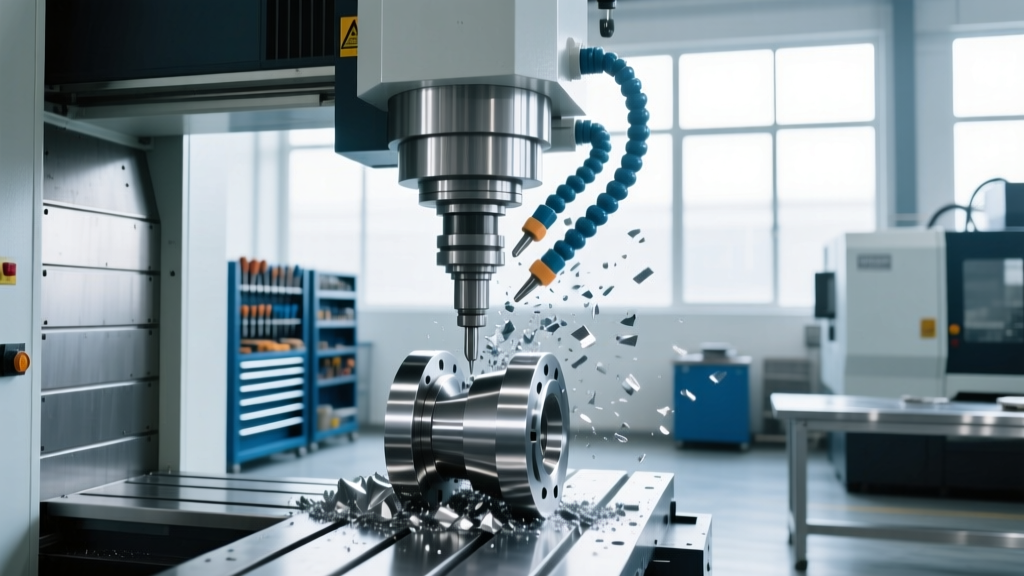
To guarantee precision, the engineering team implemented a proprietary kinematic calibration cycle using a touch probe and a precision calibration sphere, executed every 4 hours to compensate for thermal growth in the Z-axis and rotary bearings. Furthermore, titanium's tendency to form long, stringy chips often leads to recutting and surface blemishes. The manufacturer solved this by programming 5-axis trochoidal toolpaths that maintain a constant radial engagement of 10%, paired with 1000 psi through-spindle coolant. Because FDA guidelines strictly prohibit sharp edges or burrs on implantable devices, the 5-axis capability was used to perform in-cycle deburring. By tilting the A-axis, a 45-degree chamfer mill could access internal window intersections that would be impossible to reach manually, eliminating the secondary hand-finishing step entirely and reducing the total cost per part from $145 to $92.
"The true value of 5-axis CNC machining services in medical manufacturing isn't just about cutting complex shapes; it's about process consolidation. When you eliminate the secondary deburring and inspection steps required by multi-setup 3-axis machining, you remove the human error variable from the FDA validation trail."
— Senior Manufacturing Engineer, Tier 1 Orthopedics Supplier
Decision Framework: In-House vs. Outsourced 5-Axis Services
Determining whether to invest in an in-house 5-axis machining center (typically $450,000 to $850,000+ for a production-grade machine) or to outsource to specialized 5-axis CNC machining services requires a rigorous analysis of part mix, volume, and CAM expertise. Use the following framework to guide capital allocation:
- Evaluate Part Geometry vs. Volume: If your annual volume exceeds 5,000 complex parts with identical geometries, in-house 5-axis machining yields a faster ROI. For high-mix, low-volume (HMLV) production where setups change daily, outsourcing leverages the service provider's existing fixture libraries and CAM template libraries.
- Audit Internal CAM Capabilities: 5-axis programming requires advanced CAM software (e.g., Siemens NX, hyperMILL) and programmers skilled in collision avoidance, tool axis tilting, and RTCP verification. If your current team only possesses 2.5D or 3-axis CAM experience, the 12-to-18-month learning curve will result in high scrap rates and crashed spindles. Outsourcing bridges this gap immediately.
- Analyze Metrology Requirements: 5-axis parts often require 5-axis CMM (Coordinate Measuring Machine) inspection. If your quality lab is equipped only with 3-axis CMMs or optical comparators, you cannot properly validate the complex contours produced by a 5-axis mill. Specialized service providers bundle 5-axis machining with 5-axis CMM inspection and full First Article Inspection (FAI) reports.
For organizations navigating the transition to advanced manufacturing, partnering with established providers allows for rapid prototyping and design-for-manufacturability (DFM) feedback. According to the Society of Manufacturing Engineers (SME), early collaboration with 5-axis service bureaus during the CAD phase can reduce overall production costs by up to 40% by optimizing draft angles, tool access radii, and fixturing datums before metal is ever cut.