Dozer Heavy Equipment Anatomy: Technical Specs & Drivetrain
Explore the technical specifications, drivetrain mechanics, and hydraulic systems of modern dozer heavy equipment for optimal fleet sizing.
The Core Anatomy of Modern Dozer Heavy Equipment
The engineering behind modern dozer heavy equipment has shifted from purely mechanical linkages to highly integrated electro-hydraulic and hydrostatic systems. Understanding the exact technical specifications, powertrain configurations, and undercarriage tolerances is critical for fleet managers and site superintendents who need to match machine capabilities to specific earthmoving applications. A mismatch in drawbar pull, hydraulic flow, or track shoe configuration can result in a 20% to 30% drop in production efficiency and accelerated component wear.
This technical breakdown examines the internal mechanics of mid-to-large class crawler dozers (150 HP to 400 HP), analyzing how torque is transferred from the engine to the blade, and how modern emissions systems impact thermal management and duty cycles.
Baseline Specs: Mid-Class Dozer (200-250 HP Range)
- Operating Weight: 45,000 lbs to 55,000 lbs (20,400 kg to 24,900 kg)
- Net Engine Power: 215 HP to 275 HP (160 kW to 205 kW)
- Implement Pump Flow: 55 to 75 GPM (208 to 284 L/min)
- System Relief Pressure: 3,800 to 4,200 PSI (262 to 290 bar)
- Standard Blade Capacity (S-U): 7.5 to 10.5 cubic yards (5.7 to 8.0 m3)
Drivetrain Mechanics: Powershift vs. Hydrostatic Transmissions
The primary divergence in dozer heavy equipment design lies in the transmission architecture. Manufacturers typically offer either a lock-up torque converter with a powershift transmission or a fully hydrostatic drive (HST). Both have distinct mechanical advantages depending on the material density and cycle distances.
Torque Converter and Powershift Architecture
Machines like the Caterpillar D8 utilize a fully automatic powershift transmission paired with a torque converter. The torque converter provides torque multiplication at stall (typically a 2.5:1 ratio), allowing the engine to lug down and multiply output torque when hitting hardpan or heavy clay. Modern iterations feature a lock-up clutch that engages once the machine reaches travel speed, eliminating slip and improving fuel efficiency by up to 18%. The planetary gear sets provide distinct speed ranges (usually 4 forward, 3 reverse), requiring the operator or auto-shift algorithm to manage gear selection to keep the engine in its optimal power band (typically 1,600 to 1,800 RPM).
Hydrostatic Drive (HST) Systems
Conversely, Komatsu's hydrostatic drive dozers utilize variable-displacement axial piston pumps and motors. HST systems provide infinitely variable ground speeds from zero to maximum without gear shifting. The mechanical advantage here is precise speed control during slot dozing and grading. Because there is no torque converter slip, HST dozers deliver maximum drawbar pull at very low speeds, making them highly efficient for short-cycle, high-resistance ripping and pushing applications.
| Feature | Powershift (Torque Converter) | Hydrostatic Drive (HST) |
|---|---|---|
| Speed Selection | Discrete Gears (Auto/Manual Shift) | Infinitely Variable |
| Stall Torque Multiplication | High (2.2:1 to 2.8:1 ratio) | N/A (Direct hydraulic pressure) |
| Best Application | Long-distance push, high travel speeds | Short-cycle slot dozing, precise grading |
| Drivetrain Efficiency | Higher at top speed (lock-up engaged) | Higher at low/medium speeds (no slip) |
| Maintenance Complexity | Moderate (Planetary gear wear, clutches) | High (Requires ultra-clean hydraulic fluid) |
Undercarriage Engineering and Wear Tolerances
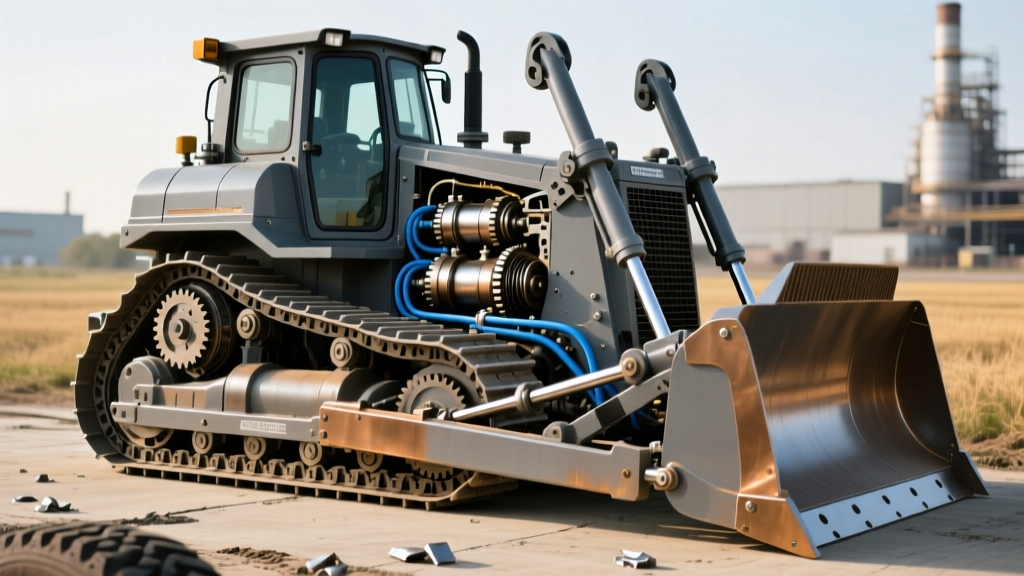
The undercarriage accounts for up to 50% of a crawler dozer's total repair and maintenance budget. Understanding the kinematics of the track chain and the precise wear tolerances is essential for preventing catastrophic failures. Modern dozer heavy equipment relies heavily on Sealed and Lubricated Track (SALT) or SystemOne-style rotating bushing designs to extend internal pin life.
Track Pitch Elongation and Sprocket Engagement
As the internal bushings and pins wear, the overall length of the track chain increases—a phenomenon known as pitch elongation. Standard track pitch on a 200-class dozer is roughly 8.1 inches (206 mm). When wear causes the pitch to elongate by just 1.5% to 2%, the track chain no longer seats properly in the drive sprocket. This causes the track to 'ride up' on the sprocket teeth, accelerating sprocket wear and increasing the risk of track derailment under heavy side-loading.
CRITICAL MAINTENANCE WARNING: Never over-tension tracks to compensate for pitch elongation. Over-greasing the track adjuster cylinder increases internal pressure on the front idler bearings and recoil springs. This will blow out the idler seals, leading to rapid idler failure and potentially bending the recoil spring assembly—a repair that frequently exceeds $4,500 per side in parts and labor alone.Track Shoe Selection Framework
Selecting the correct track shoe is dictated by ground pressure requirements and material abrasiveness.
- Single Grouser (Standard): 24 to 28 inches wide. Features a deep V-grouser for maximum penetration and traction in hard-packed soils and rock. Highest ground pressure (8-12 PSI).
- Double Grouser: Used in mixed conditions where slightly lower ground pressure is needed without sacrificing all traction. Common on pipeline right-of-way dozers.
- Swamp Pads (Extra Wide): 30 to 40 inches wide. Flat profile with minimal grouser height. Lowers ground pressure to 4-6 PSI for working in peat, mud, or landfill applications. Highly susceptible to bending if used in rocky terrain.
Implement Hydraulics and Blade Kinematics
The implement hydraulic system on modern dozer heavy equipment utilizes load-sensing, variable-displacement axial piston pumps. Unlike older constant-flow gear pumps that dumped excess flow over the relief valve (generating massive parasitic heat), load-sensing systems only generate the exact flow and pressure required by the blade cylinders at any given millisecond.
PAT vs. S-U Blade Hydraulic Demands
The choice of blade dictates the hydraulic architecture. A Semi-Universal (S-U) blade requires only two primary hydraulic circuits: lift and tilt. Conversely, a Power Angle Tilt (PAT) blade requires four simultaneous circuits: lift, tilt, angle, and pitch. To accommodate this, PAT-equipped dozers utilize larger displacement pumps (e.g., 150 cc/rev vs. 85 cc/rev) and additional directional control valves. The hydraulic relief pressure is typically set between 3,800 and 4,200 PSI to ensure the blade can penetrate frost lines or heavily compacted clay without stalling the implement circuit.
According to Caterpillar dozer specifications, advanced electro-hydraulic pilot controls now map joystick movement to valve spool displacement electronically, allowing operators to customize blade response rates and hydraulic flow modulation directly from the cab monitor.
Tier 4 Final Thermal and Emissions Management
The integration of Tier 4 Final and EU Stage V emissions systems has fundamentally altered the thermal packaging of dozer heavy equipment. The combination of Selective Catalytic Reduction (SCR) and Diesel Particulate Filters (DPF) requires precise exhaust gas temperature management.
Interrupting an active DPF regeneration cycle repeatedly by shutting down the engine will cause severe soot loading. In extreme cases, the engine control module (ECM) will derate the engine to 50% power to prevent a thermal runaway event in the exhaust system, effectively halting production until a parked regeneration or dealer-level bake-out is performed.
DEF (Diesel Exhaust Fluid) consumption typically ranges from 3% to 5% of total diesel fuel volume. For a 250 HP dozer consuming 8 gallons of diesel per hour, expect to use approximately 0.25 to 0.4 gallons of DEF per hour. Fleet managers must factor this into their daily fluid logistics, as DEF crystallizes at 12°F (-11°C) and requires heated tanks and lines in cold-weather applications, as outlined by EPA emissions standards documentation.
Procurement and Total Cost of Ownership (TCO)
When spec'ing dozer heavy equipment, evaluating the initial purchase price is insufficient. The True Cost of Ownership must account for hourly operating expenses, which vary wildly based on undercarriage selection and application severity.
Estimated Hourly O&O Costs (200-250 HP Class)
- Fuel Consumption: 7.5 to 9.0 GPH @ $4.25/gal = $31.87 - $38.25 / hr
- DEF Consumption: 0.3 GPH @ $3.50/gal = $1.05 / hr
- Undercarriage Wear Reserve: Standard SALT = $6.50 / hr | Severe Abrasive = $14.00 / hr
- Preventative Maintenance & Lube: $4.25 / hr
- Estimated Total Direct Cost: $43.67 to $57.55 per operating hour (excluding operator labor and capital depreciation).
Specifying a hydrostatic drive for long-distance push applications will increase fuel burn and pump maintenance costs, while spec'ing a powershift for precise, short-cycle trench backfilling will result in excessive transmission clutch wear and operator fatigue. Aligning the technical specifications with the exact site geometry and material density is the only way to protect the machine's ROI over its 10,000 to 15,000 hour first life.