Heavy Equipment Dozer vs Scraper: 2026 Alternatives
Compare the heavy equipment dozer against motor scrapers and wheel loaders. Discover 2026 pricing, production rates, and haul distance thresholds.
The 300-Foot Rule: Defining the Economic Haul Distance
Selecting earthmoving machinery hinges on a single, unforgiving metric: the economic haul distance. While a heavy equipment dozer is the undisputed king of short-distance push loading and site preparation, its efficiency degrades exponentially once material must be moved beyond 300 feet. Conversely, motor scrapers and large wheel loaders suffer from high mobilization costs and poor maneuverability in tight, sub-300-foot footprints. Understanding the exact crossover points between these machines is the difference between a profitable 2026 earthmoving contract and a margin-destroying equipment mismatch.
Quick Asset Selection Matrix:- 0 - 300 feet: Heavy Equipment Dozer (Lowest cost per Bank Cubic Yard)
- 300 - 3,000 feet: Motor Scraper (Optimal balance of speed and capacity)
- 3,000+ feet: Articulated Dump Trucks (ADTs) or Rigid Haulers paired with Excavators/Loaders
Heavy Equipment Dozer Profile: 2026 Market Leaders & Costs
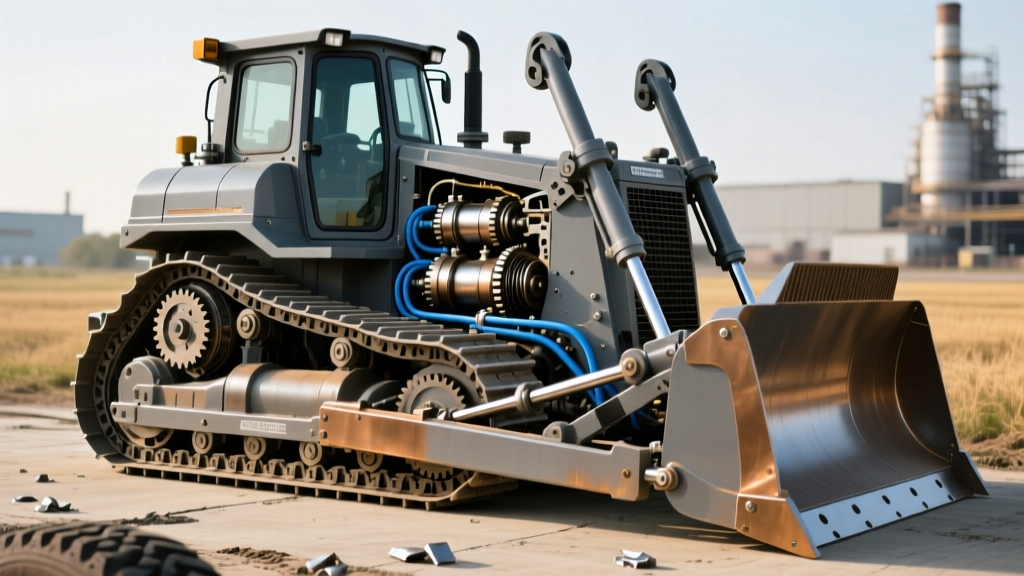
The modern heavy equipment dozer market is dominated by Tier 4 Final / Stage V compliant machines that leverage advanced hydrostatic and automated powershift transmissions to maximize track slip control. According to current Caterpillar dozer specifications, the benchmark mid-size/large dozer segment (300-400 hp) offers the highest versatility for general contractors.
Market Leaders and Pricing Benchmarks
For 2026 procurement, base pricing for heavy-duty dozers in the 80,000 to 95,000 lb operating weight class ranges from $420,000 to $580,000, heavily dependent on undercarriage configuration and technology packages.
- Caterpillar D8: Featuring a 354 hp engine and an operating weight of roughly 85,000 lbs. The D8 utilizes a fully automatic transmission that optimizes engine speed for the load, reducing fuel burn by up to 18% compared to legacy powershift models. Base price: ~$485,000.
- John Deere 1050K: A direct competitor offering 335 hp via a hydrostatic transmission. Hydrostatic drives allow for infinite speed control and dynamic braking, which is highly advantageous in precise grading and soft-underfoot conditions. Base price: ~$440,000 (reference John Deere construction dozers for localized dealer pricing).
- Komatsu D155AX-8: Weighing in at 88,000 lbs with 354 hp, this model features Komatsu’s SIGMA blade, which increases dozing capacity by 10% without requiring additional horsepower.
The Hidden Cost: Undercarriage Wear
When analyzing dozer alternatives, operators frequently underestimate undercarriage depreciation. A heavy equipment dozer operating in highly abrasive materials (like shot rock or decomposed granite) will consume $40,000 to $65,000 in undercarriage components (pads, chains, sprockets, idlers) every 4,000 to 6,000 hours. Scrapers and wheel loaders, relying on rubber tires, shift this cost to tire replacement, which is generally cheaper per hour in abrasive conditions but highly vulnerable to punctures.
Blade Configuration: S vs. SU vs. U
The blade attached to the dozer dictates its production rate and material retention. Selecting the wrong blade negates the machine's inherent pushing power.
- Straight (S) Blade: Best for hard, compacted soils and fine grading. Lacks side wings, resulting in material spillage during high-volume pushes.
- Semi-Universal (SU) Blade: The industry standard for general earthmoving. Features short wings that retain material without sacrificing the penetration force of a straight blade. Ideal for mixed soils and clay.
- Universal (U) Blade: Features massive side wings designed to push large volumes of light, low-density materials (coal, woodchips, loose topsoil). Using a U-blade in hard clay will cause the blade to ride up and over the material rather than penetrating it.
The Primary Alternative: Motor Scrapers for Mid-Range Hauls
When the haul distance exceeds 300 feet, the heavy equipment dozer becomes economically unviable due to its slow travel speed (typically capped at 6-8 mph). The motor scraper is the direct alternative for distances up to 3,000 feet.
A machine like the Cat 637K Twin Engine Scraper (approx. 650 total hp, 44 cubic yard heaped capacity) can load itself in roughly 45 seconds and travel at speeds up to 32 mph. While a single dozer might cost $500,000, a twin-engine scraper easily exceeds $1.2 million. However, the scraper's cost per Bank Cubic Yard (BCY) drops significantly over longer distances because it eliminates the need for a separate loading tool (like an excavator) and a separate hauling tool (like an ADT).
Warning: The Push-Loading RequirementMost conventional motor scrapers cannot self-load efficiently in hard or dense soils. They require a heavy equipment dozer to "push-load" them from behind during the cutting phase. If your site lacks the space for a dozer to maneuver behind the scraper, you must upgrade to an elevating scraper, which uses an internal elevator to self-load, albeit at a 20% reduction in overall capacity and a higher initial purchase price.
The Secondary Alternative: Large Wheel Loaders
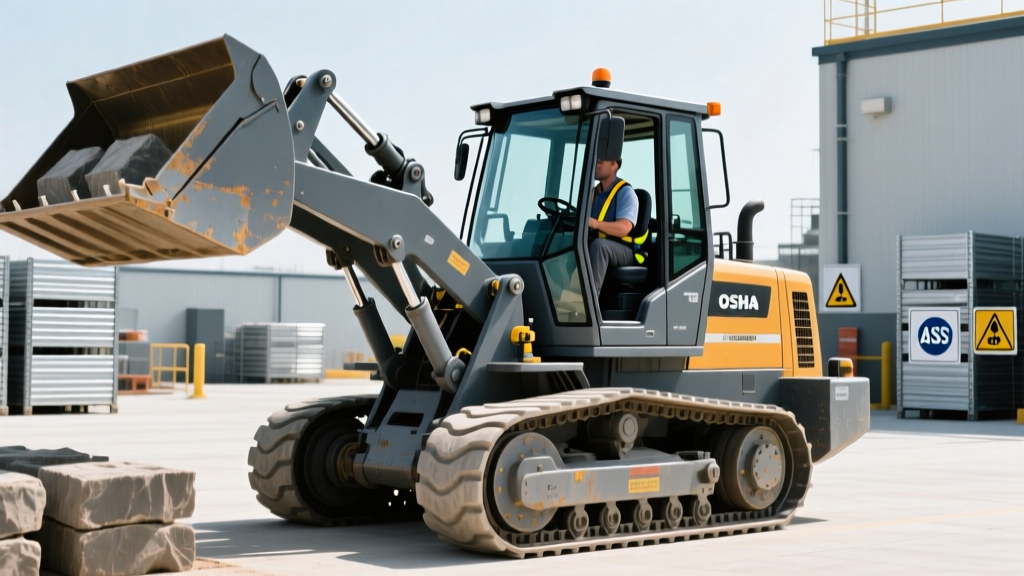
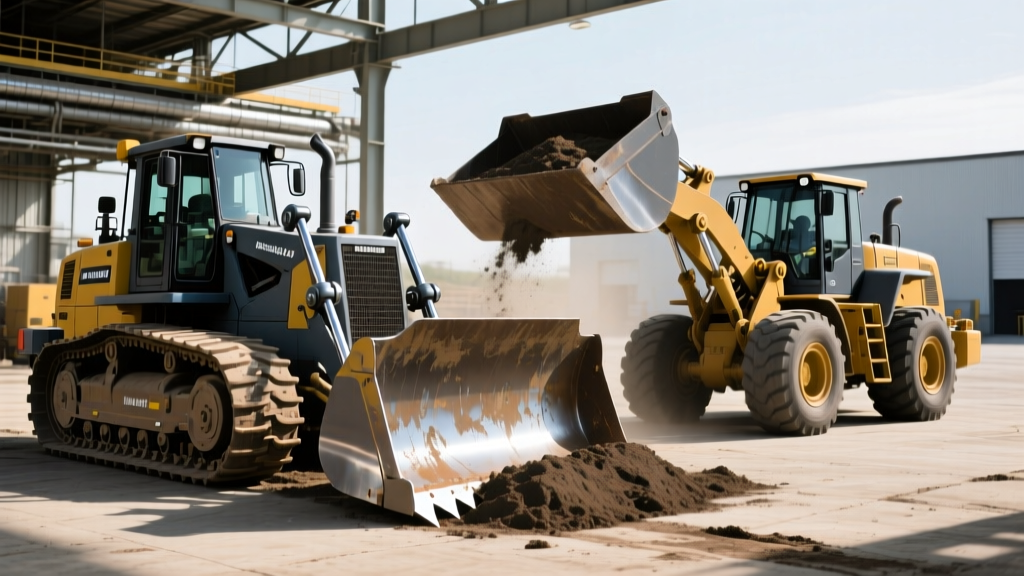
For operations that require high mobility, frequent travel over paved or finished surfaces, and precise load-out capabilities (such as feeding a hopper or loading trucks), large wheel loaders (e.g., Cat 980 XE or Volvo L150H) serve as a versatile alternative to dozers.
While a wheel loader cannot push-load or grade like a dozer, its articulated steering and high travel speeds make it superior for stockpile management and load-and-carry operations up to 500 feet. The primary trade-off is ground pressure: a 50,000 lb wheel loader exerts immense point-load pressure through its tires, causing it to sink in wet clay, whereas an 85,000 lb dozer distributes its weight across tracks, yielding a ground pressure as low as 6 to 9 psi.
Production & Cost Comparison Matrix
| Metric | Heavy Equipment Dozer (e.g., Cat D8) | Motor Scraper (e.g., Cat 637K) | Large Wheel Loader (e.g., Cat 980) |
|---|---|---|---|
| Optimal Haul Distance | 0 - 300 ft | 300 - 3,000 ft | 50 - 500 ft (Load & Carry) |
| Approx. Base Price (2026) | $440,000 - $580,000 | $1,100,000 - $1,400,000 | $650,000 - $800,000 |
| Ground Pressure | Low (6 - 10 psi) | High (Tire dependent) | Very High (Point load) |
| Primary Wear Component | Steel Undercarriage | Cutting Edges & Tires | Tires & Bucket Pins |
| Best Application | Bulk pushing, rough grading, ripping | High-volume mid-distance earthmoving | Stockpiling, truck loading, hopper feeding |
Edge Cases: When the Heavy Equipment Dozer Fails
Despite its versatility, deploying a dozer in the wrong scenario will rapidly destroy profit margins. Avoid utilizing a heavy equipment dozer in the following conditions:
1. Hauling Over Finished Surfaces
Steel tracks will pulverize asphalt and finished concrete. If the project requires moving material across existing roadways or paved staging areas, a dozer is strictly prohibited unless equipped with specialized (and highly expensive) rubber track pads, which reduce traction and increase wear rates.
2. High-Moisture, Low-Density Muck
While dozers have excellent flotation, standard SU blades will simply slice through liquid muck or high-water-content peat without pushing it. In dredging or wetland reclamation scenarios, specialized environmental blades or amphibious excavators are required.
3. Precise Trenching or Deep Excavation
A dozer can only push material at or slightly below ground level. Attempting to dig deep foundations or trenches with a dozer results in severe track spin, undercarriage trenching, and an inability to maintain a level cutting plane. Excavators or backhoes are mandatory for sub-grade excavation.
Final Procurement Framework: Calculating $/BCY
Before finalizing a rental or purchase agreement, calculate the estimated Cost per Bank Cubic Yard ($/BCY) for your specific site parameters. Use this formula:
Total Hourly Machine Cost (Ownership + Operating + Labor) / Estimated Hourly Production (in BCY) = $/BCY
For a 2026 Cat D8 operating at an hourly cost of roughly $185 (including fuel, DEF, undercarriage depreciation, and operator wages), pushing loose earth at 250 feet with a cycle time of 2.5 minutes, the hourly production might be 350 BCY. This yields a highly profitable $0.52 per BCY. If that same machine is forced to push material 800 feet, cycle times triple, production drops to 110 BCY, and the cost skyrockets to $1.68 per BCY—at which point, renting a motor scraper at $1.10 per BCY becomes the mathematically superior alternative.