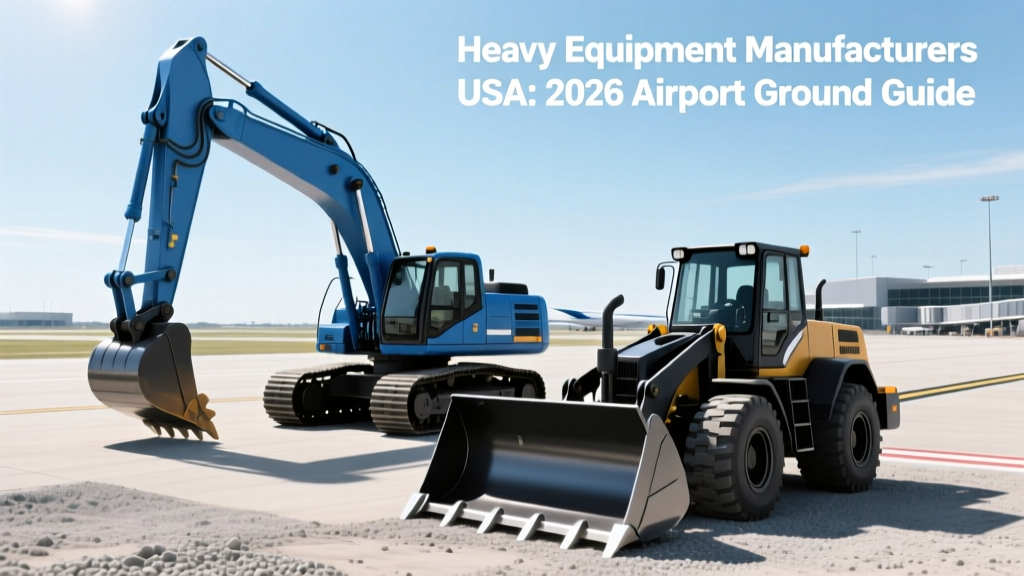
Heavy Equipment Manufacturers USA: 2026 Airport Ground Guide
Compare top heavy equipment manufacturers USA for airport ground support. 2026 buying guide covering eGSE specs, TCO, and FAA grant compliance.
The Shift to eGSE: Why USA Airports Are Overhauling Fleets
Airport ground support equipment (GSE) represents some of the most specialized heavy machinery in the aviation sector. Unlike standard construction or agricultural equipment, GSE must operate in high-stakes, high-density environments where a single mechanical failure can cascade into thousands of dollars in airline delay penalties. As of 2026, the defining trend in this sector is the aggressive transition to electric GSE (eGSE), driven by strict emissions mandates at major hubs like LAX, JFK, and SFO.
2026 eGSE Market Data Highlight- Market Penetration: 68% of new pushback tractor orders in North America are now fully electric, up from 42% in 2023.
- Battery Chemistry: Lithium Iron Phosphate (LFP) has overtaken NMC due to superior thermal stability and a 4,000+ cycle life.
- Cold Weather Derating: Operators in regions like Chicago O'Hare must specify integrated battery thermal management systems (BTMS), which add roughly $18,000 to the base unit cost but prevent 30% capacity loss in sub-zero temperatures.
Evaluating the Market: Domestic Supply Chain Advantages
Procurement teams often begin their RFP process by filtering for heavy equipment manufacturers USA to ensure compliance with Buy American Act provisions required for FAA-funded infrastructure projects. Sourcing domestically also mitigates the severe lead-time volatility that plagued international supply chains over the last five years. Below is a technical breakdown of the top domestic manufacturers dominating the 2026 airport heavy equipment landscape.
1. JBT AeroTech: Heavy Pushback and De-Icing Dominance
JBT AeroTech remains the benchmark for heavy-duty aircraft movement. Their Commander series pushback tractors are the industry standard for narrow-body and wide-body aircraft. The 2026 Commander 150E (electric) features a proprietary AC drive system that delivers 15,000 lbs of continuous drawbar pull without the torque degradation seen in older DC motor setups. For wide-body operations, the Commander 300E utilizes a dual-motor configuration to achieve 45,000 lbs of drawbar pull, sufficient for moving a fully loaded Boeing 777-300ER on a 2% incline.
Expert Insight: When specifying JBT electric tractors for humid environments (e.g., Miami or Houston), request the optional IP67-rated battery enclosure. Standard IP65 enclosures can suffer condensation buildup during rapid temperature shifts between air-conditioned hangars and outdoor tarmacs.
2. Textron GSE: Baggage and Tow Tractor Workhorses
Textron Specialized Vehicles focuses on the high-cycle, lower-weight segment of GSE. Their Premier TMX-150 tow tractor is ubiquitous in baggage handling operations. The 2026 electric iteration utilizes a 48V LFP battery pack that supports opportunity charging—a critical feature for baggage tugs that run 18-hour shifts. The TMX-150E can recoup 30% of its charge during a standard 45-minute driver break using high-amperage DC fast chargers, eliminating the need for battery swap-outs.
3. Tronair: Heavy Lifting and Hydraulic Jacking
While JBT and Textron handle horizontal movement, Tronair (headquartered in Ohio) engineers the heavy lifting equipment required for landing gear maintenance and engine changes. Their 7000-series hydraulic jacks are rated up to 100 tons. The 2026 models feature closed-loop electro-hydraulic controls that maintain lifting precision within 0.05 inches, a mandatory tolerance when jacking modern composite-wing aircraft like the Airbus A350 to prevent fuselage torsion stress.
Equipment Selection Matrix: Matching Specs to Aircraft Class
Selecting the wrong drawbar pull rating results in either underpowered equipment that stalls on wet tarmacs or over-specified machinery that wastes capital and damages aircraft nose gears. Use this matrix to align your procurement with your terminal's fleet mix.
| Aircraft Class | Max Takeoff Weight (MTOW) | Required Drawbar Pull | Recommended USA Model (2026) |
|---|---|---|---|
| Regional Jet (CRJ-900, E175) | < 100,000 lbs | 6,000 - 8,000 lbs | Textron Premier TMX-50E |
| Narrow-Body (A320, B737 MAX) | 100,000 - 190,000 lbs | 12,000 - 18,000 lbs | JBT Commander 150E |
| Wide-Body (B787, A330) | 300,000 - 500,000 lbs | 25,000 - 35,000 lbs | JBT Commander 200E |
| Heavy Wide-Body (B777, A380) | > 600,000 lbs | 40,000 - 55,000 lbs | JBT Commander 300E |
Total Cost of Ownership (TCO): Diesel vs. Electric Pushback Tractors
The capital expenditure (CapEx) for eGSE is undeniably higher, but the operational expenditure (OpEx) inversion typically occurs before the midpoint of the equipment's 10-year lifecycle. Below is a realistic 2026 TCO breakdown for a narrow-body pushback tractor operating 3,500 pushbacks annually.
Diesel (JBT Commander 150D)
- Base CapEx: $185,000
- Annual Fuel (Ultra-Low Sulfur): $14,800
- Annual Maintenance (DEF, filters, transmission): $9,200
- 10-Year OpEx: $240,000
- 10-Year Total Cost: $425,000
Electric (JBT Commander 150E)
- Base CapEx: $295,000
- Annual Energy (Industrial kWh rates): $3,400
- Annual Maintenance (Greasing, software, cooling loops): $2,800
- 10-Year OpEx: $62,000
- 10-Year Total Cost: $357,000
The Verdict: The electric model yields a net savings of $68,000 over 10 years, with a break-even point at year 4.6. However, this calculation assumes the installation of 480V DC fast-charging infrastructure at the gate, which can add $40,000 to $75,000 per charging node depending on existing terminal electrical capacity.
Navigating FAA Grants for GSE Procurement
Because eGSE directly impacts local air quality, USA airports can heavily subsidize these purchases through federal programs. Procurement officers must structure their RFPs to align with specific federal guidelines to unlock these funds.
"Airports that proactively map their GSE replacement cycles to the FAA VALE (Voluntary Airport Low Emission) program criteria can recover up to 50% of the cost differential between diesel and electric equipment, fundamentally altering the CapEx hurdle."
Step-by-Step Procurement Framework for FAA Compliance
- Emissions Baseline Audit: Before issuing an RFP, conduct a localized emissions audit of your current diesel fleet. The Airport Improvement Program (AIP) and VALE grants require quantifiable baseline NOx and PM2.5 data to calculate projected reductions.
- Buy American Certification: Ensure your chosen manufacturer provides explicit certification that the equipment meets the domestic content requirements of the Buy American Act. JBT and Textron maintain dedicated compliance documentation for municipal and airport authorities.
- Infrastructure Load Study: Include a terminal electrical load study in your procurement budget. FAA grants can cover the charging infrastructure, but only if the study proves the local grid can handle the simultaneous charging of multiple 150kWh battery packs without requiring utility-side transformer upgrades.
- Telematics Integration Requirement: Mandate that all new heavy GSE includes API-accessible telematics. Modern grant reporting requires automated, verifiable data on equipment utilization and energy consumption, moving away from manual driver logs.
Final Procurement Directives
Selecting airport ground support heavy equipment in 2026 requires looking past the initial purchase price. The true cost lies in the integration of the machinery into your terminal's electrical grid, the specific thermal demands of your local climate, and the precise drawbar requirements of your dominant airline partners. By leveraging domestic manufacturers and aligning your RFP specifications with federal sustainability grants, airport authorities can modernize their heavy equipment fleets while insulating themselves against the operational volatility of legacy diesel machinery.