2026 Heavy Equipment Wash Pad Costs for Remote-Control Fleets
Analyze 2026 capital and operational costs for building a heavy equipment wash pad tailored to modular and remote-controlled construction fleets.
The Hidden Infrastructure Costs of Washing Autonomous & Modular Iron
The rapid deployment of remote-controlled heavy equipment and modular machinery has fundamentally altered site logistics, but it has also exposed a critical blind spot in fleet maintenance: wash infrastructure. Standard heavy equipment wash pad designs, optimized for high-pressure blasting of monolithic diesel excavators, actively damage the sensitive sensor arrays and exposed modular connection points of modern fleets. When budgeting for a new wash facility in 2026, fleet managers must account for the unique architectural and mechanical requirements of machines like the Cat D11T remote-controlled dozer, Husqvarna DXR demolition robots, and autonomous haul trucks.
Remote-controlled and autonomous machines rely on external LiDAR pods, millimeter-wave radar, and stereo camera arrays. These components are typically rated IP67 or IP69K, meaning they can withstand temporary immersion and high-pressure steam. However, daily exposure to 3,000 PSI pressure wands rapidly degrades seal integrity, leading to moisture ingress and catastrophic navigation faults. Furthermore, modular equipment—designed to be broken down into power packs, booms, and chassis for transport or underground mining—exposes flat-face hydraulic couplers and multi-pin electrical connectors during disassembly. Standard high-pressure washing forces abrasive silica grit directly into these unsealed connection points, causing premature micro-pitting and electrical arcing.
2026 Fleet Maintenance Insight: Replacing a single autonomous LiDAR navigation pod costs between $18,000 and $34,000. A single blown multi-pin harness on a modular Brokk 700 power pack can exceed $12,000. The capital expenditure for a sensor-safe, modular-ready wash pad is routinely justified within the first 14 months of operation purely through avoided electronic component replacements.Capital Expenditure (CapEx) Breakdown: Building an Electronic-Safe Pad
Designing a heavy equipment wash pad for modular and remote fleets requires shifting from a high-pressure, low-volume paradigm to a low-pressure, high-volume, and chemically assisted cleaning model. The pad must also feature dedicated component staging zones with overhead compressed air for drying connection pins before reassembly.
Below is a detailed 2026 CapEx estimate for a 60-foot by 80-foot electronic-safe wash pad engineered to handle a mixed fleet of modular demolition robots and remote-controlled earthmovers. According to agricultural and industrial engineering guidelines from Penn State Extension, proper pad sloping (1% to 2%) and concrete thickness are non-negotiable for heavy point-loads.
| Infrastructure Component | Technical Specification | Estimated 2026 Cost |
|---|---|---|
| Site Prep & Earthwork | Sub-base compaction, 4-inch aggregate base, trenching | $21,500 |
| Concrete Slab & Sealing | 8-inch reinforced (5000 PSI), #4 rebar on 2-ft centers, chemical-resistant epoxy seal | $38,200 |
| API 450 Oil-Water Separator | 500 GPM capacity, coalescing plate packs, heavy solids sump | $26,800 |
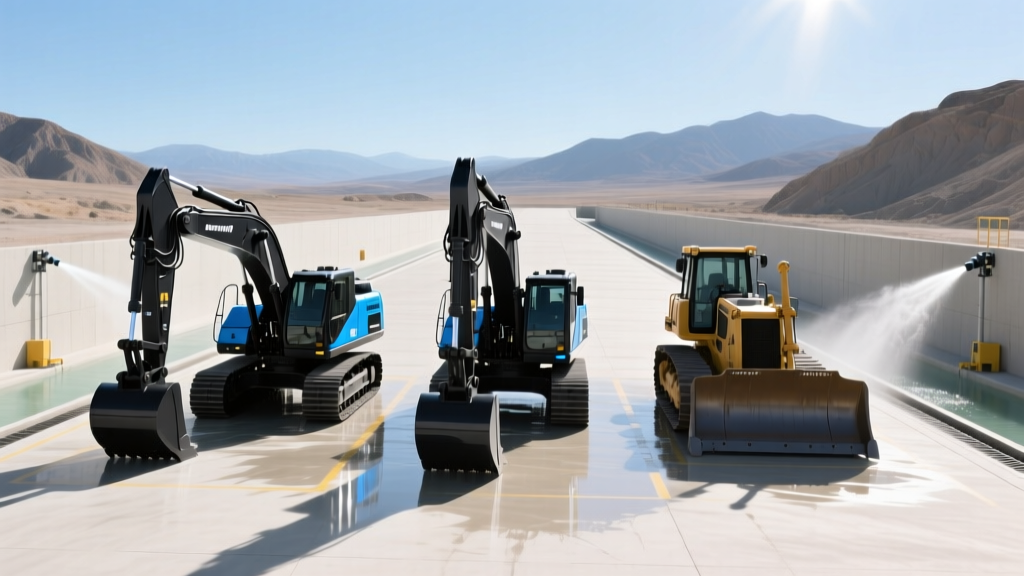
| Low-Pressure Wash Booms (x4) | articulating booms, max 800 PSI, 15 GPM fan nozzles | $16,400 |
| DI Water Generation System | 1,200-gallon storage, dual-bed deionization resin tanks | $22,100 |
| Modular Staging & Dry-Off Zone | Heavy-duty fiberglass grating, overhead 150 CFM compressed air drops | $14,500 |
| Engineering & NPDES Permitting | Hydrological survey, civil engineering, EPA compliance filing | $18,000 |
| Total Estimated CapEx | Turnkey, compliant, sensor-safe facility | $157,500 |
Operational Expenditure (OpEx) and Water Reclamation
The transition to a closed-loop water reclamation system drastically alters the ongoing OpEx profile. For remote-controlled equipment, mineral deposits from hard water on optical sensors and camera lenses cause blindness and algorithmic drift. Therefore, the final rinse phase must utilize Deionized (DI) water.
DI Resin and Consumable Costs
DI water systems require periodic resin bed regeneration or replacement. For a mid-sized mining or demolition contractor washing 15 modular/autonomous units weekly, expect to budget $4,200 annually for DI resin replacement and $3,800 for specialized, non-ionic surfactants that do not leave optical film on LiDAR housings.
Solids Management and Sludge Hauling
Modular equipment often operates in confined, high-silt environments (e.g., underground tunneling, basement excavation). The wash pad's settling pit and API 450 separator will accumulate fine particulate matter rapidly. Budget $1,800 per month for vacuum truck services to evacuate the heavy solids sump, ensuring the coalescing plates do not blind and bypass oil into the municipal discharge or retention pond.
Decision Matrix: Pre-Fab Modular Pads vs. Poured-in-Place
When planning the budget, site managers must choose between traditional poured-in-place concrete and modern pre-fabricated modular wash pads. The decision heavily impacts both upfront capital and long-term site flexibility.
- Poured-in-Place Concrete:
- Pros: Superior longevity (30+ years), handles extreme point-loads of 100-ton autonomous haulers, fully customizable drain placement.
- Cons: High upfront cost, 4-to-6 week curing and installation timeline, permanent site alteration.
- Best For: Permanent mining camps, established heavy civil yards, long-term quarry operations.
- Pre-Fabricated Steel/Composite Pads:
- Pros: Deployable in 72 hours, integrated grating and sump systems, 100% relocatable if the project site shifts.
- Cons: Lower point-load limits (requires load-spreading mats for ultra-class mining trucks), higher maintenance on steel anti-corrosion coatings.
- Best For: Multi-year highway projects, temporary modular mining sites, demolition contractors who rotate yards frequently.
Regulatory Compliance and Environmental Permitting
Washing heavy equipment generates industrial wastewater laden with hydrocarbons, heavy metals, and suspended solids. Discharging this water without treatment violates the Clean Water Act. The EPA's National Pollutant Discharge Elimination System (NPDES) strictly regulates industrial wash water. If your wash pad discharges to a municipal sewer (POTW), you must secure a local industrial pretreatment permit, which often mandates a pH neutralization system (budget an additional $8,500 for automated dosing pumps) to counteract the alkaline nature of heavy-duty degreasers.
If discharging to surface waters or a retention pond, the NPDES permit process requires rigorous baseline water testing and continuous effluent monitoring. Failing to spec an adequately sized oil-water separator—such as undersizing a 250 GPM unit for a pad that actually experiences 400 GPM peak flow during simultaneous washing of two modular rigs—will result in immediate permit violations and fines exceeding $50,000 per incident.
"The most common budgeting failure we see in 2026 is contractors treating a heavy equipment wash pad as a simple concrete slab with a drain. When you introduce remote-control dozers and modular demolition robots, the wash pad becomes a precision maintenance bay. If you do not budget for low-pressure fan nozzles, DI water rinses, and covered component staging grates, your autonomous fleet will spend more time in the shop for sensor recalibration than it does on the dirt." — Director of Fleet Maintenance, Tier-1 North American Earthmoving Contractor
Strategic Budgeting Takeaways for 2026
Allocating funds for a heavy equipment wash pad designed for modular and remote-controlled fleets requires a departure from legacy estimating models. By front-loading capital into sensor-safe wash booms, API-compliant separation technology, and modular component staging zones, operations protect their multi-million-dollar autonomous investments. Ensure your 2026 budget explicitly line-items DI water generation, low-pressure plumbing retrofits, and specialized NPDES permitting to avoid catastrophic downstream operational costs.