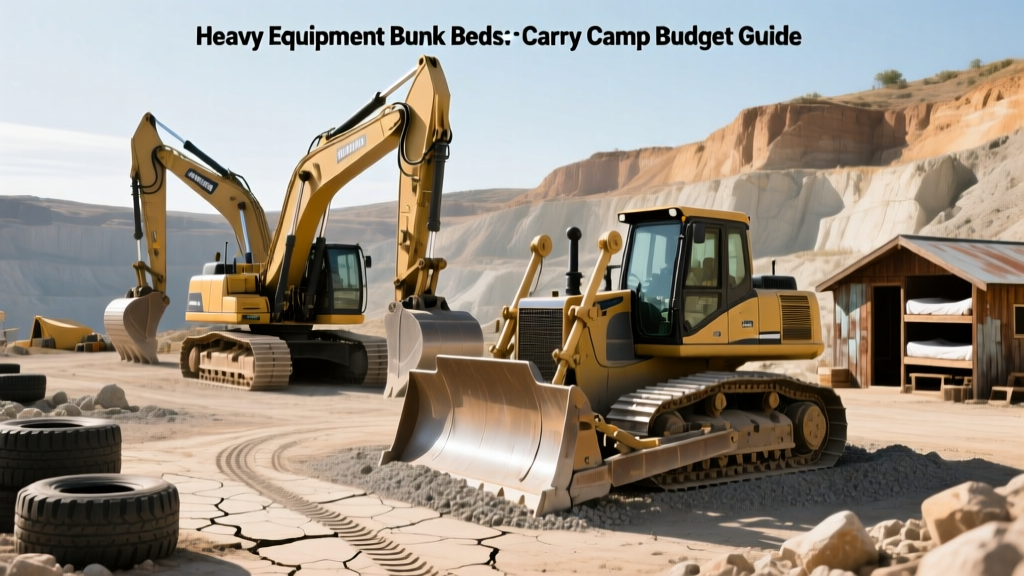
Heavy Equipment Bunk Beds: Quarry Camp Budget Guide
Analyze the true cost of heavy equipment bunk beds for remote quarry camps. Compare industrial specs, MSHA compliance, and aggregate fleet ROI.
The CapEx Blind Spot in Remote Quarry Operations
Remote limestone, granite, and basalt quarry operations rely on continuous 24/7 cycles to justify the massive capital expenditure of modern aggregate processing equipment. A single high-tonnage crushing spread—featuring primary jaw crushers, secondary cone crushers, and multi-deck vibrating screens—can easily exceed $2.5 million in initial CapEx. To maximize the return on this investment, quarry managers implement rotating shift schedules, necessitating on-site modular ISO container camps for operators and maintenance crews.
When outfitting these remote camps, procurement teams frequently make a critical budgeting error: specifying residential or light-commercial furniture instead of purpose-built heavy equipment bunk beds. This oversight leads to premature furniture failure, sleep disruption for heavy machinery operators, and ultimately, costly fatigue-related downtime on the quarry floor.
Budget Warning: The False Economy of Commercial Beds
Purchasing standard commercial bunk beds at $350 per unit instead of industrial-grade models at $1,100 per unit appears to save $4,500 on a 60-bed camp. However, standard beds typically fail within 8 to 14 months in active quarry environments due to silica dust ingress, low-frequency vibration fatigue, and structural overloading. The resulting replacement costs, combined with operator fatigue incidents near heavy machinery, erase the initial savings within the first quarter of operation.
Environmental Stressors Near Aggregate Processing Zones
To accurately budget for camp infrastructure, procurement managers must understand the specific environmental stressors generated by quarry and aggregate processing equipment. Camps are often situated 300 to 800 meters from the primary processing plant to minimize land acquisition costs, placing them directly in the path of industrial disturbances.
Low-Frequency Vibration Transfer
Equipment such as Metso Outotec Lokotrack mobile crushers and large-scale vibrating screens generate continuous low-frequency seismic vibrations. Unlike high-frequency noise, these ground-borne vibrations travel through the soil and into the structural foundations of modular camp buildings. Standard bunk beds, which rely on bolted joints and thin tubular steel, begin to rattle and squeak within weeks as the vibration loosens fasteners. Heavy equipment bunk beds mitigate this through continuous MIG-welded A36 carbon steel seams and isolated spring-float bases that decouple the frame from the floor structure.
Respirable Crystalline Silica (RCS) and Dust Ingress
Quarry environments are inherently dusty. While modern processing plants utilize wet suppression and dust collection systems, fine particulate matter inevitably reaches camp perimeters. Standard fabric mattresses and hollow tubular bed frames trap dust, creating long-term health hazards and degrading the sleeping environment. Industrial quarry beds require sealed frame joints and specialized mattress encasements to prevent the accumulation of respirable crystalline silica.
Cost Matrix: Heavy Equipment Bunk Beds vs. Commercial Alternatives
The following matrix breaks down the true cost and specification differences between standard commercial beds and heavy-duty industrial beds designed for mining and aggregate camps. Pricing reflects 2026 industrial supply rates.
| Specification | Light Commercial Bed | Heavy Equipment Bunk Bed (Quarry Spec) |
|---|---|---|
| Frame Material | 18-gauge tubular steel | 14-gauge welded structural steel |
| Weight Capacity (Per Tier) | 250 lbs | 500+ lbs |
| Dust Mitigation | None (open tubular ends) | Welded end-caps, silica-resistant powder coat |
| Vibration Damping | Standard rubber feet | Isolated neoprene spring-float base |
| Mattress Encasement | Standard cotton/poly blend | Sealed TPU (Thermoplastic Polyurethane) |
| Unit Cost (2026) | $350 - $450 | $890 - $1,450 |
| Expected Lifespan | 8 - 14 months | 7 - 10 years |
Budgeting Framework: Integrating Camp Costs with Fleet ROI
Quarry managers must shift the perspective of camp furnishings from a 'facility expense' to an 'equipment utilization enabler.' The financial justification for heavy equipment bunk beds is directly tied to the operational readiness of the heavy machinery fleet.
Calculating the Cost of Operator Fatigue
Consider the operational cost of a Caterpillar 777G haul truck or a Komatsu PC800 excavator working in a high-wall extraction zone. The fully burdened operating cost of these machines, including fuel, maintenance, and depreciation, ranges from $120 to $180 per hour. According to CDC NIOSH fatigue guidelines, sleep deprivation caused by environmental disturbances (like bed squeaking or dust allergies) significantly increases reaction times and microsleeps in heavy machinery operators.
If poor sleep infrastructure leads to just one fatigue-related safety stand-down or minor equipment collision per month—costing an average of $4,500 in downtime, investigation time, and minor repairs—the annual loss is $54,000. Upgrading a 50-man camp with premium heavy equipment bunk beds at a $550 price premium per unit requires a total investment of $27,500. The ROI is achieved in less than six months simply by preventing fatigue-induced operational delays.
Regulatory Compliance: MSHA and OSHA Standards
Budgeting for quarry camps must also account for regulatory compliance. While the Mine Safety and Health Administration (MSHA) primarily focuses on active extraction and processing zones, camp safety falls under overlapping jurisdictions, including OSHA's temporary labor camp standards and local fire codes.
'Under OSHA Standard 1910.142, temporary labor camps must provide beds equipped with clean, sanitary mattresses, and the structural integrity of the furniture must not pose a safety hazard. Furthermore, all textiles and furnishings in high-risk industrial zones must meet stringent fire-retardant standards to prevent rapid flame spread in modular structures.'
Fire Retardancy and Material Specs
When sourcing heavy equipment bunk beds, ensure the budget includes mattresses treated with CAL 117 or NFPA 701 compliant fire retardants. The TPU encasements mentioned earlier not only block silica dust but also serve as a liquid and biohazard barrier, allowing camp janitorial staff to sanitize beds with industrial bleach solutions between shift rotations without degrading the mattress core. Budget approximately $45 to $65 per replacement TPU cover for the 5-year maintenance cycle.
Procurement Checklist for Quarry Camp Outfitting
To ensure procurement teams secure the correct specifications without falling victim to misleading supplier marketing, use this checklist when requesting quotes for heavy equipment bunk beds:
- Verify Weld Integrity: Demand X-ray or visual inspection certificates for all load-bearing joints. Bolted assemblies will fail under low-frequency crusher vibration.
- Specify Powder Coating Thickness: Require a minimum 2.0 mil polyester powder coat finish to resist corrosion from high humidity and airborne alkaline dust common in limestone quarries.
- Demand Foam Density Data: Mattresses must be high-density polyurethane (minimum 2.5 lb/ft³ density). Standard 1.5 lb/ft³ foam will permanently compress within 90 days under the weight of operators wearing heavy work gear.
- Check Guardrail Clearance: Ensure top-tier guardrails comply with MSHA safety guidelines for fall prevention, extending at least 5 inches above the top of the mattress surface, accounting for the specific mattress thickness you are ordering.
- Request Vibration Dampening Pads: If the supplier does not offer integrated spring-float bases, budget $35 per bed for aftermarket industrial neoprene isolation pads to place under the bed legs.
Final ROI Assessment for Quarry Managers
Outfitting a remote aggregate processing camp is a complex logistical challenge, but the sleeping infrastructure directly dictates the human performance required to operate multi-million-dollar crushing spreads safely. By allocating the correct budget for heavy equipment bunk beds—factoring in 14-gauge steel construction, vibration isolation, and silica-proof mattress encasements—quarry operators protect their most valuable asset: the alert, rested heavy equipment operator. The upfront premium of $890 to $1,450 per unit is not a facility expense; it is a critical risk-mitigation investment that safeguards fleet uptime and ensures compliance with rigorous industrial safety standards.