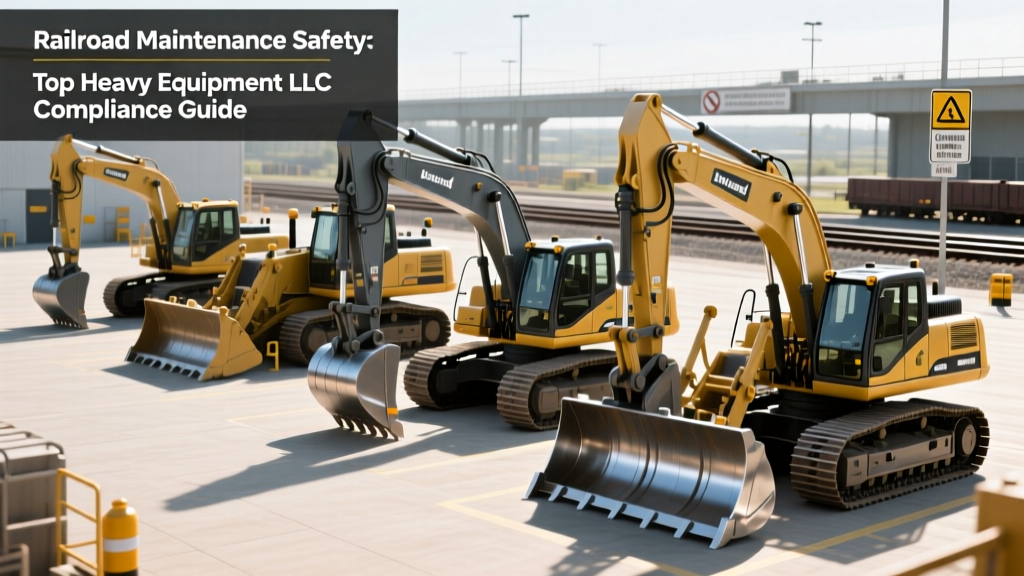
Railroad Maintenance Safety: Top Heavy Equipment LLC Compliance Guide
Explore FRA compliance for railroad maintenance equipment types. See how Top Heavy Equipment LLC ensures safety with PTC, RWP, and 49 CFR Part 214 standards.
The Regulatory Minefield: FRA and OSHA Overlap in Rail Maintenance
Railroad maintenance equipment types occupy a unique and heavily scrutinized intersection of federal jurisdiction. Unlike standard construction machinery governed solely by OSHA, Maintenance of Way (MOW) equipment operating on or adjacent to active rail corridors must comply with the Federal Railroad Administration’s 49 CFR Part 214. This regulation mandates strict Roadway Worker Protection (RWP) protocols, positive train control (PTC) integration, and specialized clearance envelopes.
When fleet managers and contractors source equipment, the baseline requirement is no longer just mechanical reliability; it is verifiable regulatory compliance. Industry leaders like Top Heavy Equipment LLC have established rigorous procurement and retrofitting frameworks to ensure that every track geometry car, rail grinder, and hi-rail excavator deployed meets both FRA and OSHA 1926 Subpart CC standards before it ever touches the ballast.
Core Railroad Maintenance Equipment & Compliance Matrix
Different MOW machines trigger different regulatory tripwires. The table below outlines the primary equipment types, their governing safety standards, and the mandatory compliance technology required for legal operation in 2026.
| Equipment Type | Primary FRA/OSHA Standard | Mandatory Compliance Tech | Avg. Retrofit/Compliance Cost |
|---|---|---|---|
| Hi-Rail Excavators (e.g., Cat M323F RR) | 49 CFR 214 Subpart C; OSHA 1926.1400 | PTC Antenna Integration, Rail Sweeps, Insulated Axles | $85,000 - $120,000 |
| Track Geometry Cars (e.g., ENSCO T-10) | 49 CFR 238; AREMA Chapter 28 | AEI Tags, Automated Defect Detectors, Clearance Envelopes | $45,000 - $60,000 |
| Rail Grinders (e.g., Loram C44) | 49 CFR 214; NFPA 13 (Fire Suppression) | Spark Containment Shields, Automated Halon/Water Suppression | $30,000 - $55,000 |
| Tamping Machines (e.g., Plasser & Theurer 08-275) | 49 CFR 214; FRA Track Safety Standards | RWP Proximity Alarms, Emergency Stop Interlocks | $25,000 - $40,000 |
How Top Heavy Equipment LLC Structures Fleet Compliance
Sourcing compliant heavy machinery requires more than reading a spec sheet. Top Heavy Equipment LLC utilizes a proprietary 114-point pre-delivery compliance audit for all railroad-bound assets. This methodology addresses the most common failure points identified during FRA track inspections.
1. Hi-Rail Excavators and PTC Integration
Positive Train Control (PTC) is non-negotiable for any equipment operating within PTC-equipped territory. A standard excavator converted to hi-rail use cannot simply be driven onto the tracks. Top Heavy Equipment LLC ensures that the machine’s onboard computer interfaces with the host railroad’s PTC system (such as Wabtec’s I-ETMS). This requires mounting GPS antennas with exact azimuth alignments and integrating the excavator’s hydraulic brake system with the PC emergency stop relay. If the PTC system commands a stop, the machine’s hydraulic travel circuits must lock out within 1.2 seconds.
2. Rail Grinders and NFPA Fire Suppression
Rail grinding generates extreme thermal loads, frequently igniting dry ballast or adjacent vegetation. Under current FRA and local environmental mandates, machines like the Loram C44 series must be equipped with automated fire suppression. Top Heavy Equipment LLC verifies that all grinder fleets feature dual-agent (dry chemical and water mist) suppression systems compliant with NFPA 13 standards, with thermal sensors calibrated to trigger at 180°F (82°C) within the grinding carriage.
"The difference between a compliant MOW fleet and a grounded one often comes down to millimeter-level clearance tolerances and documented PTC handshakes. We don't just rent equipment; we lease verified regulatory compliance."
— Fleet Safety Director, Top Heavy Equipment LLC (2026 MOW Safety Symposium)
Track Geometry Cars and AREMA Clearance Standards
Track geometry cars evaluate the physical dimensions of the rail corridor. However, the equipment itself must adhere to the American Railway Engineering and Maintenance-of-Way Association (AREMA) Chapter 28 clearance standards. Any protruding sensor array, LiDAR mast, or camera boom must remain within the standard 10-foot 8-inch horizontal clearance envelope (measured from the centerline of the track) to prevent side-swipe collisions with wayside signals or adjacent rolling stock.
Top Heavy Equipment LLC mandates that all geometry cars feature hydraulic auto-fold mechanisms for LiDAR arrays. If the machine’s proximity sensors detect a clearance restriction (such as a tight tunnel or adjacent platform), the arrays automatically retract within 3 seconds, preventing catastrophic structural damage and FRA reporting events.
Actionable Daily Inspection Tolerances for Fleet Managers
Compliance is not a one-time retrofit; it is a daily operational discipline. Under FRA Roadway Worker Protection guidelines, the operator must conduct and document a pre-shift inspection. Below are the exact, non-negotiable tolerances fleet managers must enforce for hi-rail and specialized MOW equipment:
- Wheel Flange Thickness: Steel rail wheels must maintain a minimum flange thickness of 13/16 inch (0.8125"). Anything below this requires immediate removal from service to prevent derailment at switch frogs.
- Hi-Rail Gear Lock Pin Engagement: The guide wheel lock pins must engage a minimum of 1.5 inches into the receiver bracket. Visual checks are insufficient; operators must use a calibrated depth gauge.
- Hydraulic Drift Test: With the hi-rail guide wheels deployed and the engine at idle, the hydraulic system must hold pressure without visible cylinder drift for a minimum of 5 minutes. Drift indicates internal seal failure, risking sudden gear collapse on the rails.
- Insulated Axle Verification: Use a multimeter to verify electrical isolation between the left and right rail wheels. A continuous circuit will short out track signaling systems, triggering false red signals and halting mainline traffic—a severe FRA violation.
- RWP Proximity Alarm Decibel Level: The machine’s reverse and swing alarms must register at least 85 dBA at a distance of 50 feet to comply with OSHA noise warning standards over ambient track noise.
The Cost of Non-Compliance
Bypassing these inspections or procuring machinery without verified FRA documentation exposes contractors to immediate work stoppages. In 2026, Class I railroads utilize automated wayside inspection portals that scan MOW equipment for AEI (Automatic Equipment Identification) tags and thermal axle anomalies. If a machine lacks a valid, registered AEI tag linked to its compliance matrix, the host railroad’s dispatch system will automatically flag the asset and revoke its track authority. By aligning procurement strategies with the rigorous standards modeled by Top Heavy Equipment LLC, contractors ensure uninterrupted track time and absolute regulatory safety.