Orange Heavy Equipment: Earthmoving Maintenance & Service Guide
Master orange heavy equipment maintenance with exact 500-hour earthmoving service schedules, UV coating care, and hydraulic interval matrices.
High-Visibility Orange: Why Fleets Choose It and How to Protect It
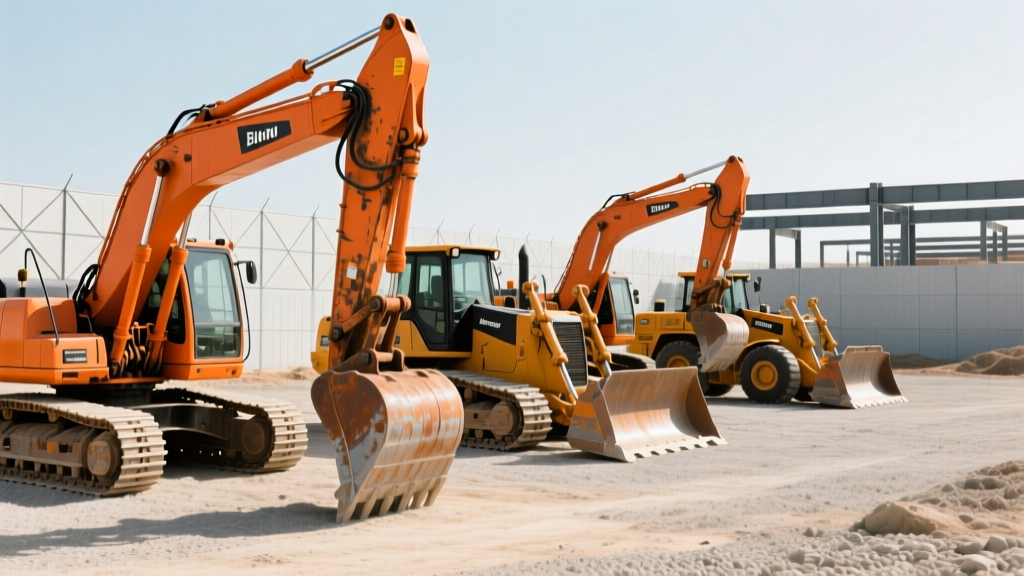
Municipal right-of-way crews, dense forestry operations, and deep-pit mining fleets frequently specify orange heavy equipment to maximize visual contrast against standard construction yellow, gray rock, and green timber. While the safety benefits are proven, the maintenance reality of orange pigments introduces unique service requirements. Standard azo and diketopyrrolopyrrole (PR254) orange pigments are highly susceptible to ultraviolet (UV) degradation. Without rigorous coating maintenance, the clear coat will chalk, the orange base will fade to a dull peach, and the high-visibility safety rating of the earthmover is compromised.
Warning: UV Rot on Hydraulic HosesWhen the UV-blocking clear coat on an orange boom or stick fails, the underlying hydraulic hoses are exposed to direct sunlight. Unprotected rubber hoses lose up to 40% of their tensile strength after 24 months of direct UV exposure, leading to catastrophic blowouts. Inspect hose wraps and boom coatings simultaneously during the 500-hour service interval.
To protect the finish on custom-painted orange earthmovers, fleets must apply a high-grade synthetic polymer sealant (such as PPG Speedokote or equivalent ceramic-infused wax) every 90 days. This preserves the 2K aliphatic polyurethane clear coat. Budget approximately $3,500 to $5,000 per machine every four years for a professional boom and cab spot-repaint to maintain OSHA and MSHA visibility compliance.
Core Earthmoving Applications & Powertrain Intervals
Whether operating a high-vis orange hydraulic excavator for trenching or a wheel loader for stockpiling, the powertrain service schedules remain governed by engine hours and telematics data. Modern 2026 fleet management relies on API CK-4 15W-40 diesel engine oils to protect high-pressure common rail (HPCR) fuel systems found in Tier 4 Final engines.
Hydraulic Excavators (Mass Excavation & Trenching)
For 20-ton to 30-ton class excavators (e.g., custom-painted Volvo EC300E or Komatsu PC210LC variants), the swing circle and boom pivot points endure extreme shock loading. Standard lithium-complex greases are insufficient. Maintenance teams must purge the swing bearing with NLGI #2 Molybdenum Disulfide (Moly) grease every 50 hours. The molybdenum disulfide particles plate the metal surfaces, preventing brinelling (indentation wear) on the swing gear teeth during high-inertia trenching cycles.
Wheel Loaders (Load-and-Carry & Stockpiling)
Orange wheel loaders operating in municipal aggregate yards face severe articulation pivot wear. The center hinge pin and bushings on machines like the Caterpillar 950 GC or John Deere 644L require automatic lubrication system verification every 250 hours. If the auto-lube reservoir runs dry, manual greasing must deliver exactly 12 to 15 strokes per zerk fitting to force out contaminated grit from the articulation seals. Torque specifications for the articulation pivot retaining bolts must be checked annually at 450–500 Nm using a calibrated hydraulic torque wrench.
Fluid & Filter Service Matrix
Adhering to strict fluid intervals prevents the majority of unplanned earthmover downtime. The following matrix outlines the baseline service schedule for heavy earthmoving equipment operating in standard to severe dust environments.
| Interval | System | Action & Specification | Est. Cost (USD) |
|---|---|---|---|
| 250 Hours | Engine Oil | Sample & top-off; check API CK-4 15W-40 level | $45 |
| 500 Hours | Engine & Fuel | Replace engine oil, primary/secondary fuel filters (5-micron) | $350 - $450 |
| 500 Hours | Hydraulics | Replace pilot filter, check ISO VG 46 fluid for water ingress | $120 |
| 1,000 Hours | Swing Drive / Final Drive | Drain and refill with SAE 80W-90 GL-5 gear oil | $200 - $300 |
| 2,000 Hours | Hydraulic Tank | Replace return filter (10-micron), clean tank breather cap | $180 |
| 5,000 Hours | Coolant | Flush OAT (Organic Acid Technology) coolant, replace belts | $600 - $850 |
Undercarriage and Hydraulic Contamination Control
For tracked orange heavy equipment like dozers and excavators, the undercarriage represents up to 50% of total lifetime maintenance costs. Track tension must be calibrated to the specific ground conditions. In soft clay or municipal trenching, tracks should be set slightly loose (allowing 1.5 to 2.0 inches of sag between the front idler and carrier roller) to prevent mud packing, which can snap track chains and damage final drive seals. In hard rock applications, tension must be tightened to 1.0 inch of sag to prevent track slap and link pin wear.
Hydraulic contamination is the silent killer of earthmoving pumps. Modern variable displacement axial piston pumps operate at pressures exceeding 5,000 PSI. At these pressures, a single 15-micron particle of silica can score a valve plate. To combat this, upgrade standard hydraulic tank breathers to 10-micron desiccant breathers with integrated check valves. These cost roughly $85 each but prevent atmospheric moisture and dust from entering the reservoir during the thermal contraction cycle when the machine cools down after a shift.
Fleet managers utilizing 2026 telematics platforms like KOMTRAX or Cat VisionLink can now set automated alerts for hydraulic oil temperature anomalies. If the oil consistently operates above 180°F (82°C), the fluid oxidizes rapidly, turning varnish-like and destroying servo valves. Telematics data allows maintenance teams to schedule hydraulic cooler core blow-outs before catastrophic pump failure occurs.
Tier 4 Final Emissions & DEF System Servicing
Modern earthmovers rely on Selective Catalytic Reduction (SCR) and Diesel Exhaust Fluid (DEF) to meet emissions standards. The EPA's nonroad diesel engine regulations mandate strict NOx reduction, making the SCR system a critical maintenance item. DEF crystallization is the most common failure mode. When operators shut down the engine without allowing the SCR purge cycle to complete (which takes 60 to 120 seconds), residual DEF bakes on the injector nozzle, forming hard white crystals that trigger derate codes.
Every 1,000 hours, the DEF tank must be drained and flushed with distilled water to remove sediment and polymer buildup. The DEF supply module filter, typically located inside the tank or on the chassis rail, must be replaced. Never use shop air to blow out DEF lines, as moisture and oil from standard compressors will instantly contaminate the fluid and destroy the SCR catalyst brick—a replacement cost exceeding $4,500.
Visibility, Decal, and Lighting Upkeep
The primary reason fleets invest in orange heavy equipment is safety and visibility. However, heavy earthmoving applications subject lighting arrays and reflective decals to severe abrasion from flying gravel and brush. According to OSHA earthmoving equipment standards, all cabs and operational zones must maintain adequate lighting and visibility markers for safe site operation.
- LED Work Lights: Inspect polycarbonate lenses for micro-fractures. Once a lens is cracked, moisture ingress will short the LED driver board. Apply a UV-resistant headlight restoration coating annually to prevent lens yellowing.
- Reflective Decals: High-visibility chevrons on the counterweight and boom must be cleaned with a non-abrasive, pH-neutral cleaner. Solvent-based degreasers will strip the retroreflective glass beads embedded in the decal vinyl, rendering them useless at night.
- Backup Alarms: Test broadband (white noise) backup alarms weekly. Broadband alarms are preferred over tonal alarms in municipal environments as they reduce noise pollution complaints while maintaining sharp directional localization for ground workers.
Troubleshooting Edge Cases in Earthmoving Maintenance
Hydraulic Drift on Excavator Booms
If an orange excavator's boom drops more than 1 inch per hour while suspended, the issue is rarely the main control valve. Instead, check the boom holding valve (load check valve) for internal bypassing, or inspect the cylinder piston seals for extrusion caused by operating the machine in extreme cold without adequately warming the ISO VG 46 hydraulic fluid.
Wheel Loader Steering Hesitation
Hesitation or 'kickback' in the articulation steering of a wheel loader usually points to air entrainment in the steering hydraulics. Check the steering pump suction hose for pinhole leaks. A pinhole will not leak oil outward under pressure, but it will suck air inward under vacuum, causing spongy steering and cavitation damage to the steering pump gears.