Underground Mining Heavy Equipment Testing: Real Case Studies
Explore real-world case studies on heavy equipment testing for underground mining machinery, including LHDs, drill jumbos, and haul trucks.
The Crucible of the Subsurface: Why Standard Testing Fails
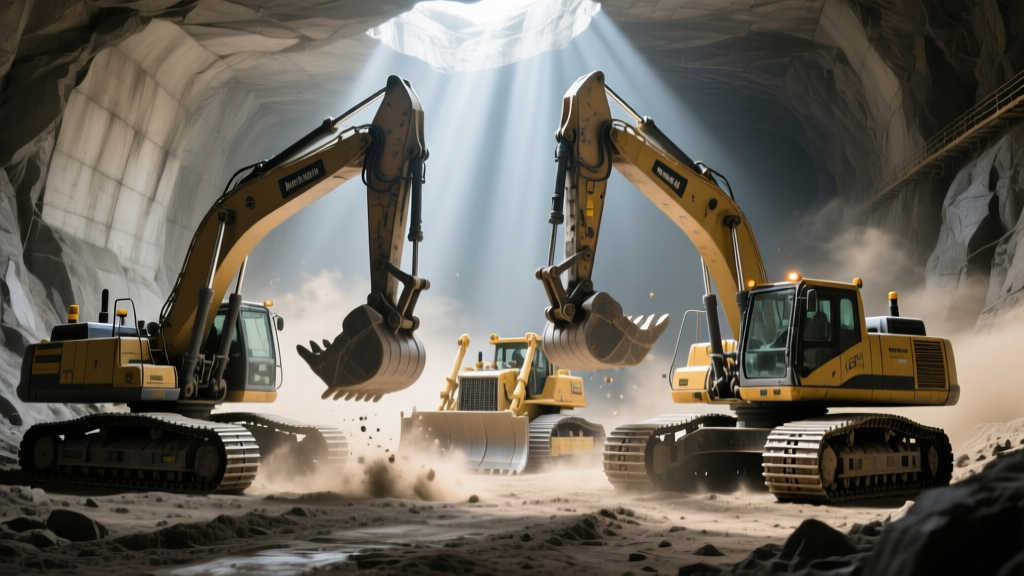
Subsurface environments subject machinery to extreme torsional stress, ambient temperatures exceeding 40°C, and corrosive groundwater. Standard surface-level heavy equipment testing is fundamentally insufficient for underground mining equipment types. The confined geometry of hard-rock tunnels restricts airflow, creating severe thermal soak conditions that rapidly degrade standard elastomers and hydraulic fluids. Furthermore, the abrasive nature of silica dust and fragmented ore accelerates wear on drivetrain components at a rate three to four times faster than surface operations.
According to the Mine Safety and Health Administration (MSHA), all diesel-powered and electrical underground equipment must undergo rigorous approval processes to prevent the ignition of combustible gases and ensure structural integrity. Heavy equipment testing in this sector requires specialized accelerated life testing (ALT) and finite element analysis (FEA) to predict failure modes before a machine ever descends a shaft.
Data Highlight: Unplanned downtime for a primary underground development fleet costs operations between $2,500 and $4,200 per hour in lost production and idle labor. A single catastrophic hydraulic failure in a decline can halt an entire shift, making predictive heavy equipment testing a critical financial imperative.Case Study 1: Sandvik LH650i LHD Thermal & Drivetrain Validation
The Sandvik LH650i is an 18-tonne payload Load Haul Dump (LHD) loader designed for high-volume production. During its validation phase, heavy equipment testing focused heavily on the Cummins QSL9 engine and the integrated transmission under simulated subterranean heat soak conditions. Unlike surface loaders, underground LHDs operate in poorly ventilated headings where ambient temperatures routinely exceed 45°C.
Engineers equipped the LH650i prototype with over 140 strain gauges and thermocouples, logging data via the CAN bus at 100Hz. The primary objective was to map the engine derating curve against transmission oil temperatures during continuous ramping operations (typically a 15% gradient over 2 kilometers). Testing revealed that standard coolant flow rates were insufficient during the 'dump and reverse' cycle, leading to localized boiling in the cylinder head. The engineering team redesigned the water pump impeller and increased the radiator core thickness by 18%, dropping peak operating temperatures by 7°C and extending the expected overhaul interval from 12,000 to 15,000 hours.
| Testing Parameter | Standard Surface Protocol | Underground ALT Protocol |
|---|---|---|
| Ambient Temperature | 25°C (Standard) | 45°C + Radiant Heat Simulation |
| Dust Ingress | ISO 5011 Coarse Dust | Sub-micron Silica & Ore Fines |
| Load Cycling | Flat ground, steady state | 15% gradient, high-torque tramming |
Case Study 2: Epiroc Boomer S2 Drill Jumbo Boom Fatigue Analysis
Drill jumbos like the Epiroc Boomer S2 face extreme cyclic loading. The BUT 36 boom is subjected to continuous extension, retraction, and lateral slewing while the rock drill generates high-frequency percussive vibrations. Heavy equipment testing for the Boomer S2 focused on structural fatigue and hydraulic impulse resistance.
Research supported by the National Institute for Occupational Safety and Health (NIOSH) highlights that whole-body vibration and localized structural resonance are primary drivers of micro-fractures in boom weldments. To address this, Epiroc utilized ultrasonic Non-Destructive Testing (NDT) and magnetic particle inspection on all high-stress pivot joints after subjecting the boom to 1.2 million simulated drilling cycles. The hydraulic system was tested to ISO 6803 standards, requiring the primary boom hoses to survive 1 million impulse cycles at 133% of their 350-bar working pressure without weeping or burst failures.
'In underground drilling, the boom does not just position the drill; it absorbs the reactive shockwave of the percussive head. If the heavy equipment testing does not account for the harmonic resonance between the rock drill frequency and the boom's natural frequency, you will see catastrophic pin failures at 3,000 hours instead of 10,000.'
— Senior Structural Engineer, Mobile Mining Equipment Division
Case Study 3: Caterpillar R1700G Haul Truck ROPS/FOPS Compliance
The Caterpillar R1700G is a 15-tonne payload underground haul truck. Given the inherent risk of rockfalls and vehicle rollovers in confined decline tunnels, the Roll-Over Protective Structure (ROPS) and Falling Object Protective Structure (FOPS) are critical life-saving components. Heavy equipment testing for the R1700G cabin is governed by strict international standards.
Compliance with ISO 3449:2020 dictates that earth-moving machinery protective structures must absorb specific kinetic energy levels without intruding into the operator's deflection-limiting volume (DLV). For a 15-tonne class underground truck, the ROPS must absorb a minimum of 150 kJ of lateral energy. During physical validation, the R1700G cab was mounted to a test bed and subjected to a 30,000 kg lateral pendulum impact, followed by a vertical static load of 196 kN. Strain gauges placed on the cab's A-pillars and roof cross-members confirmed that the high-tensile steel alloy maintained structural elasticity, preventing plastic deformation that could crush the operator during a real-world rollover event.
Warning: A common blind spot in underground equipment commissioning is neglecting the thermal soak phase of hydraulic testing. Filling a system with standard AW46 hydraulic fluid and immediately subjecting it to 350-bar percussive loads at 10°C ambient shaft temperature will cause localized cavitation and pump scoring. Always mandate a 45-minute low-pressure circulation phase to bring fluid viscosity to optimal operating windows before applying full load.Decision Matrix: Matching Testing Protocols to Equipment Types
Selecting the correct heavy equipment testing framework requires aligning the machine's primary function with its most vulnerable subsystems. The matrix below provides a practical decision framework for fleet managers and OEM validation teams.
| Equipment Type | Primary Test Focus | Critical Metric / Standard |
|---|---|---|
| LHD Loaders (e.g., Sandvik LH650i) | Thermal derating, Z-bar linkage torsion, drivetrain heat soak. | Peak transmission temp < 110°C at 15% continuous gradient. |
| Drill Jumbos (e.g., Epiroc Boomer S2) | Boom harmonic resonance, hydraulic impulse fatigue, weldment NDT. | ISO 6803 (1M cycles at 133% pressure); Ultrasonic weld mapping. |
| Haul Trucks (e.g., Cat R1700G) | ROPS/FOPS energy absorption, suspension articulation, braking fade. | ISO 3449:2020 (150 kJ lateral absorption); DLV non-intrusion. |
| Roof Bolters (e.g., Fletcher HDDR-2) | Mast vertical load stability, dust extraction airflow, electrical arcing. | MSHA Part 18 electrical enclosure integrity; 300 CFM dust capture. |
Effective heavy equipment testing in underground mining is not a static checklist; it is a dynamic simulation of the harshest conditions on earth. By mandating accelerated life testing, rigorous thermal validation, and strict adherence to ISO and MSHA structural standards, operators can drastically reduce subsurface downtime and ensure the safety of their underground crews.