Underground Mining Equipment Costs: Rojas Heavy Equipment LLC
Analyze underground mining equipment costs, TCO profiles for LHDs and jumbos, and procurement strategies with Rojas Heavy Equipment LLC.
Subterranean Fleet Economics: Beyond the Sticker Price
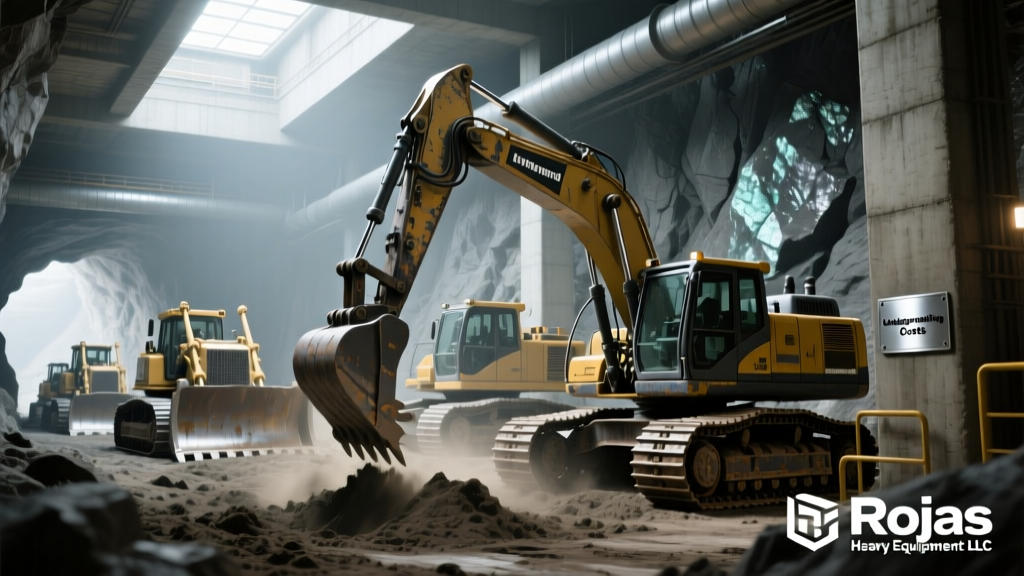
Underground mining requires specialized, low-profile machinery engineered for confined spaces, poor ventilation, and extreme rock mechanics. Budgeting for these assets in 2026 requires a shift from simple capital expenditure (CAPEX) evaluation to rigorous Total Cost of Ownership (TCO) modeling. Subterranean environments accelerate component degradation through geothermal heat, abrasive muck, and high-humidity corrosion. A comprehensive budget must account for the hidden operational expenditures (OPEX) that dictate actual profitability, including ventilation scaling, specialized ground support, and localized dealer network dependencies.
2026 Baseline Market Shift
Battery Electric Vehicle (BEV) adoption in underground hard rock mining has crossed the 35% threshold for new fleet acquisitions. While BEV Load-Haul-Dump (LHD) loaders command a 40% CAPEX premium over diesel equivalents, they eliminate the need for massive diesel-particulate ventilation infrastructure, fundamentally altering the 5-year TCO equation.
Core Underground Equipment Classes & CAPEX Profiles
Allocating capital requires understanding the baseline costs of primary development and production fleets. The following matrix outlines current market pricing for Tier 4 Final and BEV underground machinery.
| Equipment Class | Primary Function | Base CAPEX (Diesel) | Base CAPEX (BEV) | Estimated Lifespan |
|---|---|---|---|---|
| LHD Loader (14-17 tonne) | Load and haul blasted muck | $650,000 - $820,000 | $950,000 - $1.25M | 18,000 - 22,000 hrs |
| Development Drill Jumbo (2-Boom) | Face drilling and bolting | $850,000 - $1.1M | N/A (Diesel/Electric tether) | 20,000 - 25,000 hrs |
| Articulated Dump Truck (40-45t) | Ramp haulage | $550,000 - $700,000 | $800,000 - $1.0M | 20,000 - 24,000 hrs |
| Ground Support Scaler | Scaling loose rock post-blast | $700,000 - $850,000 | N/A | 15,000 - 18,000 hrs |
The Ventilation Trade-Off: Diesel vs. BEV Economics
The most significant budgetary differentiator in underground mining is ventilation. According to NIOSH mining safety and ventilation guidelines, diluting diesel particulate matter (DPM) and nitrogen oxides (NOx) requires massive airflow. The standard regulatory baseline dictates approximately 0.06 cubic meters per second (m³/s) of air per kilowatt of diesel engine power.
For a 250 kW diesel LHD, this requires 15 m³/s of dedicated ventilation. Scaling this across a fleet of 10 loaders necessitates main fan upgrades, larger ventilation shafts, and continuous cooling infrastructure, which can easily add $2.5 million in CAPEX and $400,000 in annual electrical OPEX to the mine plan. BEV loaders, such as the Sandvik Artisan series BEV loaders, generate zero exhaust emissions, allowing operators to downsize primary ventilation shafts and redirect capital toward automated charging infrastructure.
Strategic Procurement: Leveraging Specialists like Rojas Heavy Equipment LLC
Mid-tier mining operations and junior explorers rarely have the capital reserves to absorb $15M+ in new underground fleet CAPEX. Strategic procurement requires leveraging the secondary market and specialized regional distributors to optimize cash flow. When structuring a 2026 fleet expansion, partnering with specialized entities like Rojas Heavy Equipment LLC provides a distinct advantage in localized TCO modeling and asset lifecycle management.
'Procuring certified pre-owned underground loaders or utilizing specialized rebuild programs can reduce initial capital outlay by 35-45%. Regional specialists understand localized supply chain bottlenecks and can secure OEM-backed powertrain warranties on remanufactured units, drastically de-risking the first three years of operation.'
For example, engaging Rojas Heavy Equipment LLC for a fleet audit often reveals that a remanufactured Sandvik LH514, priced between $380,000 and $450,000, yields a faster ROI than a brand-new unit for mines with a remaining life of under five years. Furthermore, dealers like Rojas Heavy Equipment LLC maintain localized inventories of high-wear underground components—such as hardox-lined LHD buckets and heavy-duty tramming motors—reducing equipment downtime from weeks to hours.
Hidden OPEX Traps in Subterranean Operations
Surface mining budgets rarely translate to underground realities. Financial planners must account for the following subterranean failure modes and their associated costs:
1. DPF Coking and Active Regeneration Failures
Underground diesel equipment frequently operates in low-load, high-torque cycles (e.g., tramming up a 1:7 grade ramp). This prevents the exhaust system from reaching the 600°C required for passive Diesel Particulate Filter (DPF) regeneration. The resulting soot coking forces active regeneration cycles that consume excess fuel and degrade engine oil. When a DPF fails catastrophically due to ash loading, replacement costs range from $12,000 to $18,000 per unit. Budgeting for forced DPF baking and chemical cleaning every 1,500 hours is mandatory.
2. Geothermal Hydraulic Degradation
At depths exceeding 1,500 meters, ambient rock temperatures routinely exceed 45°C (113°F). Standard hydraulic hoses and seals blister and extrude under these conditions combined with high system pressures (350+ bar). Operations must budget a 20% premium for specialized 4-spiral wire hydraulic hoses and high-temperature Viton seals, scheduling mandatory hose replacement every 4,000 hours regardless of visual condition to prevent catastrophic hydraulic fires.
3. Cable Tramming Wear (Electric Units)
For electric tethered equipment like development drill jumbos (e.g., the Epiroc Boomer series), the trailing cable is a massive consumable. Constant flexing, dragging over abrasive muck piles, and exposure to blasting flyrock destroys standard cables. A 150-meter, 1000V trailing cable costs upwards of $25,000. Budgeting for two spare cables per jumbo per year is a baseline requirement for uninterrupted development footage.
Leasing vs. Outright Purchase: A Decision Matrix
Choosing between operating leases and outright purchase depends heavily on the mine's proven reserves and the operator's cost of capital. Use the following framework to guide 2026 procurement decisions:
| Financial Scenario | Mine Life | Recommended Strategy | Primary Advantage |
|---|---|---|---|
| High Cost of Capital / Junior Miner | Under 5 Years | Operating Lease (via specialists like Rojas Heavy Equipment LLC) | Preserves cash flow; shifts major rebuild risk to the lessor. |
| Strong Balance Sheet / Major Producer | 10+ Years | Outright Purchase + In-House Rebuild Program | Lowest long-term TCO; complete control over asset customization. |
| Exploration / Early Development | Unknown | Short-Term Rental / Used Acquisition | Maximum flexibility; prevents stranded assets if the ore body fails to prove out. |
Executing the 2026 Budget
Accurate budgeting for underground heavy equipment requires abandoning surface-level assumptions. By modeling the exact ventilation requirements, accounting for geothermal consumable degradation, and leveraging specialized procurement channels like Rojas Heavy Equipment LLC for certified pre-owned assets and localized support, operators can protect their margins against the extreme hidden costs of subterranean extraction.