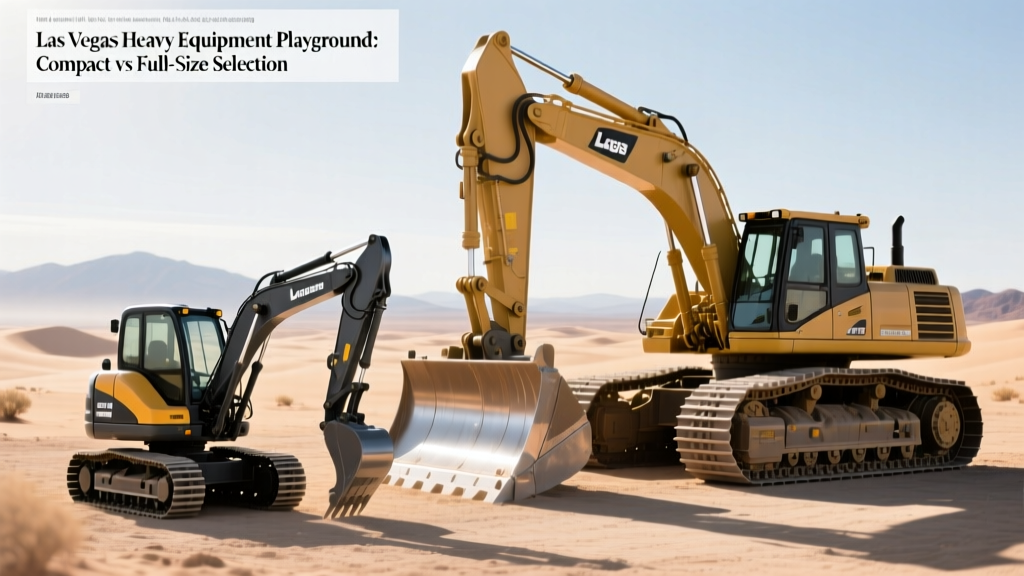
Las Vegas Heavy Equipment Playground: Compact vs Full-Size Selection
Discover how operator training at the Las Vegas heavy equipment playground informs compact vs full-size construction equipment selection and fleet ROI.
The Value of Seat Time: Beyond the Spec Sheet
Fleet managers and lead operators know that brochure specifications rarely tell the whole story. When evaluating the critical decision between compact and full-size construction machinery, there is no substitute for physical, hands-on evaluation. This is exactly why the Las Vegas heavy equipment playground—most notably the sprawling 250-acre outdoor demo grounds at CONEXPO-CON/AGG and specialized regional training facilities—has become the ultimate proving ground for heavy iron.
Selecting the right machine size is not merely a matter of matching bucket capacity to trench depth. It requires a deep understanding of operator ergonomics, hydraulic feedback, transport logistics, and site-specific constraints. By leveraging hands-on testing environments, construction firms can bridge the gap between theoretical fleet planning and real-world operational reality.
💡 Transport Logistics Callout: The CDL ThresholdBefore selecting a compact machine like the Bobcat E35 (operating weight ~7,600 lbs) versus a mid-size rig, calculate your combined Gross Vehicle Weight Rating (GVWR). A 3.5-ton mini excavator on a 14,000-lb trailer behind a heavy-duty pickup keeps you under the 26,001-lb federal threshold, avoiding the need for a Commercial Driver’s License (CDL). Stepping up to a 14-ton model like the Caterpillar 313 instantly mandates a CDL, a lowboy trailer, and specialized transport logistics, drastically altering your mobilization costs.
Operator Feedback: Hydraulics, Swing Torque, and Visibility
At the Las Vegas heavy equipment playground, master trainers focus heavily on how operators physically interact with the machine's hydraulic systems. The transition from compact to full-size equipment involves a massive shift in hydraulic flow, pilot pressure, and swing torque.
The Compact Advantage: Precision in Tight Quarters
Compact equipment, such as the Kubota KX040-4 or Volvo ECR35D, excels in finesse. Operators training on these machines learn to utilize the zero-tail-swing (ZTS) or conventional-tail-swing designs to navigate 8-foot fence lines and urban backyards. The auxiliary hydraulic flow on these machines typically maxes out around 16 to 24 Gallons Per Minute (GPM), which is perfectly calibrated for tilt rotators, hydraulic thumbs, and light breakers. Training best practices dictate that operators master "feathering" the joystick controls on compacts to prevent over-swinging in confined spaces, relying on the machine's lower swing torque (often under 10,000 lb-ft) to make micro-adjustments.
Full-Size Dominance: Production and Reach
Moving to a full-size excavator like the Caterpillar 330 or John Deere 210G LC changes the operator's physical and mental workflow. These machines push auxiliary hydraulic flows well past 80 GPM and generate swing torques exceeding 80,000 lb-ft. In training environments, operators must relearn their spatial awareness; the cab sits nearly 10 feet in the air, creating massive blind spots on the right side and directly behind the counterweight. Best practices require full-size operators to rely heavily on 360-degree camera systems and standardized ground-person communication protocols before initiating a swing cycle.
The Fleet Manager’s Selection Matrix
Choosing between compact and full-size equipment requires a systematic evaluation of job site variables. According to AEMP (Association of Equipment Management Professionals) guidelines, fleet utilization and idle time are the primary destroyers of equipment ROI. Use the matrix below to guide your selection process based on real-world operational constraints.
| Evaluation Metric | Compact Equipment (e.g., 3-5 Ton Excavator) | Full-Size Equipment (e.g., 20-30 Ton Excavator) |
|---|---|---|
| Primary Application | Utility trenching, landscaping, residential plumbing, indoor demolition. | Mass excavation, deep foundations, heavy truck loading, quarry work. |
| Mobilization Cost | Low ($150-$300 per move via standard tow rig). | High ($1,500-$3,500+ per move requiring lowboy and permits). |
| Ground Pressure (PSI) | 4.5 - 6.0 PSI (Ideal for finished turf and soft soils). | 7.5 - 11.0 PSI (Requires engineered mats on soft ground). |
| Hourly Fuel Burn | 1.0 - 1.8 Gallons Per Hour (GPH). | 5.5 - 9.0 Gallons Per Hour (GPH). |
| Operator Skill Floor | Moderate (Forgiving of minor grade errors). | High (Mistakes cause severe safety and financial damage). |
Training Protocols: Transitioning Operators Between Sizes
One of the most dangerous practices in construction is assuming an operator proficient on a 4-ton mini excavator can seamlessly step into a 30-ton production excavator. The kinetic energy and momentum of the full-size upper carriage require entirely different muscle memory. Training programs evaluated at specialized NCCCO-aligned testing facilities utilize a structured step-up protocol.
The 3-Day Size-Transition Protocol
- Day 1: Cab Ergonomics and Blind Spot Mapping. The operator spends four hours in the cab without digging. They practice adjusting the air-ride seat, mapping the ISO/SAE joystick controls, and identifying the exact pivot point of the counterweight. They must successfully identify 15 random blind-spot hazards placed by the instructor.
- Day 2: Hydraulic Modulation and Grade Control. Operators engage in precision trenching using 2D laser or 3D GPS machine control systems. The focus is on boom-and-stick coordination. Full-size machines suffer from "boom drop" when the hydraulics are pushed to their limits; operators learn to use the regenerative hydraulic circuits to maintain smooth, continuous digging cycles without stalling the engine.
- Day 3: Production Loading and Swing Braking. The operator practices loading articulated dump trucks (ADTs). The critical lesson here is swing braking. Stopping a 30-ton excavator's upper carriage abruptly transfers massive shock loads to the swing bearing and pinion gear. Operators are trained to feather the swing pedal to decelerate smoothly, extending the life of the swing drive motor.
When training operators on compact equipment with zero-tail-swing (ZTS) capabilities, instructors must heavily emphasize the rear counterweight clearance. ZTS machines are designed to rotate within their track width, but the counterweight still extends inches beyond the tracks. Operators frequently clip utility poles, fences, or ground personnel when they falsely assume the machine has "zero" rear overhang. Always enforce a strict 15-foot exclusion zone during initial ZTS training.
The 2026 Shift: Battery-Electric Compacts in the Selection Mix
The calculus for compact vs. full-size selection has been fundamentally altered by the maturation of battery-electric compact equipment. At recent industry expos, the proliferation of models like the Volvo ECR25 Electric and the Bobcat E35e has given fleet managers a new tool for specific environments.
When bidding on interior demolition, hospital expansions, or underground utility work where diesel particulate matter (DPM) and carbon monoxide (CO) are strictly regulated, electric compacts eliminate the need for massive, expensive ventilation systems. While a full-size diesel excavator cannot currently operate in these zero-emission zones, a 5-ton electric compact can run a full 8-hour shift on a single charge (or utilize opportunity charging during lunch breaks) while delivering the exact same hydraulic breakout forces as its diesel counterpart. For urban contractors, adding an electric compact to the fleet often wins bids that would otherwise require complex, costly emissions mitigation plans.
Analyzing Total Cost of Ownership (TCO) and Utilization
Ultimately, the decision between compact and full-size equipment must be grounded in financial reality. A common mistake among growing contractors is purchasing a full-size machine to "future-proof" their fleet, only to see it sit idle on smaller residential jobs.
According to CONEXPO-CON/AGG fleet management seminars, a $300,000 full-size excavator requires a minimum of 1,200 to 1,500 billable hours per year to justify its capital expenditure, insurance, and heavy transport costs. Conversely, an $85,000 compact excavator can achieve ROI at just 600 to 800 billable hours annually. If your project pipeline consists of 80% residential utility work and 20% commercial site prep, the mathematically sound decision is to own a fleet of highly utilized compacts and rent full-size machinery for the specific weeks you are performing mass excavation.
Undercarriage Wear: The Hidden Variable
Operators trained at the Las Vegas heavy equipment playground are taught to respect the undercarriage, which accounts for up to 50% of a machine's total lifetime maintenance costs. Full-size machines traveling over abrasive rock or demolition debris will chew through $15,000 sets of tracks and idlers in a matter of months if operators fail to clean the sprockets daily or travel excessively in reverse. Compact machines, with their smaller, cheaper track pads and lower ground pressure, offer a massive financial buffer when working in highly abrasive, high-wear environments.
Finalizing Your Fleet Strategy
The choice between compact and full-size construction equipment is not a binary one; it is a strategic balancing act involving operator skill, site logistics, and capital efficiency. By utilizing hands-on testing environments to evaluate hydraulic feedback, enforcing strict size-transition training protocols, and rigorously analyzing transport and utilization costs, fleet managers can build a balanced lineup that maximizes both safety and profitability. The next time you evaluate a major iron purchase, look past the brochure and demand the seat time necessary to feel the true operational differences.