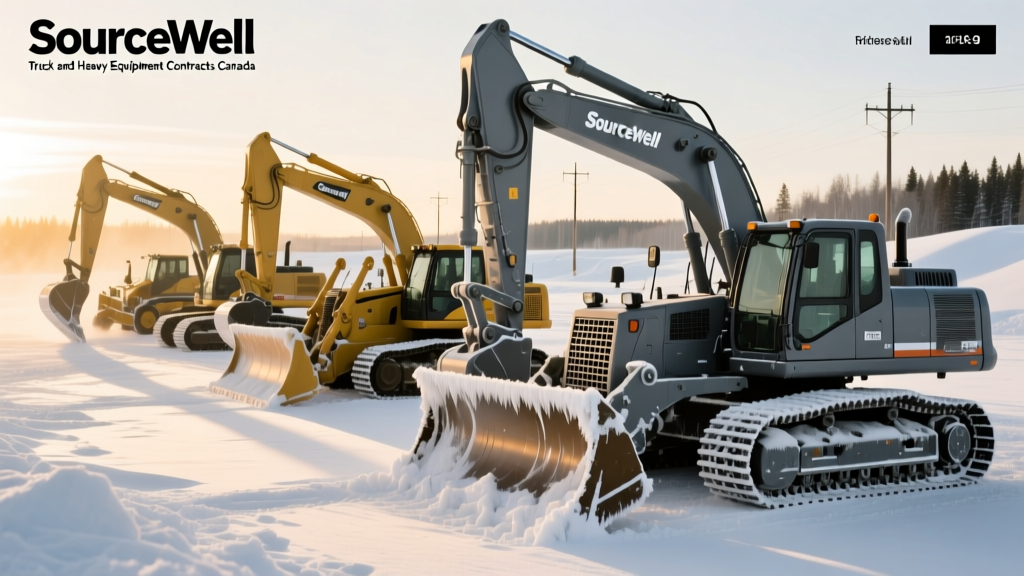
Sourcewell Truck and Heavy Equipment Contracts Canada for Snow Fleets
Evaluating Sourcewell truck and heavy equipment contracts Canada vs. local co-ops for snow removal fleets. Compare procurement routes, costs, and machinery.
The Jurisdictional Reality: Sourcewell Truck and Heavy Equipment Contracts Canada
When Canadian municipal fleet managers and private winter maintenance contractors research cooperative purchasing, the search for Sourcewell truck and heavy equipment contracts Canada inevitably surfaces. Sourcewell is a massive public-sector cooperative purchasing organization that saves US municipalities millions on heavy machinery. However, applying this framework to Canadian snow removal fleet procurement requires a strict understanding of cross-border trade laws.
⚠️ Procurement Warning: Sourcewell is a Minnesota-based government entity. Canadian municipalities and public works departments bound by the Canadian Free Trade Agreement (CFTA) or international agreements like CETA cannot legally piggyback on US-exclusive Sourcewell contracts. Doing so bypasses mandatory Canadian competitive bidding thresholds (set at $366,600 CAD for goods in 2026). Instead, Canadian entities must utilize domestic cooperative alliances or run localized RFPs.So, how do you actually procure a snow removal fleet efficiently in Canada without spending 14 months drafting RFPs? You pivot to Canadian-accessible cooperative contracts and direct-dealership negotiations. Below is a comprehensive comparison of your procurement alternatives, followed by a technical matrix of the heavy equipment required for extreme winter operations.
Procurement Alternatives Analysis: Canadian Co-ops vs. Direct Bidding
To bypass the administrative burden of a ground-up RFP while remaining compliant with Canadian procurement law, fleet managers rely on pre-competed cooperative contracts. These organizations run the competitive solicitation process on your behalf, allowing you to issue a direct purchase order to the winning dealer.
1. The Association of Municipalities of Ontario (AMO) & Provincial Equivalents
For Eastern and Central Canada, the Association of Municipalities of Ontario (AMO) operates a robust cooperative purchasing program. AMO negotiates master agreements with major OEMs like Caterpillar, John Deere, and Volvo CE. If your municipality is in Alberta or British Columbia, you would look toward the Alberta Urban Municipalities Association (AUMA) or the Western States Contracting Alliance (WSCA) Canadian chapters. These contracts lock in pre-negotiated pricing (typically 8% to 14% below MSRP) and guarantee priority allocation during supply chain bottlenecks.
2. OMNIA Partners
OMNIA Partners is one of the few major cooperative purchasing organizations with a massive footprint in both the US and Canada. They hold active, CFTA-compliant contracts for heavy construction and snow removal equipment. Utilizing an OMNIA contract allows Canadian public works departments to purchase wheel loaders and skid steers immediately, provided the specific OEM and dealer are registered under the Canadian annex of the agreement.
3. Direct Dealership RFP (The Traditional Route)
If your fleet requires highly customized snow removal configurations (e.g., specialized high-flow hydraulics for rotary snow blowers or custom chassis mounts for containment plows), cooperative contracts often fall short. Co-ops negotiate base machine pricing; they rarely cover complex, multi-vendor upfitting. In these cases, a direct RFP targeting local heavy equipment dealerships remains the only viable path.
Procurement Route Comparison Matrix
| Procurement Route | Lead Time (2026 Est.) | Admin Burden | Custom Upfit Flexibility | Best For |
|---|---|---|---|---|
| Provincial Co-ops (AMO/AUMA) | 3 - 5 Months | Low (Issue PO) | Low (Base machines only) | Standard wheel loaders & motor graders |
| OMNIA Partners | 4 - 6 Months | Low | Medium | Cross-border standardized fleets |
| Direct RFP / Bidding | 8 - 14 Months | High (Full CFTA process) | High (Fully customized) | Specialized blowers & multi-attachment rigs |
Snow Removal Heavy Equipment Matrix: Models & Specifications
Procuring the iron is only half the battle. Specifying the exact machine for winter abuse requires understanding hydraulic flow rates, operating weights, and cold-weather engineering. Below is the 2026 benchmark matrix for municipal snow removal fleets.
Class 1: Articulated Wheel Loaders (The Primary Pushers)
Wheel loaders are the backbone of any municipal snow clearing operation, utilized for pushing heavy, wet snow into windrows and loading it into tandem-axle dump trucks.
- Top Models: Caterpillar 950 GC, John Deere 624L, Volvo L120H.
- Operating Weight: 18,500 kg to 20,500 kg.
- Snow-Specific Spec: Must be ordered with limited-slip differentials or locking axles to maintain traction on black ice. Standard open differentials will result in severe tire spin and premature wear when pushing asymmetric snow loads.
- Attachment Pairing: 12-foot to 14-foot containment plows (e.g., Henderson RPV-14 or Trip-Edge models). Ensure the loader's Z-bar linkage provides enough rollback to keep the moldboard from spilling snow at full lift height.
Class 2: Heavy-Duty Skid Steers & Compact Track Loaders (The Clean-Up Crew)
Used for clearing cul-de-sacs, downtown sidewalks, and loading out windrows where a full-size wheel loader cannot maneuver.
- Top Models: Bobcat S86 (Wheeled) / T86 (Tracked), Caterpillar 299D3 XE.
- Hydraulic Requirements: You must spec the Super High-Flow auxiliary hydraulic package (up to 40 GPM / 151 L/min). Standard flow (18 GPM) is entirely insufficient for running commercial-grade front-mount snow blowers like the Larue D70 or Sno-Way SB series.
- Cab Engineering: Demand a fully sealed and pressurized cab with an upgraded HVAC system. Non-pressurized cabs will ingest fine snow dust generated by the blower, destroying the cabin air filter and freezing the operator.
Class 3: Motor Graders (The Precision Scrapers)
Essential for hard-pack ice removal and bare-pavement scraping on arterial roads.
- Top Models: Caterpillar 140, John Deere 672L.
- Blade Configuration: Spec a 14-foot moldboard with carbide-impregnated cutting edges. Standard steel edges will wear down to the base metal in less than 40 hours of scraping abrasive asphalt and concrete.
- Underbody Plows: Most Canadian municipalities require the dealer to install an underbody (belly) plow kit. This scrapes the ice layer directly beneath the machine's center of gravity, preventing the grader's rear tandem axles from sliding on polished ice.
Do not accept standard OEM hydraulic fluid for Canadian winter fleets. Mandate that the dealer flushes and fills all new equipment with a synthetic, biodegradable hydraulic fluid such as Petro-Canada EnviroSyn HF 46 or Mobil EAL Arctic 22. These fluids maintain optimal viscosity and prevent cavitation in hydraulic pumps at temperatures dropping to -40°C, whereas standard mineral oils will gel and destroy pump seals during cold startups.
Decision Framework: Which Procurement Route Should You Choose?
Use this rapid decision tree to determine your procurement strategy for the upcoming winter season:
- Are you a private contractor? Cooperative contracts (Sourcewell, AMO, OMNIA) are strictly for public entities, non-profits, and government agencies. Private contractors must negotiate directly with dealerships or utilize commercial financing/leasing programs (e.g., Cat Financial, John Deere Financial).
- Are you buying base machines only (e.g., 5x Wheel Loaders)? Use a provincial co-op or OMNIA Partners. You will save 10% on the base MSRP and bypass the 6-month RFP drafting process.
- Are you buying highly customized rigs (e.g., Graders with underbody plows, wing plows, and pre-wet systems)? You must run a direct RFP. Cooperative contracts do not cover the complex, multi-stage upfitting required for specialized ice-control equipment, and attempting to piece it together via secondary POs will void your OEM warranty.
Final Considerations for 2026 Fleet Budgets
While the search for Sourcewell truck and heavy equipment contracts Canada highlights a desire for streamlined purchasing, Canadian fleet managers must operate within the legal frameworks of the CFTA and local municipal bylaws. By leveraging domestic cooperatives like AMO and OMNIA Partners, you achieve the same administrative efficiency without risking audit penalties. Pair these smart procurement routes with rigorous cold-weather equipment specifications—locking axles, super high-flow hydraulics, and synthetic arctic fluids—and your snow removal fleet will dominate the winter season with minimal downtime.