How Heavy Equipment Tech Transforms Marine Port Operations
Discover how advanced heavy equipment tech is revolutionizing marine port operations with automated STS cranes, AGVs, and real-world terminal case studies.
The Shift from Manual to Automated Terminal Operations
Global marine ports handle over 80% of international trade by volume, a metric that demands relentless optimization in cargo throughput. The integration of advanced heavy equipment tech into maritime infrastructure has shifted from a competitive advantage to an operational baseline. Modern terminal operators are no longer simply purchasing steel and hydraulics; they are deploying cyber-physical systems where Programmable Logic Controllers (PLCs), 5G private networks, and AI-driven sensor fusion dictate the speed of global supply chains. According to the UNCTAD Review of Maritime Transport, ports that have fully digitized and automated their heavy machinery stacks report a 22% reduction in vessel turnaround times and a 30% decrease in carbon emissions per TEU (Twenty-foot Equivalent Unit) handled.
Terminal Throughput Data Highlight
Manual Terminal Average: 25–30 Moves Per Hour (MPH) per crane.
Tech-Enabled Automated Terminal: 38–45 MPH per crane, sustained over 24/7 operations with zero shift-change degradation.
Core Marine Heavy Machinery & Tech Integrations
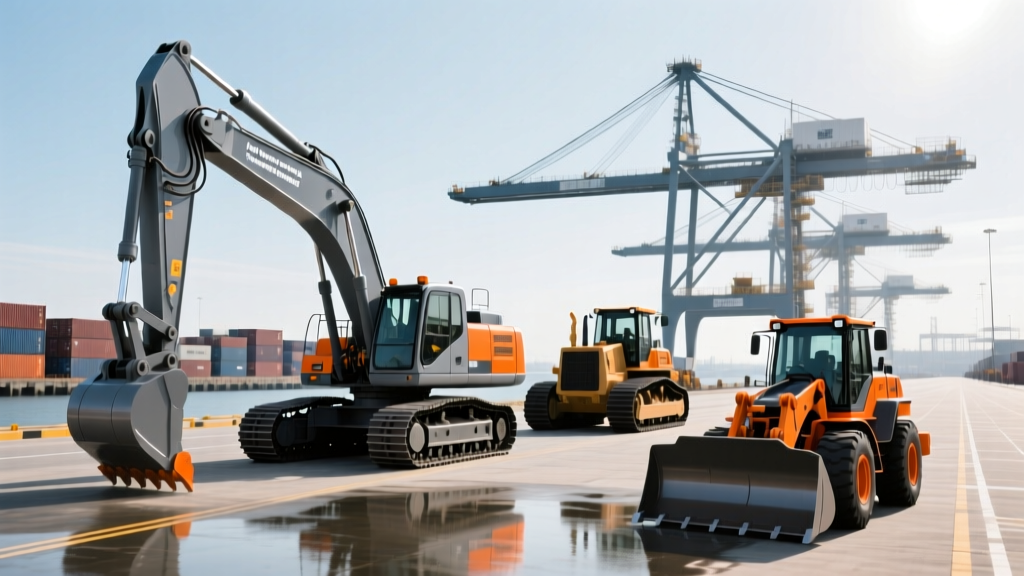
The modern port ecosystem relies on three primary categories of heavy equipment, each heavily augmented by digital technology, LiDAR mapping, and automated drive systems.
Ship-to-Shore (STS) Gantry Cranes
The STS crane is the apex predator of port equipment. Current market leaders, such as the Konecranes Super Post-Panamax STS, are engineered to service ultra-large container vessels (ULCVs) carrying over 24,000 TEUs. These machines feature an outreach of up to 73 meters (accommodating 24-container-wide ship rows) and a Safe Working Load (SWL) of 65 tonnes under a single spreader, or 85 tonnes in tandem lift mode.
The true value lies in the heavy equipment tech integrated into the crane's trolley and spreader. Modern STS cranes utilize closed-loop anti-sway systems driven by inertial measurement units (IMUs) and machine vision. By calculating the pendulum effect of the suspended load in real-time, the PLC automatically adjusts the trolley's acceleration and deceleration profiles. This eliminates the 4-to-6 seconds of manual stabilization time previously required by human operators per cycle, directly compounding the hourly move rate.
Automated Guided Vehicles (AGVs) & Straddle Carriers
Ground-level transport has transitioned from diesel-powered terminal tractors to Battery-Electric Automated Guided Vehicles (BE-AGVs). A standard BE-AGV utilizes a 200 kWh Lithium Iron Phosphate (LFP) battery pack, providing 8 hours of continuous operation. The critical heavy equipment tech here is the automated opportunity charging infrastructure. Using overhead pantographs or inductive ground pads, AGVs receive 600kW burst charges during natural workflow pauses (e.g., waiting for a crane cycle), eliminating the need for manual battery swapping or 12-hour plug-in charging bays.
Case Study: Sensor Fusion in High-Density Stacking Yards
Consider the deployment of Automated Stacking Cranes (ASCs) in high-density container yards. In a major European hub terminal upgrade, operators replaced traditional Rubber-Tyred Gantry (RTG) cranes with Automated Rail-Mounted Gantry (ARMG) cranes. The primary challenge was navigation and collision avoidance in 'canyons' of stacked steel containers, where traditional RTK-GPS signals suffer from severe multipath errors due to signal reflection off the corrugated container walls.
To solve this, the heavy equipment tech stack was augmented with 3D LiDAR SLAM (Simultaneous Localization and Mapping). The ARMGs were fitted with 128-channel solid-state LiDAR arrays operating at 905nm wavelength. When RTK-GPS confidence dropped below 85% (triggered when stacking heights exceeded 1-over-5 configurations), the system seamlessly handed over lateral positioning to the LiDAR SLAM algorithm, maintaining a positioning accuracy of ±15mm. This sensor fusion eliminated the 12 to 15 manual interventions per shift that previously occurred when automated cranes lost GPS lock in dense yard sectors.
Conventional vs. Tech-Enabled Port Equipment Matrix
| Feature / Metric | Conventional Heavy Equipment | Tech-Enabled / Automated Equipment |
|---|---|---|
| STS Crane Cycle Time | 2.5 to 3.0 minutes per container | 1.8 to 2.2 minutes per container |
| Ground Transport Fuel | Diesel (approx. 12-15 L/hour per tractor) | Grid-electric (LFP battery, 0 local emissions) |
| Positioning Accuracy | Manual visual alignment (±150mm) | LiDAR/RTK-GPS fusion (±15mm) |
| Asset Utilization | 60-65% (limited by shift changes, fatigue) | 85-92% (continuous 24/7 operation) |
| Maintenance Strategy | Reactive / Scheduled interval-based | Predictive (vibration/acoustic IoT sensors) |
Edge Cases & Failure Modes in Marine Tech Deployments
Deploying heavy equipment tech in marine environments introduces severe edge cases that do not exist in land-based logistics hubs. Terminal engineers must design for the following failure modes:
- Salt Spray Sensor Fouling: LiDAR and machine vision cameras are highly susceptible to salt crystallization and marine fog. Automated air-knife cleaning systems are mandatory. These systems must deliver a minimum of 2.5 CFM at 40 PSI directly across the optical lenses, triggered automatically when the LiDAR detects a 5% drop in point-cloud density.
- Magnetic Interference from Ship Hulls: When STS cranes operate over the massive steel hulls of ULCVs, the magnetic anomaly can disrupt the compass modules used in secondary spreader positioning systems. Heavy equipment tech stacks must rely on dual-antenna RTK-GPS heading calculations rather than magnetometers to maintain spreader rotation accuracy.
- 5G Network Latency Spikes: Remote-controlled STS cranes require a maximum network latency of 10ms to prevent operator motion sickness and ensure precise micro-adjustments. In ports where commercial 5G bands overlap with private terminal networks, network slicing and dedicated edge-computing nodes (located within 2km of the quay) are required to guarantee the ultra-reliable low-latency communication (URLLC) standard.
Financial & Operational ROI: What Terminal Operators Must Know
The capital expenditure (CapEx) for integrating advanced heavy equipment tech is substantial, but the operational expenditure (OpEx) savings dictate the long-term viability of the investment. A single automated Super Post-Panamax STS crane commands a CapEx of $9.5M to $13M, representing a 35% premium over a conventional manual crane. An automated ground transport fleet of 50 BE-AGVs requires an initial outlay of $25M to $30M, including the central fleet management software and automated charging infrastructure.
"The transition to automated marine heavy equipment is no longer just about labor reduction; it is about asset predictability. By embedding IoT vibration and thermal sensors into the hoist motors and trolley drives of an ARMG crane, operators are shifting from catastrophic failure replacements to precision component swapping, extending the functional lifespan of a $3.5M crane by up to 7 years."
— Port Automation Engineering Directive, 2025 Maritime Logistics Symposium
The ROI is realized primarily through energy and maintenance optimization. BE-AGVs reduce energy costs per moved container by up to 65% compared to diesel equivalents, leveraging regenerative braking systems that feed power back into the terminal's microgrid during deceleration. Furthermore, predictive maintenance algorithms analyzing motor current signature analysis (MCSA) data can detect bearing degradation in crane hoists up to 400 operating hours before catastrophic failure, allowing maintenance to be scheduled during planned vessel gaps rather than causing catastrophic quay-side downtime that can cost terminals upwards of $15,000 per hour in delayed vessel demurrage fees.
For terminal operators evaluating upgrades, the decision framework must prioritize the software integration layer. Purchasing the most advanced STS cranes or Liebherr mobile harbor cranes yields minimal returns if the terminal operating system (TOS) cannot execute real-time API calls to the equipment's PLCs. The true value of heavy equipment tech in marine ports is unlocked only when the physical machinery acts as a seamless, low-latency extension of the terminal's digital brain.