Snow Removal Types: Heavy Equipment for Mining in Extreme Cold
Explore snow removal heavy equipment types for mining. Discover case studies, winter haul road strategies, and arctic machinery specs for 2026.
The Hidden Economics of Winter Haul Road Maintenance
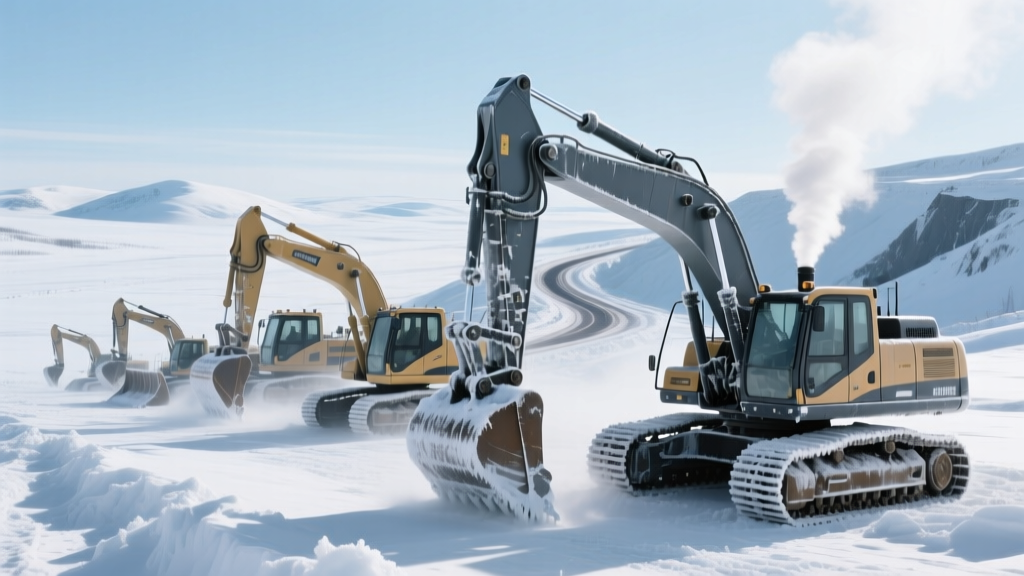
When operating in high-altitude or sub-arctic regions, snow and ice accumulation on haul roads is not merely a logistical nuisance; it is a critical threat to site profitability and safety. For large-scale extractive operations, selecting the right heavy equipment for mining in extreme cold requires moving beyond standard earthmoving machinery. Winterized snow removal fleets must combat hardpack ice, 10-foot snowdrifts, and ambient temperatures that routinely drop below -40°C.
The financial stakes are immense. A fleet of 300-ton ultra-class haul trucks idling due to an impassable, snow-drifted haul road can burn upwards of $18,000 per hour in lost productivity and wasted fuel. To mitigate this, mine operators deploy highly specialized snow removal configurations designed to maintain 24/7 haulage cycles in brutal winter conditions.
Winter Haulage Data Point: According to logistics analyses from the Canadian Institute of Mining, Metallurgy and Petroleum, a 15% reduction in haul truck cycle time due to snow-slip and poor traction can decrease overall mine throughput by up to 8% during Q1 and Q4. Proper snow removal equipment pays for itself within a single winter season by preserving cycle times.Core Snow Removal Heavy Equipment Types for Mine Sites
Standard municipal snowplows are entirely inadequate for the sheer volume and density of snow found on industrial mine sites. Heavy equipment for mining applications requires massive breakout force, specialized traction, and extreme cold-weather engineering.
1. Motor Graders with Heavy-Duty V-Plows and Scarifiers
The backbone of any winter mine site is the motor grader. However, mine-spec graders differ vastly from highway models. Machines like the Caterpillar 24M (290 hp) or Komatsu GD825A-2 are fitted with front-mounted, heavy-duty V-plows designed to fracture hardpack ice, alongside rear-mounted scarifiers (rippers) to break up frozen rutting before it turns into solid ice ridges.
- Blade Configuration: 14-foot to 16-foot moldboards with carbide-tipped cutting edges.
- Down-Pressure: Exceeding 25,000 lbs to penetrate compacted snow-ice matrices left by 400-ton haul trucks.
- Cost Factor: A base Cat 24M runs approximately $650,000. Adding a factory arctic cab, engine block heaters, and heavy-duty front plow mounts adds $55,000 to $75,000 to the capital expenditure.
2. Articulated Dump Trucks (ADTs) with Wing Plows
For clearing secondary access roads, fuel farm perimeters, and blasting zones, mines utilize Articulated Dump Trucks equipped with massive wing plows. The Volvo A45G or Bell B40E are frequently upfitted with hydraulic side-wing plows. This allows the operator to clear a 40-foot swath in a single pass without needing to turn around, a crucial efficiency metric when clearing miles of remote exploration roads.
3. High-Capacity Rotary Snowblowers
When snow depths exceed 4 feet and windrows created by loaders become unmanageable, mines deploy industrial rotary snowblowers. Models like the Marshall Falcon 1200 or airport-grade Oshkosh H-Series blowers are adapted for mining. These machines can throw up to 5,000 tons of dense snow per hour, clearing it entirely off the site footprint rather than just pushing it to the roadside where it would eventually melt and destabilize the road subgrade.
Case Study: Iron Ore Corridor Operations in Northern Quebec
To understand how these machines perform in reality, consider the logistics of major iron ore operations in the Fermont region of Northern Quebec. These sites experience over 300 cm of annual snowfall and operate at temperatures regularly hitting -38°C.
"In the Fermont corridor, we don't just clear snow; we manage ice armor. Haul trucks compress fresh snow into high-density ice ridges within hours. Our grader fleet must run continuously with rear scarifiers engaged to rip the ice, followed by front-blade leveling, all while managing diesel gelling risks."
— Senior Mobile Maintenance Superintendent, Quebec Iron Ore Logistics
Operational Metrics from the Quebec Corridor:
| Equipment Deployed | Primary Function | Clearing Speed | Fuel Burn at -35°C |
|---|---|---|---|
| Cat 24M Motor Grader | Ice scarification & primary haul road leveling | 12-18 km/h | 38 L/hr |
| Komatsu WA500-8 Wheel Loader | Pushing heavy windrows, loading out snow banks | N/A (Static/Cycle) | 45 L/hr |
| Marshall Falcon Blower | Deep drift removal at crusher dumps & fuel depots | 4-8 km/h | 65 L/hr |
Cold-Weather Engineering: Beyond the Paint Job
Specifying heavy equipment for mining in arctic conditions requires rigorous attention to metallurgical and fluid dynamics failure modes. Standard machines will suffer catastrophic failures within 48 hours at -40°C if not properly winterized.
Hydraulic and Fluid Vulnerabilities
Standard NBR (Nitrile) hydraulic hoses become brittle and burst under high-pressure loads in extreme cold. Mine-site snow removal fleets must be retrofitted with PTFE (Teflon) lined hoses with stainless steel braiding. Furthermore, standard hydraulic fluid thickens into a gel. Operations must flush systems with ISO VG 15 synthetic arctic hydraulic fluid to maintain pump suction and prevent cavitation during startup.
Traction and Ground Engagement
Pushing snow requires immense tractive effort. Standard L5 rock tires will slip on polished ice. Mines invest heavily in specialized winter traction tires, such as the Michelin X-Snow or equivalent L3/L4 winter tread patterns, often equipped with replaceable tungsten carbide studs. While these tires cost upwards of $12,000 per corner for a large grader, they reduce slip-induced cycle delays by over 40%.
Operator Safety Thresholds: The NIOSH Cold Stress Guidelines mandate strict work/warm-up cycles for operators in sub-zero environments. Modern arctic cabs on mining graders feature positive pressurization, dual-pane heated glass to prevent interior icing, and Webasto auxiliary coolant heaters that maintain cab temperatures at 22°C even when the main engine is idling at -40°C ambient.Decision Framework: When to Deploy vs. When to Halt
Mine dispatchers must balance road clearing against the risk of equipment damage and operator fatigue. Use this operational framework to manage snow removal fleet deployment:
- Phase 1 (0 to 15 cm accumulation): Deploy ADTs with wing plows. Maintain haul truck speeds at 80% of dry limits. Apply liquid magnesium chloride brine to primary haul roads to prevent snow-bonding to the gravel substrate.
- Phase 2 (15 to 40 cm accumulation): Dispatch motor graders with V-plows. Restrict haul truck speeds to 50%. Engage continuous scarifier passes to prevent hardpack formation.
- Phase 3 (Blizzard conditions / >40 cm with high wind): Haulage must be reduced to single-lane, convoy-only operations led by a grader. Rotary blowers must be deployed at critical choke points (crusher dumps, fuel farms) where wind drifts exceed 2 meters. Haul truck speeds restricted to 20 km/h.
The Future of Winter Mine Logistics
As mining operations push further into the Arctic Circle and higher altitudes to secure critical minerals, the demand for autonomous and remote-controlled snow removal equipment is accelerating. By 2026, several tier-one miners are piloting remote-operated motor graders, allowing operators to manage haul road clearing from heated surface control rooms, entirely eliminating cold-stress risks and reducing the need for massive, heavily insulated arctic cabs. Understanding the precise mechanical and operational requirements of winter heavy equipment is no longer optional; it is a fundamental pillar of modern, resilient mine planning.