Modern Heavy Equipment Names and Pictures for Green Energy
Identify next-gen green energy machinery. Explore modern heavy equipment names and pictures, specs, and tech trends for solar, wind, and geothermal sites.
The Shift to Specialized Renewable Energy Machinery
The transition toward utility-scale renewable energy has fundamentally altered the equipment requirements for heavy civil contractors. Standard diesel-powered earthmovers are no longer sufficient for the precision, scale, and environmental constraints of modern solar arrays, wind farms, and geothermal plants. In 2026, site managers require specialized, technology-integrated machinery to meet aggressive deployment timelines and strict emissions mandates.
Finding accurate heavy equipment names and pictures for these specialized renewable energy projects is critical for site planning, procurement, and operator training. This guide bypasses generic construction catalogs to detail the exact models, technical specifications, and visual identification markers of next-generation machinery dominating the green energy sector.
Market Context: The 2026 Equipment Deficit
According to the U.S. Department of Energy's Wind Technologies Market Report, the average hub height for onshore wind turbines now exceeds 100 meters, with rotor diameters surpassing 170 meters. This physical scaling has rendered traditional 500-ton crawler cranes obsolete for primary erection, driving a massive capital shift toward 1,000-ton+ class cranes with variable counterweight technology.
Solar Farm Deployment: Autonomous and GPS-Guided Piling
Utility-scale solar farms require hundreds of thousands of foundation piles. Manual surveying and traditional hydraulic hammers are too slow and prone to error. The industry standard has shifted to GPS-guided, semi-autonomous pile drivers.
Spotlight: Junttan PMx22 Solar Piling Rig
The Junttan PMx22 represents the pinnacle of solar foundation technology. Unlike modified excavator attachments, the PMx22 is a purpose-built piling rig designed specifically for solar and wind foundations.
- Engine: Cummins B6.7 Stage V (224 kW / 300 hp) with integrated eco-mode reducing fuel consumption by 18%.
- Guidance Tech: Integrated Topcon 3D GPS RTK system with ±10mm positional accuracy, eliminating the need for pre-marked ground stakes.
- Production Rate: Capable of driving 300 to 400 H-beam piles per 10-hour shift in medium-density soil.
- Capital Cost: $480,000 – $550,000 (base configuration).
Spotlight: Vermeer PD10R Pile Driver
For tighter terrain and rocky substrates, the Vermeer PD10R utilizes a high-frequency vibratory hammer combined with a down-the-hole (DTH) air hammer option. Its rubber-track undercarriage minimizes soil compaction, a critical requirement for agricultural land leased for solar development.
Wind Turbine Erection: Variable Position Counterweight (VPC) Cranes
Erecting 3MW to 5MW onshore wind turbines requires lifting nacelles weighing over 100 metric tons to heights exceeding 110 meters. Traditional crawlers require massive counterweight stacks and extensive ground preparation. Modern heavy equipment manufacturers have solved this via Variable Position Counterweight (VPC) technology.
| Feature | Standard 1000-Ton Crawler | VPC-Equipped Crawler (e.g., Manitowoc MLC300) |
|---|---|---|
| Counterweight Management | Fixed radius; requires full stack for max load | Hydraulically extends/retracts based on real-time load |
| Ground Bearing Pressure | High; requires extensive crane pad engineering | Reduced by up to 25%; smaller crane pad footprint |
| Assembly Time (Boom + CW) | 5 to 7 days (requires assist crane) | 2 to 3 days (self-assembly capabilities) |
| Wind Tolerance (Erection) | Max 9 m/s (20 mph) | Max 13 m/s (29 mph) due to active load management |
The Liebherr LR 11000 and Manitowoc MLC300 VPC-MAX dominate this space. By automatically adjusting the counterweight radius during the lift, these machines maintain optimal stability while drastically reducing the ground bearing pressure, saving contractors up to $40,000 per pad in civil engineering costs.
Visual Identification Guide: Field Markers for Next-Gen Machinery
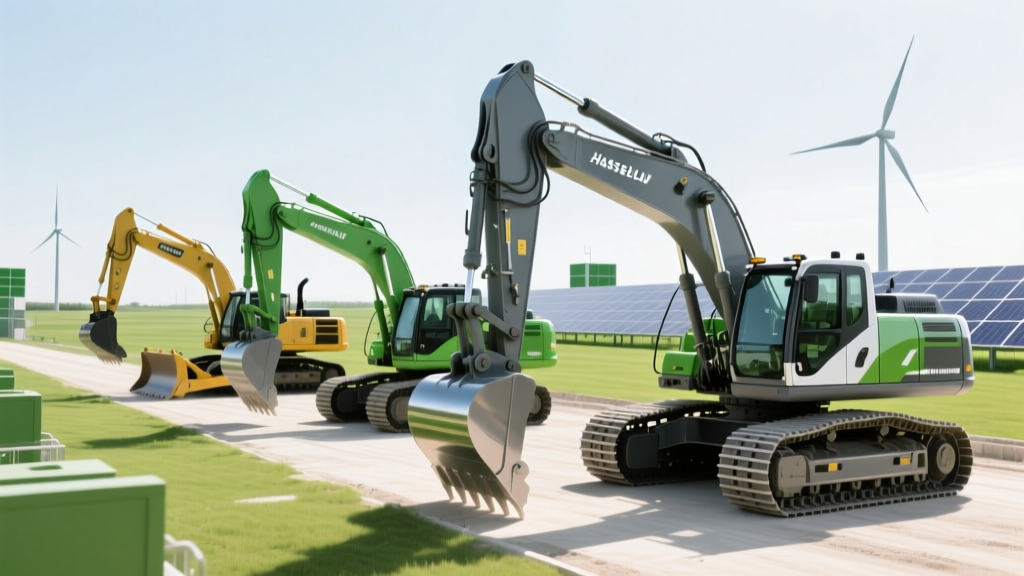
While digital manuals provide specifications, site supervisors and safety officers often need to rapidly identify machinery on active sites. When searching for heavy equipment names and pictures, physical silhouettes and distinct visual markers are the most reliable identification methods in the field.
Field Identification Matrix
- Machine: Junttan PMx22 (Solar Piler)
Visual Marker: Distinctive bright green or yellow chassis with a tall, vertical mast lacking the traditional excavator cab. Features a side-mounted power pack and a visible GPS dome on the mast apex. - Machine: Manitowoc MLC300 VPC (Wind Crane)
Visual Marker: Massive lattice boom with a visible, articulated rear counterweight tray that physically extends backward on hydraulic rails during heavy lifts, unlike fixed counterweight blocks. - Machine: Ditch Witch HT125 (HVDC Trencher)
Visual Marker: Low-profile, elongated tracked chassis with a massive rear-mounted rock wheel (up to 72 inches in diameter) and a side-discharge conveyor. Lacks a traditional operator cab; controlled via remote or side-stand. - Machine: Volvo ECR25 Electric (BESS Site Prep)
Visual Marker: Compact excavator silhouette lacking a rear exhaust stack and engine air intakes. Features prominent side-panel charging ports and blue electric-drive badging.
Geothermal and Grid Interconnection: Electric Trenching and Earthmoving
The final bottleneck in renewable energy construction is grid interconnection. Trenching for High-Voltage Direct Current (HVDC) lines and geothermal brine pipelines requires continuous, high-yield excavation. Furthermore, Battery Energy Storage System (BESS) facilities demand zero-emission equipment for indoor or enclosed site preparation.
High-Capacity Trenching: Ditch Witch HT125
For HVDC lines spanning hundreds of miles, the Ditch Witch HT125 All-Terrain Trencher is the industry benchmark. Powered by a 600-hp CAT C18 engine, it utilizes a hydrostatic rock saw attachment capable of cutting 48-inch wide trenches through solid limestone at depths up to 10 feet. The integration of automated depth-control telemetry ensures precise cable-burial compliance without manual grading.
Zero-Emission BESS Preparation: Volvo ECR25 Electric
Constructing the concrete pads and cable trenches inside enclosed BESS facilities requires compact, zero-exhaust machinery. The 2.5-ton Volvo ECR25 Electric provides 4 hours of continuous heavy digging on a single 48V lithium-ion charge. Its lack of engine vibration reduces operator fatigue and prevents micro-fractures in sensitive battery racking installations during close-quarters trenching.
Procurement Strategy: Rent vs. Buy in the Renewable Sector
The Association of Equipment Manufacturers (AEM) notes that the rapid evolution of green tech makes long-term ownership of highly specialized renewable equipment risky for general contractors. The procurement framework for 2026 dictates a split approach:
- Buy High-Utilization Earthmoving Assets: Electric compact excavators and standard GPS-equipped dozers maintain high resale value and cross-industry utility.
- Rent Highly Specialized Erection Assets: 1,000-ton VPC crawler cranes and specialized solar piling rigs should be leased on a per-project basis. The $4M+ capital expenditure of a wind crane, combined with the rapid scaling of turbine sizes, makes ownership a depreciating liability.
- Invest in Telemetry Subscriptions: Whether renting or buying, ensure the equipment includes active OEM telemetry (e.g., CAT VisionLink, John Deere JDLink). Predictive maintenance data is non-negotiable for remote wind and solar sites where a single breakdown can halt a multi-million-dollar critical path.
Final Operational Directives
Success in renewable energy construction relies on matching the exact machine capability to the site's geological and spatial constraints. By moving beyond generic equipment lists and understanding the specific technological advantages of VPC cranes, GPS-guided piling rigs, and electric trenchers, project managers can drastically reduce civil costs and accelerate grid interconnection timelines.