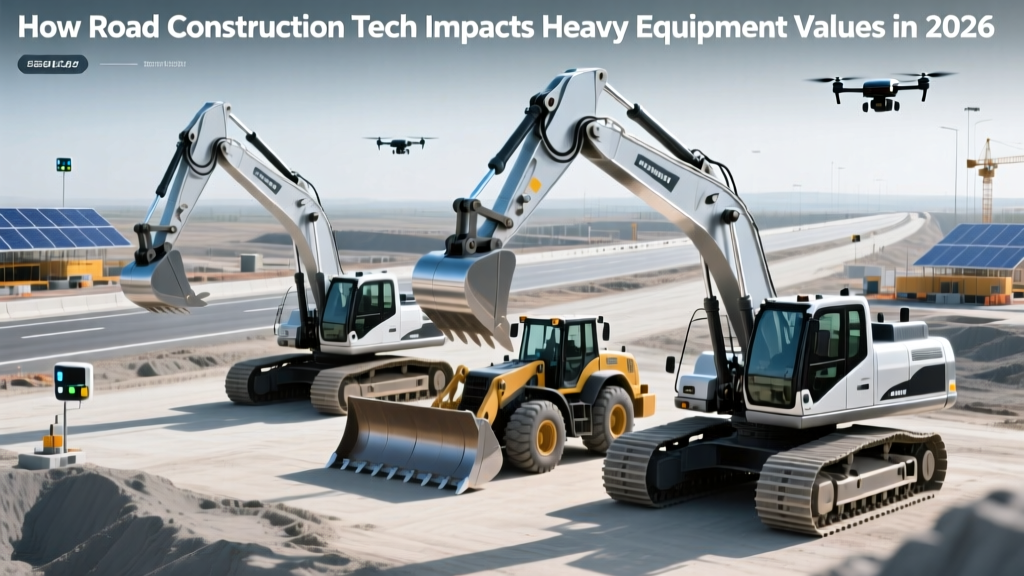
How Road Construction Tech Impacts Heavy Equipment Values in 2026
Discover how 2026 tech trends in road construction classification, from smart pavers to autonomous rollers, impact heavy equipment values and ROI.
The Shift from Iron to Intelligence in Road Building
Historically, road construction equipment classification relied strictly on mechanical function: earthmoving, base preparation, paving, and compaction. Buyers evaluated machines based on engine horsepower, operating weight, and blade width. In 2026, this classification model is obsolete. The modern hierarchy of road building machinery is defined by digital integration, automation, and powertrain innovation. This fundamental shift in how we classify and utilize road construction assets is directly rewriting the rules of depreciation, auction premiums, and overall heavy equipment values.
Contractors and fleet managers who fail to align their procurement strategies with these technological classifications risk holding assets that depreciate at accelerated rates. Conversely, spec'ing machines with integrated 3D grade control, telematics, and electric-assist compaction systems creates a secondary market premium that significantly protects capital investments.
Road Construction Equipment Classification: The 2026 Tech Matrix
To understand current market valuations, we must reclassify road construction equipment not by what it pushes or pulls, but by its level of digital autonomy and powertrain architecture. The table below maps traditional classifications against their 2026 tech-enabled counterparts and the resulting impact on asset retention.
| Functional Class | Legacy Classification (Pre-2020) | 2026 Tech-Enabled Classification | Impact on Heavy Equipment Values |
|---|---|---|---|
| Subgrade & Earthmoving | Mechanical Motor Graders (e.g., Cat 140 series) | 3D GPS-Automated Graders (e.g., Cat 14M with Cat Grade) | +18% to +24% auction premium over non-GPS analog models |
| Asphalt Paving | Manual Screed Pavers | Machine-Control Pavers (e.g., Vögele SUPER 1880-3i with AutoTrac) | Reduces 5-year depreciation curve by 12% due to mat quality guarantees |
| Compaction | Diesel Vibratory Rollers | Electric/Asphalt-Sensing Rollers (e.g., Ammann eAMX, Volvo DD105 OSC) | High upfront cost; long-term value retention tied to battery health data |
| Milling | Standard Cold Planers | 3D-Mapped Milling Machines (e.g., Wirtgen W 210 Fi with LEVEL PRO PLUS) | Commands top 10% pricing bands at Ritchie Bros auctions |
Telematics and 3D Grade Control: The Primary Value Drivers
The most significant factor currently propping up heavy equipment values in the road sector is the integration of machine control. The Federal Highway Administration's Every Day Counts initiative has heavily pushed 3D modeling and e-Construction, making digital grade control a baseline requirement for municipal and state DOT contracts.
When a motor grader like the John Deere 872 or Caterpillar 14M is equipped with fully integrated Topcon 3D-MC2 or Cat Grade systems, it eliminates the need for traditional survey staking. This reduces rework by up to 30% and cuts fuel consumption by minimizing unnecessary passes. Because these machines generate verifiable data logs proving compaction and grading accuracy, they are highly sought after on the secondary market.
Depreciation Curve Alert: The 'Analog Penalty'
Fleet data from 2025-2026 indicates that mechanical-only motor graders and pavers without factory-integrated telematics are experiencing an 'analog penalty.' At the 60-month mark, non-connected graders are depreciating 15% to 20% faster than their smart counterparts. Buyers at auction are actively discounting machines that require expensive, third-party aftermarket GPS retrofits, preferring factory-calibrated OEM grade control systems that carry transferable software licenses.
Electrification in Compaction: Navigating the Resale Risk-Reward
Compaction equipment classification is undergoing a radical transformation due to electrification and intelligent compaction (IC) sensors. Machines like the Ammann eAMX electric tandem roller and Volvo CE’s electric soil compactors are entering the market with a 20% to 30% price premium over diesel equivalents (roughly $45,000 to $60,000 extra upfront).
How does this affect heavy equipment values? The secondary market is currently bifurcated. On one hand, electric rollers offer massive total cost of ownership (TCO) advantages—saving an estimated $12,000 annually in fuel and fluid maintenance. On the other hand, the secondary market remains cautious regarding high-voltage battery degradation and the cost of out-of-warranty cell replacement.
'In the current market, an electric compactor with a certified, transferable battery health report and remaining OEM battery warranty will sell at parity or a slight premium to a low-hour diesel machine. Without that documentation, buyers will discount the asset by $20,000 or more to hedge against battery replacement risks.'
— 2026 Equipment Appraisal Guidelines, Heavy Machinery Valuation Board
According to recent Ritchie Bros. market reports, intelligent compaction systems that map roller passes and stiffness values in real-time are becoming mandatory for highway projects. Rollers lacking IC mapping hardware are increasingly relegated to low-margin commercial parking lot jobs, severely limiting their resale pool and depressing their auction values.
Actionable Framework: Spec'ing Road Equipment for Maximum Resale
To protect your capital and maximize heavy equipment values when it is time to liquidate or trade in, procurement teams must adopt a forward-looking spec strategy. Follow this decision matrix when ordering new road construction fleets:
- Mandate Factory-Integrated Machine Control: Never buy a grader, dozer, or paver without OEM 3D GPS hardware. Aftermarket retrofits do not hold value equivalently and often void specific hydraulic warranties.
- Secure Transferable Software Licenses: Ensure the OEM software agreements for grade control and telematics are tied to the machine's PIN/serial number, not your corporate account, so the license transfers to the next owner at auction.
- Prioritize Intelligent Compaction (IC) Hardware: Even if your current local DOT contracts do not require IC mapping, spec the accelerometers and GNSS receivers on all new vibratory rollers. The hardware costs roughly $18,000 new but adds $25,000+ in auction value three years later.
- Document Battery Health for Electric Assets: If adopting electric compactors or pavers, implement strict monthly battery diagnostic logging. A verifiable, continuous health log is the single most critical document for establishing resale value on electric heavy iron.
- Standardize Telematics Across the Fleet: Mixed fleets with different telematics ecosystems (e.g., mixing Cat VisionLink with John Deere JDLink) frustrate secondary buyers. Standardizing on one data architecture increases the bulk-sale premium of your fleet.
Frequently Asked Questions
Does retrofitting older road equipment with GPS improve resale value?
Retrofitting a 2018-era paver or grader with a third-party 3D system (like Trimble Earthworks) will improve its utility and productivity on the job site, but it rarely yields a 1:1 return on investment at auction. Secondary buyers heavily discount aftermarket wiring harnesses and non-OEM hydraulic valve integrations due to long-term reliability concerns. Factory-integrated systems always command higher heavy equipment values.
How do emissions tier changes affect road construction equipment classification and value?
The transition to Tier 5 / Stage V emissions standards has created a hard line in equipment valuation. Machines requiring complex Diesel Exhaust Fluid (DEF) systems and active regeneration DPFs are scrutinized heavily on the used market. Road building equipment classified with simpler, advanced combustion-only engines (where legally permitted for off-road use) often see a localized spike in resale value among buyers looking to minimize emissions-system maintenance.
Are autonomous asphalt pavers impacting the values of traditional crew-operated pavers?
Fully autonomous pavers are still largely in the pilot phase for 2026, but semi-autonomous features—such as Vögele’s AutoTrac for automated screed width and thickness control—are standardizing. Traditional pavers requiring manual screed adjustments are seeing a 5% to 8% drop in resale values as contractors prioritize the mat consistency and material savings guaranteed by automated systems.