Matching Heavy Equipment Hydraulic Oil to Road Machinery Classes
Classify road construction machinery by hydraulic stress and match each to the exact heavy equipment hydraulic oil viscosity and additive specs required.
Executive Classification Matrix
Road construction machinery dictates hydraulic fluid selection based on three primary stress profiles: High-Pressure Shear (Graders/Loaders), Thermal Degradation (Pavers/Millers), and Shock-Load Cavitation (Compactors). Selecting the correct heavy equipment hydraulic oil requires matching ISO VG grades and additive packages (ZDDP vs. Ashless) to these specific operational classes.
The Hydraulic Demands of Road Construction Classification
Road construction equipment operates in some of the most unforgiving environments in heavy industry. Unlike stationary manufacturing machinery, mobile road-building equipment faces extreme ambient temperature swings, heavy particulate contamination, and severe cyclic loading. The Federal Highway Administration (FHWA) notes that equipment downtime on critical path paving projects can cost contractors upwards of $10,000 per hour in cascading delays. A significant percentage of these hydraulic failures stem not from mechanical defects, but from the misapplication of hydraulic fluids.
To specify the correct heavy equipment hydraulic oil, fleet managers must classify their road construction assets into three distinct operational categories. Each class places unique demands on the fluid’s viscosity index (VI), anti-wear (AW) additive package, and thermal stability.
Class 1: High-Pressure Earthmoving and Grading Equipment
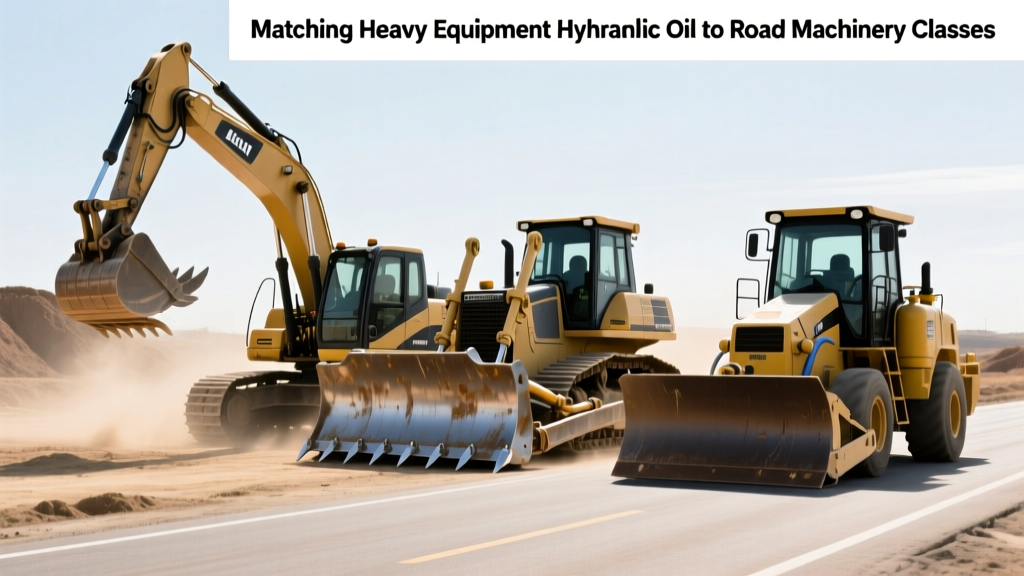
Equipment Profile: Motor graders (e.g., Cat 14M, John Deere 872GP), wheel loaders, and bulldozers.
Hydraulic Stress Profile: Continuous high-pressure operation (4,000 to 5,500 PSI) utilizing variable-displacement axial piston pumps. These systems demand exceptional shear stability to prevent viscosity loss across the pump’s tight tolerances.
Technical Fluid Specifications
- Base Viscosity: ISO VG 46 (AW 46). This provides the optimal balance between cold-start flow and high-temperature film strength for most temperate climates.
- Additive Package: Zinc-based (ZDDP - Zinc Dialkyldithiophosphate). ZDDP is critical here because it forms a sacrificial tribofilm on the metal surfaces of piston slipper pads and swash plates during boundary lubrication conditions.
- Viscosity Index (VI): Minimum 140. Motor graders frequently idle in the cold morning and operate under heavy draft loads by midday. A high VI ensures the fluid does not thin out excessively when reservoir temperatures reach 180°F (82°C).
Class 2: High-Temperature Paving and Milling Machinery
Equipment Profile: Asphalt pavers (e.g., Volvo ABG8820, Cat AP1055), cold planers/milling machines, and material transfer vehicles (MTVs).
Hydraulic Stress Profile: Severe thermal degradation. Pavers operate in direct proximity to 300°F (149°C) asphalt mats. Radiant heat from the screed and the material hopper drastically elevates hydraulic reservoir temperatures, often pushing them past 200°F (93°C).
Technical Fluid Specifications
Standard mineral-based AW oils will rapidly oxidize and form varnish at these sustained temperatures. Varnish buildup causes sticky spools in the screed’s proportional control valves, leading to uneven mat thickness and failed smoothness (IRI) tests.
- Base Viscosity: ISO VG 46 or ISO VG 68 Synthetic Blend.
- Additive Package: Ashless (Zinc-Free) Anti-Wear. Modern pavers utilize highly sensitive electro-hydraulic proportional valves to control screed extensions and tampers. Zinc additives can leave metallic ash deposits that foul the microscopic clearances (often under 5 microns) of these servo valves.
- Thermal Stability: Synthetic Group II or Group III base stocks with an oxidation induction time (OIT) exceeding 250 minutes (per ASTM D2272).
| Parameter | Asphalt Paver | Cold Planer / Milling Machine |
|---|---|---|
| Primary Stress | Radiant Heat & Varnish Risk | High Shock Load & Contamination |
| Recommended ISO VG | ISO VG 68 (Synthetic) | ISO VG 46 (High-VI Mineral) |
| Additive Type | Ashless / Zinc-Free | Zinc-Based (ZDDP) |
| Filtration Target | ISO 4406 Code 16/14/11 | ISO 4406 Code 18/16/13 |
Class 3: Vibratory Compaction and Finishing Equipment
Equipment Profile: Single-drum soil compactors (e.g., Bomag BW 213), pneumatic tire rollers, and oscillatory asphalt rollers.
Hydraulic Stress Profile: Extreme cyclic shock loads and micro-cavitation. The vibratory mechanism in a soil compactor is driven by a hydraulic motor that reverses direction or undergoes massive pressure spikes (often exceeding 6,000 PSI transiently) hundreds of times per minute.
Technical Fluid Specifications
The primary failure mode in compactor hydraulics is not wear, but micro-dieseling (cavitation). When the vibratory motor abruptly stops or changes direction, localized pressure drops cause dissolved air to come out of solution and form bubbles. When these bubbles collapse under high pressure, they create microscopic shockwaves that pit metal surfaces and erode pump housings.
- Base Viscosity: ISO VG 68. The thicker fluid film is necessary to cushion the severe shock loads transmitted through the drum drive motors.
- Air Release Properties: Must meet ASTM D3427 with an air release time of less than 5 minutes at 50°C. This ensures entrained air escapes the fluid before it reaches the high-pressure zone of the pump.
- Anti-Foam Agents: Silicone-based anti-foam additives are mandatory to prevent surface foaming in the reservoir, which exacerbates cavitation.
Electro-Hydraulic Systems and the Shift to Zinc-Free Oils
A critical shift in 2026 road construction equipment design is the widespread adoption of electro-hydraulic proportional control systems. Older machines relied on mechanical linkages and direct-acting pilot valves. Modern graders, dozers, and pavers use electronic joysticks that send signals to proportional solenoids, which in turn meter hydraulic flow.
"The clearance tolerances in modern electro-hydraulic spool valves are measured in single-digit microns. Traditional ZDDP (zinc) additives, while excellent for protecting high-pressure piston pumps, can thermally degrade and form insoluble zinc phosphate sludge. In a modern paver's screed control system, this sludge causes valve stiction, resulting in visible ridges in the asphalt mat. For any machine relying on proportional servo-valves, a high-quality zinc-free heavy equipment hydraulic oil is no longer optional; it is a mechanical requirement."
— Fluid Power Systems Engineering Guidelines
When specifying oil for mixed fleets, contractors face a dilemma: piston pumps prefer zinc for wear protection, but servo-valves require zinc-free fluids to prevent stiction. The industry solution is the use of universal, ashless synthetic hydraulic fluids that utilize advanced organic anti-wear additives (like phosphorus-nitrogen compounds) to protect pumps without leaving metallic ash deposits.
Troubleshooting Flowchart: Diagnosing Fluid Misapplication
Use this diagnostic framework when road construction equipment exhibits hydraulic anomalies that mechanical repairs fail to resolve.
Symptom: Sluggish Implement Response on Motor Graders (Cold Mornings)
- Check 1: Is the fluid ISO VG 68? If yes, the viscosity is too high for cold starts. Switch to ISO VG 46 or a multi-grade synthetic equivalent.
- Check 2: Is the VI (Viscosity Index) below 120? If yes, the fluid is shearing down and losing film strength. Upgrade to a High-VI (150+) formulation.
Symptom: Screed Vibration Stuttering on Asphalt Pavers
- Check 1: Check reservoir temperature. Is it >190°F (88°C)? If yes, mineral oil is oxidizing. Check for varnish on the servo-valve spools.
- Check 2: Is the current oil Zinc-based (ZDDP)? If yes, transition to an Ashless/Zinc-Free synthetic AW 46 to eliminate metallic sludge buildup in the proportional valves.
Symptom: Whining/Cavitation Noise in Soil Compactor Drum Drives
- Check 1: Test for entrained air (ASTM D3427). If air release time is >10 minutes, the anti-foam additive has depleted. Fluid replacement is required.
- Check 2: Is the fluid ISO VG 32 or 46? If yes, the fluid film is too thin to prevent micro-dieseling under shock loads. Upgrade to ISO VG 68 with enhanced air-release properties.
Maintaining Cleanliness Standards (ISO 4406)
The ASTM D2422 standard for ISO Viscosity Classification defines the thickness of the fluid, but it does not address contamination. In road construction, silica dust from earthmoving and asphalt fines from milling are ubiquitous. The lifespan of heavy equipment hydraulic oil is directly tied to particulate filtration.
Fleet managers must mandate specific ISO 4406 cleanliness codes based on the pump architecture of the equipment:
- Gear Pumps (e.g., auxiliary fan drives on rollers): Target 18/16/13. These pumps are highly tolerant of contamination.
- Vane Pumps (e.g., steering circuits on loaders): Target 17/15/12. Moderate tolerance; requires standard 10-micron return line filtration.
- Axial Piston Pumps & Proportional Valves (e.g., main implements on graders and pavers): Target 16/14/11 or better. Requires high-efficiency (Beta ratio β10 ≥ 200) offline kidney-loop filtration systems.
By aligning the heavy equipment hydraulic oil specifications—viscosity, additive chemistry, and cleanliness targets—with the specific operational class of the road construction machinery, contractors can eliminate valve stiction, prevent pump cavitation, and extend fluid drain intervals by up to 40% in severe-duty paving applications.