How Heavy Equipment Brands Engineer Compact vs Full-Size Machines
Explore how top heavy equipment brands engineer compact vs full-size machines, comparing hydraulic flow, chassis dynamics, and technical specifications.
The Engineering Divide: Hydraulic Architecture and Flow Dynamics
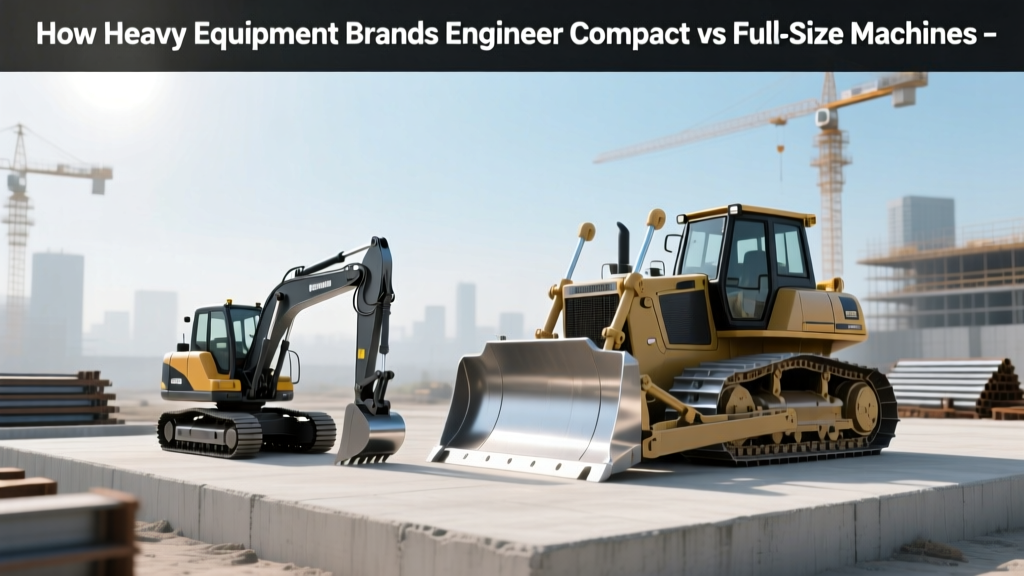
When site managers evaluate heavy equipment brands, the decision between deploying a compact track loader (CTL) and a full-size wheel loader is rarely just about physical footprint. The fundamental divergence lies in the hydraulic architecture and how each machine class translates engine power into implement force. Compact machines and full-size counterparts utilize entirely different fluid power philosophies to achieve their respective design goals.
Compact equipment, such as the Caterpillar 259D3 or Bobcat T770, typically relies on open-center hydraulic systems or basic closed-center gear pump setups. These systems generate a standard hydraulic flow of 23 to 30 gallons per minute (GPM). While high-flow options can push this to 40 GPM, the underlying architecture prioritizes cost-efficiency and packaging density over thermal management. When a compact machine hits relief pressure—such as when stalling a trencher attachment in dense clay—the excess hydraulic energy converts directly into heat, rapidly degrading the fluid and requiring aggressive cooling fan engagement.
Conversely, full-size wheel loaders like the Cat 950 GC or John Deere 544P utilize advanced Closed-Center Load Sensing Systems (CLSS). These machines employ variable-displacement axial piston pumps that deliver up to 75 GPM on demand. According to engineering principles documented by For Construction Pros, CLSS architecture ensures that the pump only generates the exact flow and pressure required by the implement at any given millisecond. This eliminates the 'heat penalty' of open-center systems, allowing full-size machines to run heavy hydraulic attachments like rock grapples or sweepers continuously without derating engine RPMs for cooling.
Data Highlight: The Power-to-Weight Ratio Shift
While a compact CTL boasts a superior power-to-weight ratio for its size (approximately 12.5 hp per 1,000 lbs of operating weight), full-size loaders prioritize breakout force per gallon of fuel. A modern 240-hp wheel loader achieves up to 35,000 lbs of bucket breakout force while maintaining a 15% fuel efficiency advantage over hydrostatic compact equivalents during continuous load-and-carry cycles.
Technical Specification Matrix: Compact CTL vs. Full-Size Wheel Loader
To understand how heavy equipment brands segment their engineering resources, we must look at the raw specifications. The following matrix compares a flagship compact track loader against a mid-sized production wheel loader, reflecting 2026 market configurations.
| Technical Specification | Compact Track Loader (Cat 259D3) | Full-Size Wheel Loader (Cat 950 GC) |
|---|---|---|
| Gross Engine Power | 74.3 hp (55.4 kW) | 241 hp (180 kW) |
| Standard Hydraulic Flow | 23 gpm (87 L/min) | 66 gpm (250 L/min) |
| Operating Weight | 9,300 lbs (4,218 kg) | 42,775 lbs (19,403 kg) |
| Ground Pressure (PSI) | 4.5 psi (Track Dependent) | 33 - 45 psi (Tire Dependent) |
| Bucket Breakout Force | 6,654 lbs (3,018 kg) | 35,120 lbs (15,930 kg) |
| Estimated Base MSRP (2026) | $95,000 - $115,000 | $310,000 - $360,000 |
Chassis Dynamics: Ground Pressure and Soil Shear Strength
The most critical mechanical advantage of compact equipment is its ground pressure profile, a metric heavily emphasized in geotechnical site planning. A compact track loader distributes its 9,300-pound operating weight across a continuous rubber or steel track footprint, yielding a ground pressure of roughly 4.5 to 6.0 PSI. This allows the machine to operate on saturated clay, peat, or finished turf without exceeding the soil's shear strength, thereby preventing rutting and subgrade destruction.
Full-size wheel loaders, despite utilizing large L3 or L5 radial tires (e.g., 23.5R25), concentrate their massive 42,000-pound weight onto four distinct contact patches. This results in ground pressures ranging from 33 to 45 PSI. According to Association of Equipment Manufacturers (AEM) guidelines on site preparation, deploying full-size wheel loaders on uncompact subgrades requires a minimum California Bearing Ratio (CBR) of 10 to 15 to prevent catastrophic sinkage. If the site CBR is below 8, the full-size machine will require thick mats or extensive gravel tracking, negating its cycle-time advantages.
"Engineers do not select machine classes based solely on bucket capacity; they select them based on the bearing capacity of the strata they are driving on. A 3-yard wheel loader is useless if it sinks to its axles in wet loam." — Heavy Machinery Drivetrain Design Principles.
Drivetrain Architecture: Hydrostatic vs. Powershift Torque Delivery
How heavy equipment brands engineer the drivetrain dictates the machine's ideal application. Compact track loaders and skid steers rely on hydrostatic transmissions. In this setup, a hydraulic pump drives a hydraulic motor connected directly to the final drive sprockets. This provides infinite speed control from zero to maximum travel speed without shifting, and it allows the operator to 'stall' the tracks against a pile of material while directing 100% of the engine's hydraulic flow to the bucket curl cylinders for maximum breakout force.
However, hydrostatic drivetrains suffer from parasitic power loss. Approximately 10% to 15% of engine horsepower is lost to fluid friction and heat generation during transport. Full-size wheel loaders solve this by utilizing lock-up torque converters coupled with planetary powershift transmissions. When the Cat 950 GC transitions into 3rd or 4th gear for a long load-and-carry cycle, the torque converter mechanically locks, creating a direct 1:1 drive ratio from the engine to the axles. This mechanical efficiency allows full-size loaders to roading speeds of 23 mph while burning significantly less fuel per ton-mile moved compared to a hydrostatic compact machine.
Decision Framework: Matching Machine Class to Site Variables
Use this step-by-step technical framework to determine whether a compact or full-size class is required for your specific earthmoving parameters:
- Calculate Required Breakout Force: Determine the material density (e.g., blasted shale at 2,800 lbs/cu yd vs. topsoil at 2,100 lbs/cu yd). If the required breakout force exceeds 15,000 lbs to penetrate the windrow, compact machines will experience excessive track spin and undercarriage wear; select a full-size loader.
- Assess Cycle Time and Roading Distance: If the haul distance exceeds 400 feet, the mechanical powershift efficiency of a full-size wheel loader yields a 22% faster cycle time and a 14% reduction in fuel burn compared to hydrostatic compact alternatives.
- Evaluate Transport Logistics: A compact CTL can be transported on a standard 14,000 lb GVWR dual-axle trailer pulled by a 1-ton pickup. Moving a 42,000 lb full-size wheel loader requires a Class 8 semi-truck, a multi-axle lowboy trailer, and often oversize load permits, adding $350 to $600 per mobilization event.
- Verify Attachment Hydraulic Requirements: If utilizing a cold planer requiring 45 GPM at 3,500 PSI, a standard compact machine cannot support the attachment without a high-flow upgrade, whereas a full-size machine provides this flow natively from its primary CLSS pump.
Total Cost of Ownership (TCO) and Fluid Consumption Realities
The operational economics extend far past the initial capital expenditure. Fluid capacities and maintenance intervals scale non-linearly between compact and full-size classes. A compact track loader holds approximately 12 to 15 gallons of hydraulic fluid. A complete hydraulic filter and fluid service costs roughly $450 and can be completed in two hours by a single technician.
In contrast, a full-size wheel loader requires up to 85 gallons of hydraulic oil and utilizes massive spin-on or drop-in cartridge filters. A standard 500-hour service on a full-size machine, including engine oil, hydraulic fluid, DEF, and axle oils, routinely exceeds $2,800 in parts and requires a dedicated service truck. Furthermore, Diesel Exhaust Fluid (DEF) consumption on a 241-hp Tier 4 Final / Stage V full-size engine averages 2 to 3 gallons per day under heavy load, whereas a 74-hp compact engine consumes less than half a gallon daily. Fleet managers must factor these daily consumable costs, alongside the $12,000+ annual undercarriage replacement cost for compact track loaders, into their 60-month depreciation models to accurately compare the true cost per cubic yard moved.
For deeper insights into emissions compliance and Tier 4/Stage V engine integration across different machine classes, refer to the regulatory guidelines published by Caterpillar and the EPA's nonroad diesel engine standards. Understanding these mechanical and economic boundaries is the only way to accurately specify equipment that aligns with both geotechnical limits and project margins.