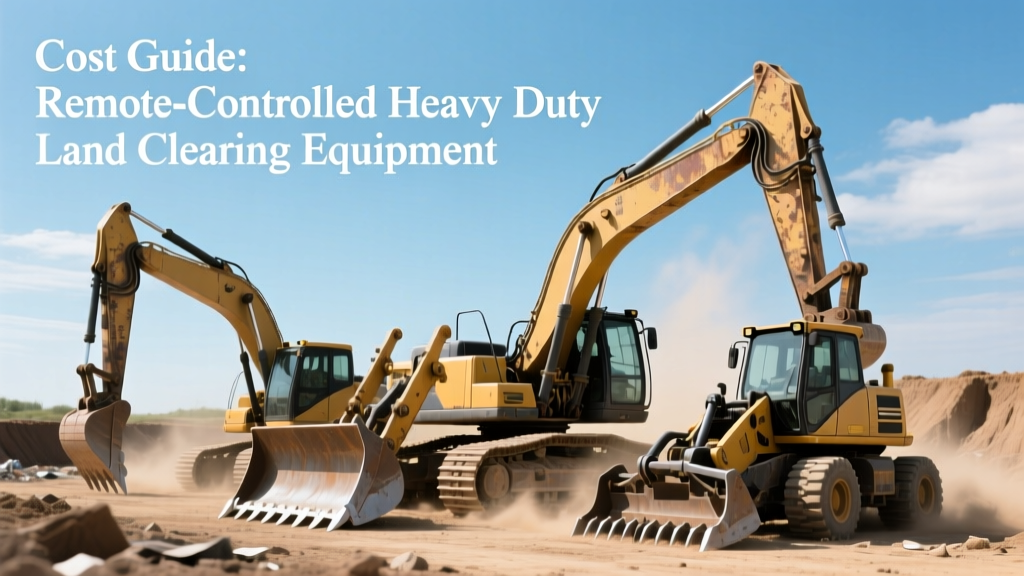
Cost Guide: Remote-Controlled Heavy Duty Land Clearing Equipment
Analyze the true costs of remote-controlled and modular heavy duty land clearing equipment. Compare ROI, attachment pricing, and operational budgets.
The Financial Case for Remote and Modular Clearing
Fleet managers and site contractors are increasingly shifting away from dedicated, single-purpose machines toward modular, remote-controlled platforms. When budgeting for heavy duty land clearing equipment in 2026, the initial capital expenditure (CapEx) of a remote tool carrier often triggers sticker shock. However, evaluating these systems strictly on purchase price ignores the massive operational expenditure (OpEx) savings generated by modularity, reduced insurance premiums, and the elimination of hazard pay for steep-slope operations.
Executive Cost Snapshot: A fully equipped remote modular carrier system (base power unit + heavy-duty drum mulcher + flail mower) typically requires a CapEx of $145,000 to $195,000. This represents a 20-25% premium over a dedicated, manned skid-steer mulcher. However, OpEx reductions in rollover insurance, operator hazard pay, and off-season idle time yield a break-even point at roughly 850 operating hours.CapEx Breakdown: Base Units, Power Packs, and Modular Heads
The core financial advantage of modular heavy duty land clearing equipment lies in the separation of the power pack (the tracked base carrier) from the work tool (the attachment). Unlike a dedicated forestry tractor that sits idle during non-clearing months, a remote carrier like the Energreen RoboEVO or Rayco RG74 can be reconfigured for right-of-way mowing, stump grinding, or even snow removal.
2026 Pricing Matrix: Remote Carriers and Modular Attachments
| Component Category | Example Models / Specs | Estimated 2026 Cost | Budget Allocation Notes |
|---|---|---|---|
| Base Remote Carrier (50-75 HP) | Rayco RG50, Fecon F70, Ahlmann AS 1600 | $85,000 - $115,000 | Includes RF remote telemetry and Tier 4 Final/Stage V engine compliance. |
| Heavy-Duty Drum Mulcher | FSI Power Systems C700, Fecon Bull Hog | $32,000 - $45,000 | Requires high-flow hydraulics (min. 30 GPM). Carbide teeth add $2,500. |
| Heavy-Duty Flail Mower | Energreen Tornado, AHWI FM800 | $18,000 - $26,000 | Ideal for softwood and brush. Lower hydraulic demand (15-20 GPM). |
| Quick-Attach Interface Kit | Universal Skid Steer Adapter + Hydraulic Couplers | $3,500 - $6,000 | Do not skip flat-face couplers to prevent hydraulic contamination. |
OpEx Variables: Hydraulics, Telematics, and Labor Reallocation
Budgeting for the purchase is only the first step. The ongoing operational costs of remote-controlled heavy duty land clearing equipment introduce unique variables that fleet controllers must account for in their annual forecasts.
The Hydraulic Flow Penalty and Pump Wear
A frequent budget killer in modular systems is hydraulic mismatching. A base carrier might output 25 gallons per minute (GPM) at 5,000 PSI, but a heavy-duty drum mulcher requires 35 GPM to maintain rotor inertia when processing dense hardwood like oak or hickory. If an operator forces a high-demand head onto an under-specced carrier, the system will constantly hit pressure relief valves. This generates excessive heat, degrading the hydraulic fluid and prematurely destroying the main hydraulic pump—a replacement cost that routinely exceeds $8,500 plus downtime. Always budget for a high-flow auxiliary hydraulic upgrade ($4,000 - $7,000) if you plan to run aggressive drum mulchers.
Insurance and Rollover Risk Mitigation
According to safety data tracked by the National Institute for Occupational Safety and Health (NIOSH), heavy equipment rollovers on steep terrain remain a leading cause of fatal site injuries. Manned dozers and excavators operating on 25-degree slopes require specialized rollover insurance policies and hazard pay premiums (often adding $12 to $18 per hour to the operator's burdened labor rate). Remote-controlled carriers completely remove the operator from the hazard zone. Contractors frequently report a 15% to 30% reduction in fleet liability insurance premiums when transitioning to remote-operated clearing equipment, as the risk of catastrophic human injury drops to near zero.
ROI Framework: When Does Remote-Modular Beat Traditional Manned?
To determine if the premium for remote modularity is justified, site managers should apply the following decision matrix based on terrain, vegetation density, and annual utilization.
Fleet Decision Matrix: Remote vs. Manned Excavator
- Choose Remote Modular If: Slopes exceed 20 degrees; vegetation is mixed (requires swapping from mulcher to mower); annual utilization is under 1,200 hours; local labor market lacks certified heavy forestry operators.
- Choose Manned Excavator/Dozer If: Terrain is flat; primary task is moving dirt alongside clearing; annual utilization exceeds 1,800 hours; material requires sorting and loading (which remote mulchers cannot do).
The Association of Equipment Manufacturers (AEM) frequently highlights that telematics and remote operation are the fastest-growing segments in compact and forestry equipment, driven largely by the shrinking pool of skilled heavy equipment operators. Paying a remote operator $48/hour to manage two semi-autonomous units from a climate-controlled command truck yields a vastly superior cost-per-acre cleared compared to paying two manned operators $42/hour each.
Hidden Costs and Edge Cases in Modular Systems
When building your 2026 equipment budget, allocate a specific contingency fund for the following edge cases unique to remote and modular heavy duty land clearing equipment:
- Telemetry and Antenna Damage: Remote units rely on RF or cellular signals to communicate with the operator's transmitter. In dense canopy or rocky ravines, antennas are frequently snapped by falling limbs. Budget $450 per replacement antenna, and anticipate at least two replacements per season per machine.
- Quick-Attach Pin Wear: Swapping a 2,500 lb mulcher head for a 1,500 lb mower repeatedly causes accelerated wear on the quick-attach locking pins and the carrier's mounting plate. If the pins shear under load, the attachment can detach on a slope. Inspect and replace locking pins ($300 per set) every 500 hours.
- Track Tension and Undercarriage Blowouts: Remote carriers operate in environments where the operator cannot physically feel the track tension. Running over hidden stumps can easily pop a rubber track or damage the idler. Budget $3,200 annually for undercarriage wear and track replacements, which is roughly 20% higher than a manned machine where the operator can feel and avoid obstructions.
Depreciation and Resale Value Dynamics
From an accounting perspective, modular carriers depreciate more favorably than dedicated machines. A dedicated forestry mulcher is highly seasonal; it sits idle for four to five months in many northern climates, yet the engine hours and calendar depreciation continue. A modular remote carrier, equipped with a snow blower or angle broom attachment, can generate revenue year-round. This continuous utilization spreads the CapEx over more billable hours, lowering the effective hourly machine rate. Furthermore, the secondary market for base power units remains robust, as buyers can adapt them to their own specific attachment needs, preserving residual values at approximately 45-55% of the original purchase price after five years.
Final Budgeting Checklist for Fleet Managers
Before signing a purchase order for remote-controlled heavy duty land clearing equipment, ensure your budget includes line items for: high-flow hydraulic upgrades, flat-face hydraulic couplers, spare telemetry antennas, specialized quick-attach pin replacements, and operator certification training for remote RF systems. By accounting for these specific modular and remote variables, contractors can accurately forecast a 22% to 28% reduction in overall cost-per-acre cleared compared to traditional manned fleets.