Heavy Equipment Lego Models vs. Digital Twins for Port Crane Design
Compare heavy equipment Lego prototypes and digital twins for port crane design. Explore gear ratios, kinematics, and material limits for STS and RTG cranes.
The Tactile Advantage in Marine Port Kinematics
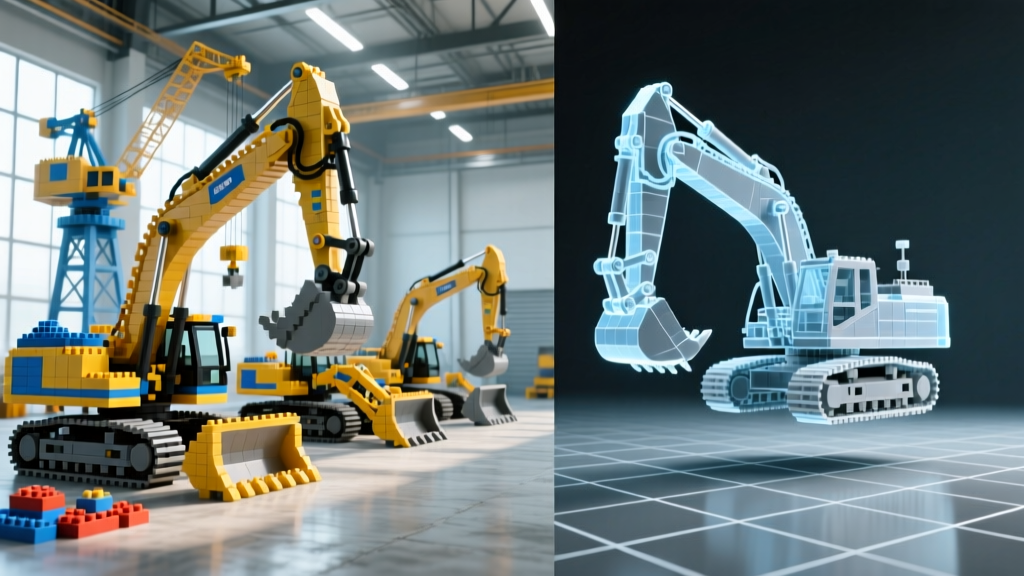
Designing Ship-to-Shore (STS) gantry cranes and Rubber-Tired Gantry (RTG) cranes requires resolving complex kinematic interference and mechanical linkage routing before multi-million-dollar steel fabrication begins. In 2026, while digital twins and Finite Element Analysis (FEA) dominate terminal planning, physical modular modeling remains a critical, tactile alternative for rapid mechanism prototyping. Frequently searched by engineering students, hobbyists, and conceptual designers as 'heavy equipment Lego', advanced modular brick systems—specifically precision-engineered lines like Lego Technic—offer a unique physical sandbox for testing gear trains, universal joints, and linear actuator limits in marine cargo handling machinery.
The primary advantage of physical modular prototyping is spatial intuition. When designing the trolley traverse system for a ZPMC STS crane, CAD software can flag geometric collisions, but it often fails to convey the physical 'feel' of gear backlash, cable routing friction, and center-of-gravity shifts under eccentric loads. By building a 1:40 scale functional model using modular ABS plastic components, marine engineers can physically manipulate the hoist and trolley mechanisms, identifying non-obvious mechanical binding that digital simulations might overlook.
Terminology Note: The 'Heavy Equipment Lego' Phenomenon
While 'Lego' is a trademarked brand name for interlocking plastic bricks, the search term 'heavy equipment Lego' has become an industry-adjacent colloquialism for modular kinematic prototyping kits. In professional engineering contexts, these are referred to as modular brick-based mechanical modeling systems. They are utilized not as toys, but as low-fidelity physical simulators for validating mechanical logic before committing to high-fidelity digital twins or CNC-machined metal prototypes.
Translating STS Hoist Mechanics to Modular Gears
To understand the utility of modular brick prototyping in port equipment design, we must examine the translation of real-world marine crane mechanics into modular components. A standard Konecranes STS hoist mechanism relies on heavy-duty planetary gearboxes, often supplied by SEW-Eurodrive or Flender, featuring reduction ratios upwards of 120:1 to manage the immense torque required to lift 65-ton spreader loads at 180 meters per minute.
Replicating this in a modular physical model requires a deep understanding of gear geometry and torque multiplication. Engineers utilize standard modular spur gears to create compound reduction trains. For example, pairing an 8-tooth pinion gear with a 24-tooth spur gear yields a 3:1 reduction. By stacking three of these stages on parallel axles, a designer can achieve a 27:1 reduction ratio in a compact physical footprint. This physical exercise forces the designer to confront real-world packaging constraints: axle deflection, gear mesh depth, and structural bracing for the gearbox housing.
Identifying Failure Modes in Physical Prototypes
When testing a modular RTG crane steering mechanism—specifically the 90-degree crab steering capability required for terminal block transfers—physical models excel at revealing failure modes. If the universal joints (U-joints) in the modular model bind at extreme steering angles, the physical model will simply stall or pop a gear. This immediate, tactile feedback alerts the engineer to adjust the steering linkage geometry or implement a constant-velocity (CV) joint equivalent in the final CAD design, saving weeks of digital troubleshooting.
Comparative Matrix: Physical Prototypes vs. Digital Terminal Simulators
While physical modular kits offer tactile kinematic validation, they cannot replace the data-driven throughput analysis provided by digital terminal simulation software like AnyLogic or Siemens Tecnomatix. Below is a direct comparison of these two methodologies for port machinery design in 2026.
| Criteria | Modular Brick Prototype (Physical) | Digital Twin Simulation (Software) |
|---|---|---|
| Primary Use Case | Kinematic linkage validation, spatial packaging, gear train logic. | Terminal throughput, fleet optimization, dynamic load FEA. |
| Cost (2026 Estimates) | $500 - $2,500 per comprehensive crane kit. | $45,000 - $150,000+ for enterprise terminal licenses. |
| Iteration Speed | Minutes to hours (physical disassembly/reassembly). | Seconds (parameter adjustment and re-rendering). |
| Material Physics | Limited to ABS plastic tensile limits; no wind load testing. | Full FEA capabilities, including F2 hurricane wind loads. |
| Stakeholder Communication | Excellent for non-technical port authority board members. | Requires data visualization expertise to interpret heat maps. |
Material Physics: ABS Plastic vs. Marine-Grade S355 Steel
The most critical limitation of using modular plastic bricks for heavy equipment prototyping is material physics. Real-world marine port equipment is constructed from high-tensile structural steel, typically S355 or equivalent marine-grade alloys, designed to withstand severe dynamic loading, saltwater corrosion, and high-cycle fatigue. A modern STS crane boom can span over 70 meters and must endure immense torsional stress when the trolley accelerates to 240 m/min with a fully loaded spreader.
The Torsion and Deflection Gap
Modular ABS plastic components possess a tensile strength of approximately 40-50 MPa, compared to the 470-630 MPa tensile strength of S355 steel. Consequently, a physical modular model cannot be used to test structural deflection or boom torsion. If an engineer attempts to scale the exact load ratios down to a 1:40 physical model, the plastic axles and connector pins will shear immediately. Therefore, physical modular prototyping must be strictly confined to mechanism logic and kinematics, while structural integrity must be deferred to digital FEA software like Ansys or Abaqus.
Engineering Warning: Never use physical modular plastic models to calculate real-world gear tooth shear limits or motor torque requirements. The friction coefficients of ABS-on-ABS plastic gearing differ wildly from hardened steel-on-steel planetary gears. Use physical models strictly to verify that the gear train logic achieves the desired directional output and ratio without spatial binding.2026 Decision Framework for Port Engineers
When planning the development cycle for a new piece of marine cargo handling equipment, engineering teams must decide where physical modular modeling fits into the workflow. Use the following decision matrix to determine the appropriate prototyping method:
- IF you are conceptualizing a novel spreader twist-lock mechanism or a new cable-reel routing path for an RTG crane, THEN build a modular physical prototype first. The tactile feedback will resolve spatial interference in hours rather than days.
- IF you need to validate the structural boom deflection of a 24-row outreach STS crane under a 65-ton eccentric load, THEN bypass physical modeling entirely and utilize digital FEA.
- IF you are pitching a fully automated terminal layout to a port authority board of directors, THEN use a large-scale modular physical model alongside digital throughput data. Physical models bridge the comprehension gap for stakeholders who struggle to interpret 3D CAD wireframes or simulation heat maps.
- IF you are calculating the exact hoist motor kW requirements and gearbox thermal dissipation, THEN rely on digital kinematic solvers (like MATLAB/Simulink) paired with OEM gearbox specification sheets.
Synthesizing Physical and Digital Workflows
The most successful marine heavy equipment manufacturers in 2026 do not view physical modular kits and digital twins as mutually exclusive alternatives; they use them sequentially. The physical 'heavy equipment Lego' approach serves as the rapid-ideation sandbox, allowing mechanical engineers to physically manipulate linkages, test gear train packaging, and validate steering geometries on a desk. Once the kinematic logic is proven and spatial constraints are locked in, the exact dimensions and ratios are ported into digital CAD and simulation environments for structural FEA, dynamic load testing, and terminal throughput analysis. By leveraging the tactile speed of modular bricks and the computational power of digital twins, port machinery designers can drastically reduce the time-to-fabrication for the next generation of marine cargo handling equipment.