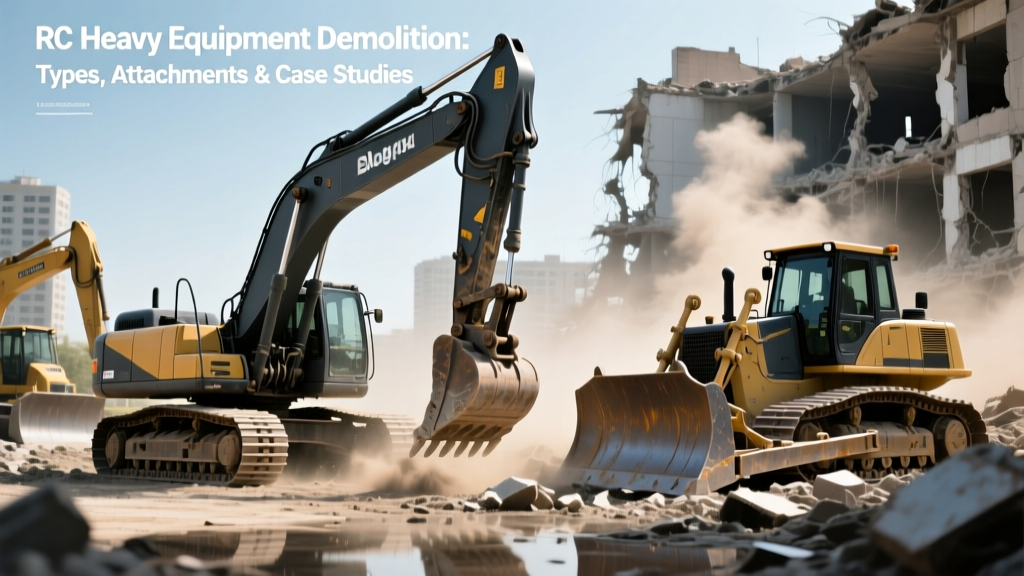
RC Heavy Equipment in Demolition: Types, Attachments & Case Studies
Discover how RC heavy equipment and remote-controlled demolition robots utilize specialized attachments for hazardous teardowns, featuring 2026 case studies.
The Shift to Remote-Controlled Demolition
Manual demolition using handheld pneumatic breakers exposes operators to severe risks, including silica dust inhalation, hand-arm vibration syndrome (HAVS), and structural collapse. In 2026, the industry standard for hazardous or confined-space teardowns has shifted decisively toward RC heavy equipment—specifically, remote-controlled demolition robots. These machines allow operators to manage multi-ton teardowns from a safe distance, utilizing a modular suite of hydraulic attachments to crush, shear, and pulverize reinforced concrete.
According to OSHA demolition standards, minimizing human presence in the immediate collapse zone is a primary safety directive. RC demolition platforms fulfill this mandate while delivering higher cycle times and precision than manual labor.
Classification of RC Demolition Heavy Equipment
Remote-controlled demolition machines are categorized by operating weight and footprint, which dictate their access capabilities and hydraulic flow rates.
1. Micro-Class (Under 1 Ton)
Designed for interior commercial renovations and residential teardowns, micro-class RC heavy equipment fits through standard 30-inch doorways and can be transported via standard passenger elevators.
- Top Models: Brokk 70, Husqvarna DXR 140.
- Hydraulic Flow: 15–25 gallons per minute (GPM).
- Base Pricing: $85,000 – $115,000.
2. Compact-Class (1 to 2 Tons)
These units balance extreme power with a relatively narrow track width. They are the workhorses of industrial plant decommissioning and mid-rise structural teardowns.
- Top Models: Brokk 120, Husqvarna DXR 270.
- Hydraulic Flow: 25–40 GPM.
- Base Pricing: $140,000 – $190,000.
3. Heavy-Class (2+ Tons)
Deployed for massive infrastructure projects, bridge abutment removal, and nuclear decommissioning. These units feature reinforced booms and advanced cooling systems for continuous 24/7 operation.
- Top Models: Brokk 520, Husqvarna DXR 310.
- Hydraulic Flow: 40–60+ GPM.
- Base Pricing: $280,000 – $450,000+.
Mission-Critical Demolition Attachments & Pricing
The versatility of RC heavy equipment lies in its quick-coupler attachment system. Below is a breakdown of the primary attachment types used in modern demolition, complete with specific model references and 2026 market pricing.
| Attachment Type | Specific Model Example | Primary Application | Key Metric | Est. Cost (2026) |
|---|---|---|---|---|
| Hydraulic Breaker | Husqvarna HB 150 / Brokk BBE 450 | Fracturing thick concrete slabs and foundations | 1,200 - 1,500 ft-lb impact energy | $12,000 - $18,000 |
| Concrete Crusher | Darda CC310 | Pulverizing walls and separating rebar from concrete | 140 tons crushing force | $18,000 - $24,000 |
| Hydraulic Shear | HSP 1500 Series | Slicing structural steel I-beams and heavy rebar | 850 tons shearing force | $22,000 - $28,000 |
| Drum Cutter | Erkat ER 150 | Precision trenching, low-vibration concrete shaving | 15-45 kW cutting power | $15,000 - $21,000 |
2026 Industry Case Studies: RC Heavy Equipment in Action
Case Study 1: High-Radiation Nuclear Decommissioning
During the ongoing decommissioning of legacy nuclear facilities in the UK and US, human entry into reactor containment buildings is restricted due to residual gamma radiation. Engineering firms deploy heavy-class RC heavy equipment, such as the Brokk 520, fitted with specialized radiation-shielded cameras and hardened hydraulic hoses.
The Execution: The operator sits in a climate-controlled, lead-lined command center up to 300 feet away. Using a 3-axis joystick and haptic feedback controllers, the operator maneuvers a hydraulic shear to dismantle contaminated stainless-steel reactor vessels. The RC platform's electric or Tier-4 diesel powerpack ensures zero exhaust buildup in the sealed containment dome, while the remote operation limits human exposure to near-zero millisieverts (mSv).
Case Study 2: Live-Hospital Interior Renovation
A major metropolitan hospital required the removal of 4,000 square feet of reinforced concrete flooring directly above an active MRI and surgical suite. Traditional jackhammers or standard excavators would transmit seismic vibrations capable of misaligning the MRI's superconducting magnets and disrupting delicate surgeries.
The Execution: The contractor utilized a micro-class Husqvarna DXR 140 equipped with an Erkat ER 150 drum cutter. Instead of impacting the concrete, the drum cutter's tungsten-carbide picks milled the slab away layer by layer. This reduced seismic vibration transmission by 94% compared to pneumatic breaking, allowing the hospital to remain fully operational during the 6-week teardown.
"The integration of drum cutters on micro-class RC demolition robots has completely changed interior commercial demolition. We can shave concrete down to the rebar mat without triggering the building's structural vibration alarms." — Lead Project Engineer, Commercial Demolition Services
The Role of Scale RC Heavy Equipment in BIM Validation
Beyond full-size industrial robots, the demolition sector has adopted an unconventional planning tool: high-fidelity, 1:14 scale RC heavy equipment models. Custom engineering firms utilize hydraulically actuated scale models (often built on modified chassis with proportional valve blocks) to physically simulate demolition sequences in confined spaces.
Before deploying a $300,000 Brokk 520 into a complex subterranean parking garage teardown, engineers will map the space and run a physical scale RC model through the environment. This physical validation catches boom-collision blind spots and articulation limits that 3D Building Information Modeling (BIM) software sometimes fails to calculate accurately due to hydraulic hose routing and real-world debris accumulation.
Decision Framework: When to Deploy RC Demolition Robots
RC heavy equipment commands a premium hourly operating cost compared to standard mini-excavators. Use this framework to determine if the investment is justified for your project:
Deploy RC Demolition Robots When:- The work environment contains hazardous materials (asbestos, lead, radiation, chemical residue).
- Overhead clearance is below 8 feet, or floor load-bearing capacity cannot support a standard excavator with a cab.
- Seismic vibration limits are strictly enforced by adjacent sensitive infrastructure.
- The project requires continuous 24/7 teardown cycles where operator fatigue in a manual cab would cause a drop in productivity.
- The site is an open-air, greenfield demolition with no structural collapse risk to the operator.
- High-volume material loading (moving loose rubble into dump trucks) is the primary task, rather than precision breaking.
Maintenance and Edge Cases
A common failure mode with RC demolition equipment is the degradation of the remote control umbilical cable or wireless receiver interference. In heavy rebar environments, dense steel meshes can block 2.4 GHz wireless signals. Always specify machines with dual-band RF capabilities or hardwired fiber-optic umbilical backups for subterranean or heavily reinforced concrete environments. Furthermore, hydraulic quick-couplers must be purged daily; concrete dust ingress into the auxiliary hydraulic lines is the leading cause of attachment valve failure in these machines.