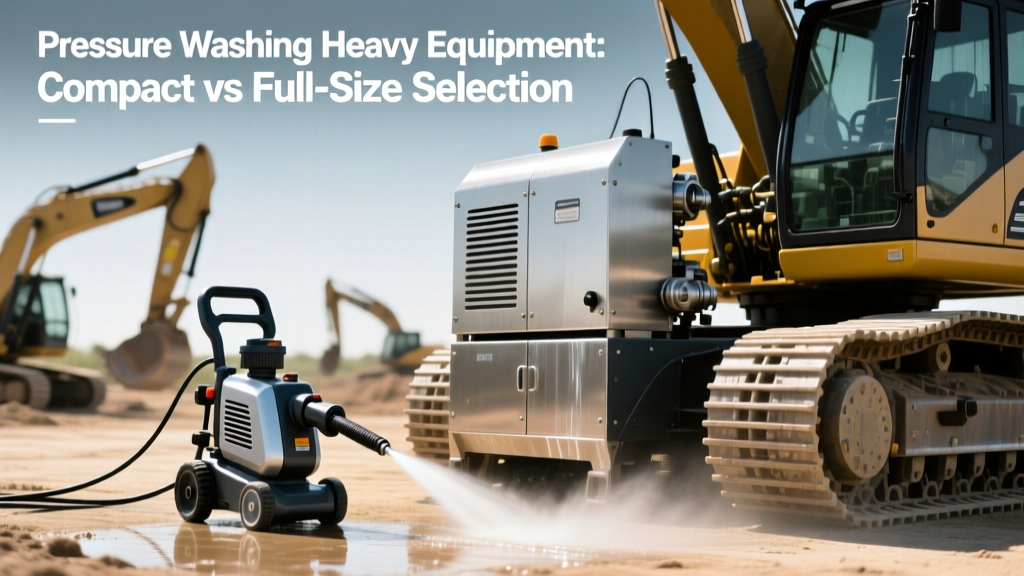
Pressure Washing Heavy Equipment: Compact vs Full-Size Selection
Compare technical specs for pressure washing heavy equipment. Learn PSI, GPM, and thermal requirements for compact vs full-size construction machinery.
The selection of compact vs full-size construction equipment for a mixed fleet dictates entirely different maintenance infrastructures. When it comes to pressure washing heavy equipment, a one-size-fits-all approach leads to destroyed telemetry sensors on compact machines or inadequate grease removal on full-size dozers. Understanding the hydrodynamic and thermal requirements for both tiers is critical for fleet managers aiming to maximize asset lifespan and comply with environmental runoff standards.
The Hydrodynamics of Dirt: Impact Force vs. Flow Rate
Cleaning power in industrial washing is not determined by pressure alone. The fundamental metric is Cleaning Units (CU), calculated by multiplying Pounds per Square Inch (PSI) by Gallons Per Minute (GPM). Pressure provides the impact force to break the bond between the contaminant and the substrate, while flow rate provides the flushing volume to carry the debris away.
Technical Insight: A 4000 PSI / 4 GPM machine (16,000 CU) will strip paint but fail to flush mud from a full-size excavator undercarriage. Conversely, a 2500 PSI / 8 GPM machine (20,000 CU) will rapidly flush heavy clay without risking hydraulic line damage. For fleet maintenance, GPM is often the more critical variable for throughput.Technical Specifications for Compact Construction Equipment
Compact construction equipment—such as skid steers (e.g., Bobcat S86), compact track loaders, and mini excavators (e.g., Kubota KX057-5)—features densely packed engine bays, exposed hydraulic hoses, and sensitive electronic control modules (ECMs) located near the chassis floor.
Washdown Parameters and Failure Modes
- Target PSI: 2,000 to 2,500 PSI. Exceeding 3,000 PSI risks cutting through standard hydraulic hose sheathing and forcing water past axle seals and cab weatherstripping.
- Target GPM: 4 to 5 GPM. Sufficient to rinse biodegradable degreasers without overwhelming the machine's drainage channels.
- Water Temperature: Ambient to 120°F. High-temperature water can warp the polycarbonate windows common in compact cabs and degrade the adhesive on wiring harness wraps.
- Primary Failure Mode: High-pressure injection into the engine air intake or ECM connectors, leading to catastrophic short circuits. Modern compact equipment relies heavily on CAN bus networks; a single water-compromised connector can disable the entire machine.
Recommended Pump Configuration
For compact equipment wash bays, a direct-drive triplex plunger pump operating at 3400 RPM is sufficient. These units are typically paired with a 13HP to 15HP gasoline engine (such as the Honda GX390 or Vanguard equivalent). Because compact machines require less aggressive flushing, the daily runtime of the pump rarely exceeds 3 hours, making the thermal limitations of direct-drive pumps acceptable.
Technical Specifications for Full-Size Construction Equipment
Full-size construction equipment selection—encompassing large wheel loaders (e.g., Cat 966), motor graders, and 50-ton excavators (e.g., Komatsu PC490LC)—introduces massive surface areas and heavy concentrations of Extreme Pressure (EP) lithium-complex greases in pivot joints and undercarriages.
Thermal Dynamics and Undercarriage Flushing
Cold water, regardless of pressure, will not dissolve EP grease. The technical specification for full-size equipment mandates a hot-water pressure washer capable of sustaining 180°F to 200°F at the nozzle tip.
- Target PSI: 3,500 to 4,000 PSI. Required to break the mechanical bond of compacted clay and cured concrete slurry found on demolition and foundation equipment.
- Target GPM: 8 to 10+ GPM. Essential for the sheer volume of water needed to flush the deep crevices of a D6 dozer undercarriage.
- Heating Coil Specifications: Schedule 80 steel pipe coils are mandatory. Schedule 40 coils will suffer thermal fatigue and rupture under continuous 200°F operation. The burner must be rated for a minimum of 350,000 BTUs to maintain temperature at high flow rates.
Recommended Pump Configuration
Full-size fleet washing requires a belt-driven or gear-reduction triplex pump (operating at 900 to 1400 RPM). Running a pump at lower RPMs drastically reduces internal friction and heat generation, allowing for 8-hour continuous daily operation. The Association of Equipment Management Professionals (AEMP) emphasizes that preventive maintenance infrastructure, including wash pads, must be scaled to handle the peak operational tempo of heavy earthmoving fleets without equipment bottlenecking.
Compact vs. Full-Size Washdown Matrix
| Specification | Compact Equipment (Skid Steers, Mini Ex) | Full-Size Equipment (Dozers, Large Ex) |
|---|---|---|
| Operating PSI | 2,000 - 2,500 PSI | 3,500 - 4,000 PSI |
| Flow Rate (GPM) | 4 - 5 GPM | 8 - 10+ GPM |
| Water Temperature | Ambient - 120°F | 180°F - 200°F (Hot Water) |
| Pump Drive Type | Direct Drive (3400 RPM) | Belt/Gear Reduction (900-1400 RPM) |
| Chemical Injection | Downstream (Low Pressure) | Upstream/High-Pressure Proportioners |
| Primary Risk | ECM/Sensor Water Intrusion | Under-greasing / Coil Rupture |
Component Breakdown: How the System Works
To properly execute pressure washing heavy equipment, operators must understand the internal mechanics of the wash rig. The unloader valve is the most critical component in the system. When the operator releases the trigger, the unloader diverts the pressurized water back into the pump inlet or a bypass loop. If the unloader valve is improperly calibrated for a high-GPM full-size rig, the bypassed water will rapidly boil inside the pump manifold due to friction, destroying the ceramic plungers and V-packings.
Nozzle Geometry and Impact
The nozzle orifice size must be perfectly matched to the pump's GPM and the engine's horsepower. An undersized nozzle will cause the pressure to spike, stalling the engine or bursting a hose. An oversized nozzle will cause a pressure drop, rendering the wash ineffective.
- 0-Degree (Red): Never use on construction equipment. It acts as a water laser and will slice through steel tracks and hydraulic lines.
- 15-Degree (Yellow): Used for breaking caked clay off full-size excavator buckets and ripper shanks.
- 25-Degree (Green): The standard workhorse nozzle for general chassis washing on both compact and full-size units.
- Rotary/Turbo Nozzles: These encase a 0-degree nozzle in a spinning ceramic housing. They increase impact force by up to 40% without increasing the system PSI, making them ideal for stripping dried concrete from mixer drums and pavers without exceeding the safe PSI limits of the machine's paint.
Environmental Compliance and Runoff Management
The selection of compact vs full-size construction equipment also impacts the volume of wastewater generated. Washing a fleet of full-size earthmovers generates hundreds of gallons of water per hour, heavily laden with suspended solids, heavy metals, and petroleum hydrocarbons.
Fleet managers must adhere to the Environmental Protection Agency's (EPA) guidelines regarding industrial wash water. Discharging untreated wash water into municipal storm drains is a violation of the Clean Water Act's NPDES regulations. Full-size wash pads require multi-stage oil-water separators and clarifier tanks to capture grease and silt before the water is either recycled through a closed-loop filtration system or discharged to the sanitary sewer. Compact equipment wash bays, generating significantly less volume, can often utilize portable containment berms and vacuum extraction systems to manage runoff.
Fleet Selection Decision Framework
When building out your maintenance infrastructure, use this framework to select the correct pressure washing setup based on your equipment selection:
- Audit the Fleet Composition: If your fleet is 80% compact equipment (landscaping, utility work), invest in multiple 2,500 PSI / 5 GPM cold-water direct-drive units. They offer lower capital expenditure and high mobility.
- Identify the Bottleneck: If you operate full-size grading and excavation equipment, a single 4,000 PSI / 10 GPM hot-water belt-driven rig is mandatory. The capital cost is 3x to 4x higher, but it reduces wash time per machine from 90 minutes to 20 minutes.
- Implement Chemical Dwell Time: Regardless of machine size, apply a heavy-duty, biodegradable alkaline degreaser via a downstream foamer. Allow a 5-to-10-minute dwell time before rinsing. This chemical action reduces the required mechanical PSI, protecting sensitive components on compact machines while ensuring deep-clean results on full-size iron.
Aligning your pressure washing technical specifications with the specific tier of construction equipment you operate ensures optimal asset preservation, reduces unplanned downtime caused by wash-bay damage, and maintains strict environmental compliance.