Is a Heavy Equipment Extended Warranty Worth It for Port Cranes?
Discover how marine ports leverage a heavy equipment extended warranty to cut STS crane downtime costs. Explore ROI case studies and marine coverage tips.
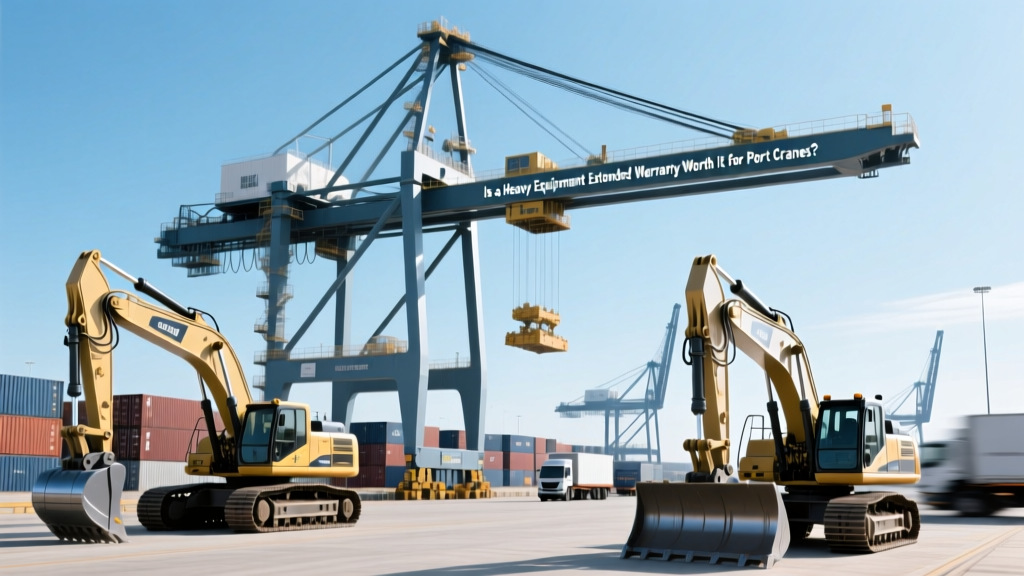
Ship-to-shore (STS) gantry cranes and rubber-tired gantry (RTG) cranes operate in one of the most unforgiving environments in heavy industry. Saltwater aerosols, 24/7 load cycling, and extreme wind shear accelerate component fatigue far beyond the parameters of standard construction machinery. When a Super Post-Panamax STS crane suffers a hoist motor failure, the resulting vessel demurrage and terminal bottleneck can cost upwards of $15,000 per hour. Consequently, evaluating a heavy equipment extended warranty for marine and port applications requires a fundamentally different calculus than standard earthmoving equipment.
The Saltwater Tax: Why Standard OEM Warranties Fail at Ports
Standard OEM warranties typically expire at 3,000 to 5,000 operating hours or 24 months. In a high-throughput marine terminal, an automated RTG (ARTG) can log 6,000 hours annually. This leaves ports entirely exposed to catastrophic drivetrain and structural fatigue during years three through ten—the statistical peak for major component failures in marine environments.
Underwriters classify marine terminals as 'severe duty' environments. Standard heavy machinery policies often contain explicit exclusions for 'saltwater corrosion,' 'galvanic degradation,' and 'environmental ingress.' If a spreader twistlock fails due to internal rust, a standard policy will deny the claim, citing inadequate preventative maintenance. To secure comprehensive protection, port authorities must negotiate specialized marine riders. According to OSHA's Marine Terminals standards (29 CFR 1917), the rigorous inspection requirements for load-bearing crane components mean that warranty providers will demand meticulous, digitized maintenance logs before honoring a claim.
⚠️ Warning: The 'Consequential Damage' TrapMany baseline extended warranties cover the failed part (e.g., a $4,500 PLC controller) but exclude the consequential damage caused by its failure (e.g., a $90,000 hoist drum damaged when the PLC failed to engage the brake). Always ensure your marine policy explicitly includes 'consequential mechanical breakdown' coverage.
Aggregated Case Study: Gulf Coast Terminal RTG Fleet Restructuring
To understand the financial mechanics, we analyzed the warranty restructuring of a Tier-2 US Gulf Coast container terminal managing a fleet of 14 Kalmar diesel-electric RTGs and 4 Konecranes Super Post-Panamax STS cranes. In 2024, the terminal faced $2.1 million in out-of-warranty drivetrain repairs due to saltwater ingress in the gantry drive motors.
The Intervention
Instead of renewing a standard comprehensive policy, the terminal's procurement team negotiated a customized heavy equipment extended warranty focused exclusively on high-value, high-failure-rate marine components. They accepted higher deductibles on structural wear items (like boom sheaves and wire ropes) in exchange for zero-deductible coverage on sealed electrical and drivetrain components.
- Previous Annual Premium (Standard Policy): $850,000 (with $25,000 deductibles per claim and strict corrosion exclusions).
- Restructured Marine Premium: $610,000 (with $50,000 deductibles on structural, $0 on drivetrain/electrical, and inclusive of galvanic corrosion riders).
- First-Year Claim Payouts: $1.4 million (covering three complete hoist gearbox rebuilds and multiple PLC replacements previously denied under the old policy).
The net savings in the first year, factoring in avoided vessel demurrage penalties, exceeded $900,000. The critical lesson was shifting the warranty focus from 'blanket coverage' to 'vulnerability-specific coverage.'
Component-Level Coverage Matrix: What to Actually Insure
Not all crane components carry the same financial risk. When structuring your coverage, use this matrix to prioritize your premium spend based on 2026 replacement costs and marine failure rates.
| Equipment Type | High-Risk Component | Replacement Cost (2026 Est.) | Warranty Priority |
|---|---|---|---|
| STS Crane | Hoist Gearbox & Motor Assembly | $110,000 - $145,000 | Critical |
| STS Crane | Spreader Twistlock Assembly | $12,000 - $18,000 | High (Wear Item) |
| RTG Crane | Gantry Drive Motor & Inverter | $25,000 - $35,000 | Critical |
| Reach Stacker | Telescopic Boom Wear Pads | $8,000 - $12,000 | Low (Maintenance) |
Calculating the True ROI of a Heavy Equipment Extended Warranty
The ROI of marine port coverage is not calculated merely by comparing premium costs to repair invoices. In marine logistics, the primary ROI metric is downtime mitigation. According to data from the UNCTAD Review of Maritime Transport, port efficiency and turnaround times are directly tied to global supply chain fluidity, making crane availability a macroeconomic factor.
Let us model a 5-year extended warranty on a fleet of six Konecranes Ship-to-Shore cranes.
The Financial Model
- Annual Premium Cost: $160,000 per crane ($960,000 fleet total).
- Average Downtime Cost: $12,500 per hour (including vessel demurrage, truck idling, and labor reallocation).
- Warranty SLA Guarantee: The specialized marine warranty includes a guaranteed 24-hour on-site technician dispatch and pre-positioned critical spares (hoist motors and PLC racks) stored at the terminal.
Without the warranty and the associated SLA, procuring a specialized hoist motor from Europe or Asia can take 14 to 21 days. At 24 hours of operation per day, a 14-day outage costs the terminal $4.2 million. By securing a warranty that mandates localized spare parts caching and immediate dispatch, the terminal reduces maximum downtime to 48 hours ($600,000). The warranty effectively acts as a $3.6 million risk mitigation instrument for a $960,000 premium.
Telematics and the Predictive Maintenance Mandate
In 2026, underwriting a heavy equipment extended warranty for port machinery is inextricably linked to IoT telematics. Insurers no longer rely on static actuarial tables; they mandate real-time data access via the crane's native PLC (Programmable Logic Controller).
'We no longer underwrite port cranes based on historical failure rates; we underwrite them based on real-time vibration analysis and thermal imaging data from the hoist motors. If a terminal disables their telematics feed or ignores automated grease-cycle alerts, the warranty is voided immediately.'
— Senior Marine Risk Underwriter, Global Industrial Syndicate
Port operators must ensure their IT infrastructure can securely pipe OEM telemetry data to the underwriter's risk portal. Failure to integrate these data streams is the leading cause of claim disputes in modern marine equipment policies.
Actionable Framework: Negotiating Your Marine Warranty
When sitting down with brokers to structure your coverage, follow this exact sequence to eliminate coverage gaps:
- Demand a 'Saltwater Ingress' Definition: Ensure the policy explicitly defines what constitutes a covered environmental failure versus excluded corrosion. Require coverage for seal failures that lead to saltwater ingress in gearboxes.
- Negotiate 'Expediting Expenses': Standard policies cover the part, but not the $40,000 air-freight cost to get a 4-ton hoist drum to the port in 48 hours. Add an expediting expense rider capped at $75,000 per incident.
- Establish a Localized Spares Cache: Write a clause requiring the OEM or insurer to maintain a 'critical spares cage' physically located within 50 miles of the terminal, stocked with high-failure-rate items like trolley drive inverters and spreader cables.
- Audit the 'Wear and Tear' Exclusions: Wire ropes and sheaves are universally excluded as wear items. However, if a sheave bearing seizes (a mechanical breakdown) and subsequently shreds the wire rope, the rope damage should be covered as consequential damage. Ensure this distinction is codified in the contract.
Securing the right coverage for marine and port equipment requires treating the warranty not as a passive insurance policy, but as an active, data-driven operational partnership. By aligning your coverage with the specific mechanical realities of the saltwater environment, terminals can transform a major expense line into a strategic shield against supply chain disruption.