Marine Port Heavy Equipment Backhoe Cost Analysis 2026
Analyze 2026 CapEx and OpEx for marine port heavy equipment backhoe fleets, including saltwater maintenance costs, attachments, and ROI frameworks.
The Financial Reality of Marine-Grade Excavation
Deploying standard earthmoving machinery in maritime environments is a fast track to catastrophic capital loss. When port authorities and marine contractors specify a heavy equipment backhoe for bulk cargo handling, dock maintenance, or basin dredging, the machine faces an aggressive triad of corrosive saltwater, high-cycle shock loading, and stringent maritime emissions regulations. Budgeting for these assets requires moving beyond base MSRP to account for the 'saltwater tax'—the compounded operational and maintenance premiums inherent to coastal logistics.
Defining the Marine Backhoe
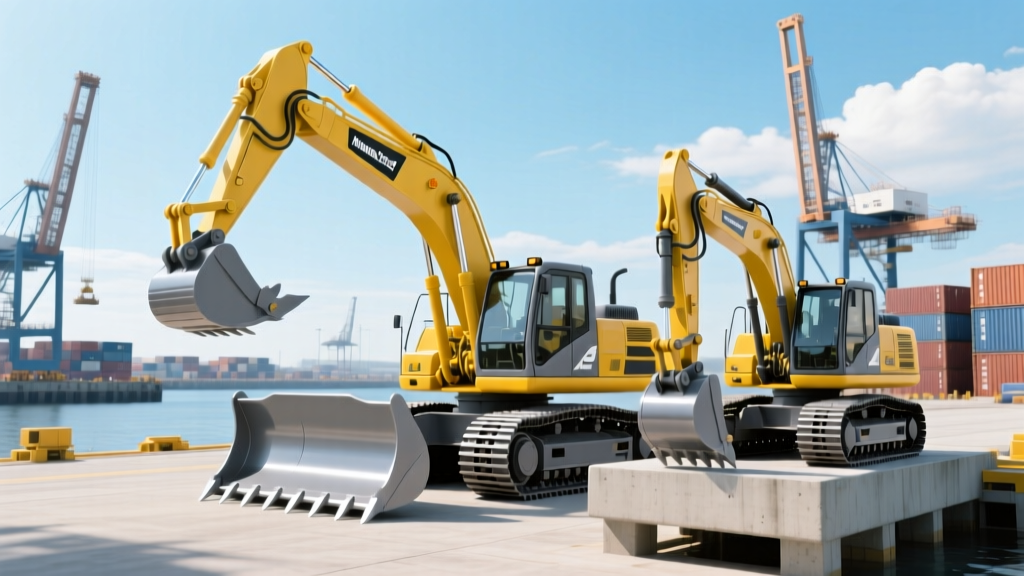
In port terminology, a 'backhoe' rarely refers to a standard tractor-loader-backhoe (TLB). It typically designates a heavy-duty hydraulic excavator (30 to 50-ton class) configured with a cab riser and specialized grapples for unloading bulk carriers, or an amphibious trackhoe utilized for shallow-water port basin dredging and dock-wall maintenance.
Capital Expenditure (CapEx): Base Machine vs. Marine Spec Upgrades
A standard 35-ton excavator might invoice around $380,000 in 2026, but a port-ready configuration demands extensive factory or aftermarket modifications. Galvanic corrosion can destroy standard undercarriages in under 18 months if left untreated. Below is a breakdown of the CapEx required to transform a standard heavy equipment backhoe into a marine-port asset.
| Machine Configuration (35-45 Ton Class) | Base MSRP (2026) | Marine/Port Upgrades | Total CapEx |
|---|---|---|---|
| Caterpillar 336 (Bulk Handling Spec) | $395,000 | $68,500 (Epoxy undercarriage, stainless pins, cab riser) | $463,500 |
| Liebherr R 945 (Port Material Handler) | $540,000 | $85,000 (Solid foam tires, seawater cooling, heavy-duty boom) | $625,000 |
| Sennebogen 860 E (Electric Drive) | $610,000 | $45,000 (Shore-power tethering, marine-grade cabling) | $655,000 |
| Wetland Equipment Amphibious 320 | $420,000 | $115,000 (Pontoon tracks, spud systems, dredging pump) | $535,000 |
According to infrastructure guidelines from the U.S. Army Corps of Engineers (USACE), maintaining navigable depths and functional dock walls requires equipment that can operate in the intertidal zone. The premium for amphibious pontoon tracks ($90,000 to $120,000) is non-negotiable for basin maintenance contracts.
Operational Expenditure (OpEx): Calculating the Saltwater Tax
The true cost divergence between inland and marine equipment manifests in OpEx. Saltwater accelerates micro-pitting on hydraulic cylinder rods and degrades standard lubricants. Fleet managers must adjust their maintenance budgets according to the following multipliers:
- Undercarriage Replacement Cycle: Inland excavators replace track chains and sprockets every 6,000 to 8,000 hours. In marine environments, even with marine-grade epoxy coatings, abrasive salt-sand cuts this lifespan to 3,500 hours. Budget an additional $28,000 per machine annually for undercarriage amortization.
- Hydraulic Rod Wipers and Seals: Standard nitrile seals fail rapidly when exposed to brine. Upgrading to specialized polyurethane wipers with stainless steel scraper rings costs $1,200 per cylinder but prevents $15,000 cylinder repacking jobs.
- Zinc Anode Consumption: Marine-spec backhoes utilize sacrificial zinc anodes on the swing bearing and dozer blade. These must be inspected every 250 hours and replaced annually, adding $1,800 in parts and labor per year.
- Grease Intervals: While inland machines require pivot greasing every 250 hours, marine machines demand automatic centralized lubrication systems running continuously, or manual greasing every 50 hours to purge saltwater from the bushings.
The Attachment Economics: Clamshells and Orange Peels
A backhoe is only as profitable as its attachment. For bulk unloading (scrap metal, coal, aggregate), ports rely on hydraulic rotators paired with clamshell buckets. A heavy-duty 4-yard clamshell with a rototilt and marine-grade hydraulic hoses averages $95,000 in 2026. Because these attachments operate with high shock loads—often dropping into the holds of barges—the rotator gearboxes require synthetic oil changes every 1,000 hours, adding roughly $2,400 to annual OpEx.
Regulatory Budgeting: Emissions and Shore Power
Port authorities are under immense pressure to decarbonize. The Port of Los Angeles Clean Air Action Plan and similar global initiatives mandate strict limits on nonroad diesel emissions. When budgeting for a new heavy equipment backhoe, compliance costs must be factored in.
Tier 4 Final / Stage V DPF Clogging Risks
Marine environments often involve high-sulfur dust (from bulk cargo like petcoke or coal) combined with salt air. This mixture rapidly clogs Diesel Particulate Filters (DPF). Budget $4,500 annually for forced DPF regeneration and baking services, or risk $12,000 replacement costs per filter.
To bypass diesel limitations entirely, some ports are transitioning to shore-power tethered electric excavators. While the CapEx for an electric drive system (like the Sennebogen E-Series) is 30% higher, the OpEx drops by 60% due to the elimination of diesel fuel and engine maintenance, provided the dock has the requisite 480V 3-phase infrastructure.
Decision Matrix: Procurement Strategy for Port Fleets
Use this framework to determine the optimal acquisition and specification strategy based on your specific marine application.
| Application Scenario | Recommended Machine Type | Budget Strategy (Buy vs. Lease) | Critical Cost Factor |
|---|---|---|---|
| Deep-water bulk cargo unloading | 45-ton Material Handler (Cab Riser) | Buy (High utilization, >3,000 hrs/yr) | Attachment rotator maintenance |
| Shallow basin dredging & dock repair | Amphibious Trackhoe (30-ton) | Lease (Project-based, seasonal) | Pontoon track structural fatigue |
| Scrap metal handling at breakbulk docks | Electric Drive Excavator (Shore-tethered) | Buy (Long-term ROI via fuel savings) | Cable management system wear |
Total Cost of Ownership (TCO) Synthesis
Procuring a heavy equipment backhoe for marine and port applications is an exercise in mitigating environmental degradation. A $400,000 base machine will easily command a $550,000 out-the-door price once marine corrosion packages, cab risers, and hydraulic rotators are installed. Over a 7-year lifecycle, the saltwater tax will add approximately $140,000 in accelerated undercarriage and hydraulic maintenance compared to an inland equivalent. However, by specifying factory-applied epoxy coatings, polyurethane seals, and centralized auto-lube systems during the initial CapEx phase, fleet managers can suppress the OpEx multiplier and secure a viable ROI in one of the harshest operating environments on earth.
'The margin in marine bulk handling isn't made on the cycle time; it's preserved in the maintenance bay. A machine that spends three days in the shop for a corroded swing bearing destroys the profit of a month's unloading.' — Fleet Maintenance Director, Gulf Coast Breakbulk Terminal
For further regulatory context on nonroad diesel engines in maritime zones, consult the EPA Nonroad Diesel Emission Standards to ensure your 2026 fleet acquisitions meet all federal and local port authority mandates.