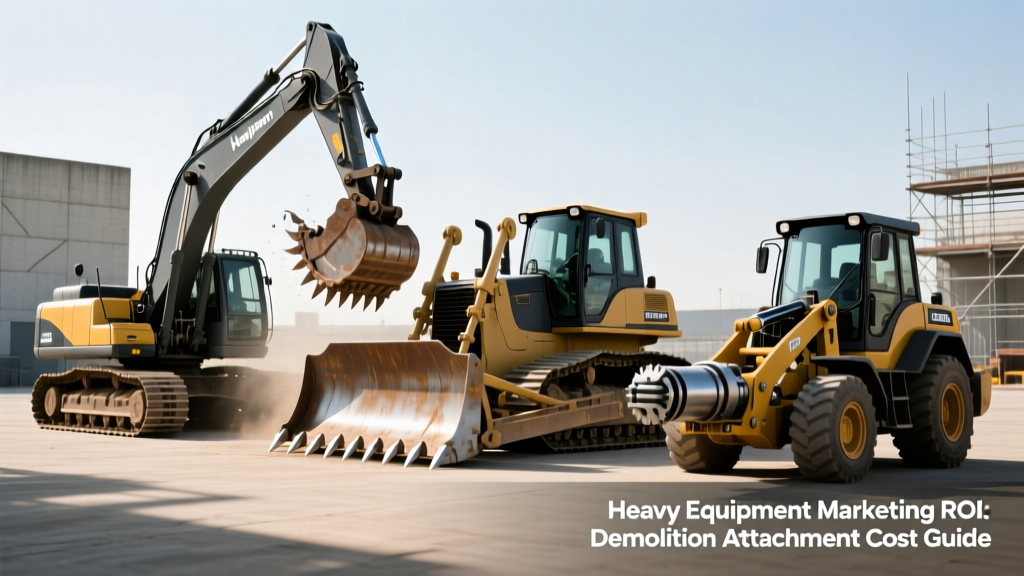
Heavy Equipment Marketing ROI: Demolition Attachment Cost Guide
Maximize heavy equipment marketing ROI by budgeting for high-yield demolition attachments. Analyze 2026 costs for shears, pulverizers, and hammers.
General contractors award complex structural teardown contracts to subcontractors who can prove specialized capability. In 2026, a demolition contractor's heavy equipment marketing strategy relies entirely on showcasing a highly specialized, well-maintained attachment fleet. Budgeting for demolition equipment requires a dual-lens approach: calculating the Total Cost of Ownership (TCO) for the iron, and allocating capital to market that iron to tier-one developers and GCs.
When you invest in a rotating hydraulic shear or a high-reach pulverizer, you are not just buying a tool; you are buying a marketing asset that justifies premium bid rates. Below is a comprehensive cost analysis and budget planning framework for procuring demolition attachments and leveraging them in B2B marketing campaigns.
The Carrier vs. Attachment Capital Allocation
The foundation of any demolition fleet is the 35-ton to 50-ton excavator class (e.g., Cat 336, Komatsu PC360LC-11, Volvo EC350E). In 2026, a new base carrier in this class costs between $420,000 and $550,000. However, a bare excavator wins zero specialized demolition bids.
The 30% Allocation Rule: Financial planning for demolition fleets dictates that your initial attachment and coupler budget should represent 25% to 35% of the base carrier's capital cost. If you finance a $500,000 excavator, you must secure an additional $125,000 to $175,000 to outfit it with the hydraulic circuits, quick couplers, and primary processing tools required to make the machine marketable to GCs.2026 Demolition Attachment Cost Matrix
Different attachments serve distinct phases of the demolition lifecycle. The table below outlines current market pricing, hydraulic requirements, and the specific heavy equipment marketing hook you should use when presenting these assets in bid proposals.
| Attachment Type | Model Example | 2026 Price Range | Required Aux Flow | Marketing Hook for GCs |
|---|---|---|---|---|
| Mobile Shear | Stanley LaBounty MSD 4500 | $110,000 - $145,000 | 150 - 200 GPM | Reduces torch-cutting labor by 80%; accelerates steel recycling revenue. |
| Pulverizer / Crusher | Genesis GPC 1500 | $65,000 - $85,000 | 120 - 160 GPM | On-site concrete processing; eliminates 40% of haul-away trucking costs. |
| Hydraulic Hammer | Epiroc HB 3600 | $45,000 - $55,000 | 75 - 100 GPM | Precision foundation breaking with minimal seismic vibration to adjacent structures. |
| Tiltrotator | Engcon EC226 | $35,000 - $45,000 | Variable (up to 80 GPM) | 360-degree sorting and selective dismantling in tight urban footprints. |
Budgeting for Heavy Equipment Marketing Campaigns
Acquiring a $140,000 mobile shear is a sunk cost if the market doesn't know you have it. B2B heavy equipment marketing in the demolition sector is highly technical. GCs do not respond to generic social media posts; they respond to logistical proof and safety documentation. According to industry insights from the National Demolition Association, contractors who provide visual, data-backed methodology plans win selective demolition bids at a 35% higher rate.
Essential Marketing Asset Budget (Per Project Bid)
- 3D Lift-and-Cut Sequence Renderings ($1,200 - $2,500): Hiring a specialized industrial animator to show exactly how your Cat 336 with a LaBounty shear will dismantle a specific truss roof system.
- Drone Videography & Photogrammetry ($2,000 - $3,500/day): Capturing high-resolution orthomosaics of your fleet executing complex concrete pulverization, proving your dust-control and safety perimeters.
- LinkedIn Targeted Ad Spend ($1,500/month): Geofencing commercial real estate developers and tier-one GC procurement officers within a 200-mile radius of your yard.
"In heavy equipment marketing, your iron is your portfolio. A GC will pay a 15% premium on a teardown bid if the subcontractor's proposal includes a time-lapse simulation of their specialized shear fleet clearing the site two weeks ahead of schedule."
Hidden Procurement Costs and Hydraulic Edge Cases
When budgeting for demolition attachments, contractors frequently overlook the auxiliary systems required to run them. Failing to budget for these edge cases results in dead capital—attachments sitting in the yard because the carrier cannot power them.
WARNING: Hydraulic Flow MismatchRunning a high-flow attachment like a mobile shear (requiring 180 GPM combined bidirectional flow) on a machine configured for standard auxiliary circuits (typically 70-90 GPM) will cause catastrophic cavitation in the excavator's main hydraulic pumps. Always budget $12,000 to $18,000 for factory-installed high-flow bidirectional circuits and dedicated cooling packages when ordering the base carrier.
The Quick Coupler Tax
Demolition sites require rapid attachment changes. Pin-on configurations are obsolete for multi-tool carriers. You must budget for a heavy-duty hydraulic quick coupler (e.g., Werk-Brau or Allied Construction Products). A 45-ton class coupler costs between $8,500 and $12,000. Furthermore, ensure your coupler complies with OSHA demolition safety standards regarding accidental release prevention, which may require secondary locking pins or electronic safety overrides ($2,500 upgrade).
Step-by-Step Fleet & Marketing Budget Framework
Use this sequential framework to align your equipment procurement with your marketing and business development goals.
- Define the Target Contract Profile: Are you bidding on interior selective demo (requires tiltrotators and sorting grapples) or structural high-reach (requires long-front excavators and shears)?
- Calculate the Carrier TCO: Factor in the base price ($450k), high-flow auxiliary circuits ($15k), heavy-duty guarding ($8k), and quick coupler ($10k).
- Procure the Primary Attachment: Allocate 30% of the carrier cost to the primary tool (e.g., $135k for a shear).
- Fund the Visual Asset Library: Dedicate $10,000 annually per major machine to create professional drone footage, spec sheets, and 3D methodology animations.
- Deploy B2B Marketing: Integrate these visual assets into your CRM and proposal templates to justify a 10-20% premium over competitors running generic bucket-and-hammer fleets.
Frequently Asked Questions
How does attachment maintenance impact marketing claims?
Marketing a shear's 'precision cutting capability' is a liability if the pivot bushings are worn. Worn bushings cause jaw misalignment, leading to stalled cuts and dropped steel beams. Budget $4,500 to $7,000 annually per heavy attachment for preventive bushing and seal replacements to ensure your fleet performs exactly as advertised in your bid proposals.
Should I rent or buy demolition attachments for marketing leverage?
Renting a Genesis pulverizer for a single $40,000 job solves an immediate operational problem but provides zero long-term marketing leverage. Buying the attachment builds your company's permanent asset portfolio, allowing you to market your in-house capabilities to GCs for years, ultimately lowering your cost-per-bid acquisition.
Where can I find reliable equipment distribution data?
For macro-level pricing trends and dealer network insights, the Associated Equipment Distributors (AED) provides vital market intelligence that helps contractors negotiate better bulk-purchase rates on carriers and attachments.