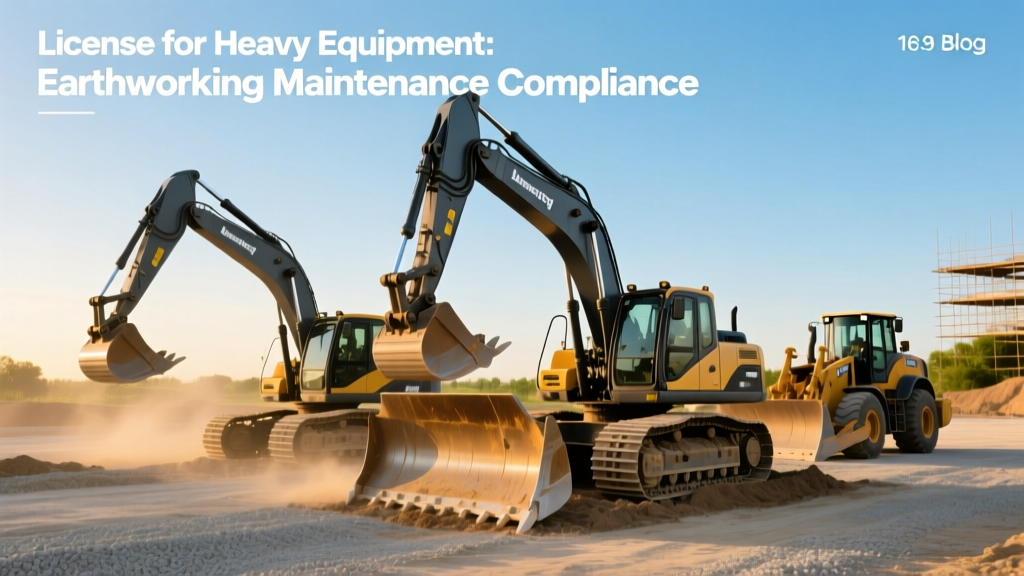
License for Heavy Equipment: Earthmoving Maintenance Compliance
Explore how your license for heavy equipment mandates specific earthmoving maintenance schedules, from daily OSHA inspections to 500-hour fluid services.
Operating a 36-ton excavator or a 200-horsepower bulldozer requires more than physical skill; it demands strict adherence to legal and mechanical frameworks. When a certified operator secures a license for heavy equipment, they are not just proving operational competency. They are legally assuming responsibility for pre-shift inspections, adherence to OEM maintenance schedules, and the immediate reporting of mechanical faults. In the earthmoving sector, where machines like the Caterpillar 336 Excavator or Komatsu D65EX-18 Dozer operate under extreme dynamic loads, the intersection of operator licensing and preventive maintenance is the primary defense against catastrophic failure and OSHA citations.
The Legal Mandate: How Licensing Intersects with Upkeep
State and federal regulations do not view equipment operation and equipment maintenance as separate entities. According to OSHA 29 CFR 1926.600, earthmoving equipment must be inspected prior to each shift. Furthermore, certification bodies like the National Commission for the Certification of Crane Operators (NCCCO) and state-level licensing boards mandate that licensed operators possess the diagnostic knowledge to identify out-of-spec wear before it compromises machine stability.
⚠️ Legal Liability Warning: If a hydraulic hose bursts on a wheel loader and injures a ground worker, investigators will pull the machine's telematics and maintenance logs. If the operator's heavy equipment license requires documented daily walk-arounds and the logbook shows skipped inspections, the legal liability shifts heavily onto the operator and the site supervisor for negligent upkeep, voiding standard insurance protections.Daily Pre-Shift Inspections: The Licensed Operator's Burden
A valid license for heavy equipment requires the operator to execute a standardized, documented walk-around. This is not a casual glance; it is a systematic verification of critical wear points and fluid levels.
Excavator Focus: Cat 336 and John Deere 210G
- Hydraulic Fluid Verification: Check the sight glass with the machine on level ground, boom lowered, and engine off. The fluid must sit between the upper and lower marks. Operators must look for milky discoloration, indicating water ingress that requires immediate ISO 46 hydraulic fluid replacement.
- Grease Point Audits: A 30-ton class excavator has over 20 daily grease points. Licensed operators must physically verify that fresh grease is purging from the boom-to-stick pivot, bucket linkage, and swing circle seals. Dry pins will gall within 40 hours of operation, leading to $8,000+ rebuild costs.
- Track Tension Check: Raise the track and measure the sag at the midpoint between the front idler and the first track roller. Standard specification is 25mm to 40mm (1 to 1.5 inches). Over-tensioning accelerates idler and sprocket wear by up to 60%.
Bulldozer Focus: Komatsu D65EX-18
- Undercarriage Alignment: Inspect the track master links and verify that the track shoes are not severely gouged. Missing bolts on extreme service (ES) shoes must be replaced immediately using grade 8 hardware torqued to OEM specs (typically 340-400 lb-ft).
- Ripper Shank Wear: Measure the ripper shank and tip. If the shank protector is worn past the wear indicator line, the operator must schedule a replacement before the shank itself begins to wear, which compromises the structural integrity of the rear mounting bracket.
Core Earthmover Service Intervals and 2026 Pricing
While daily inspections fall on the licensed operator, scheduled interval maintenance requires coordination between the operator, the fleet manager, and certified technicians. Below is the standard service matrix for a 30-to-40-ton earthmoving fleet operating in normal-to-severe dust conditions.
| Interval | Primary Services Required | Fluid / Part Specifications | Est. 2026 Dealer Cost |
|---|---|---|---|
| 250 Hours | Engine oil & filter, fuel primary/secondary filters, swing drive gear oil level check. | API CK-4 15W-40 Diesel Oil (approx. 8-10 gallons). | $650 - $850 |
| 500 Hours | Hydraulic return filters, pilot filter, swing circle grease purge, DEF system filter. | OEM Hydraulic Filter Kit, ISO 46 HVI Hydraulic top-off. | $1,200 - $1,600 |
| 1,000 Hours | Coolant flush/test, hydraulic tank breather, swing drive oil change, final drive oil change. | ELC (Extended Life Coolant), SAE 80W-90 Gear Oil. | $2,500 - $3,200 |
| 2,000 Hours | Hydraulic pump pressure testing (relief and flow), valve lash adjustment, injector cut-out test. | Requires 6,000 PSI test gauges and OEM diagnostic software. | $4,000 - $5,500 |
Telematics, Operator ID, and Warranty Compliance
Modern earthmoving equipment utilizes advanced telematics systems, such as Cat VisionLink and Komatsu KOMTRAX, to bridge the gap between the operator's license and the machine's maintenance schedule. These systems require the operator to log in using a unique PIN or RFID card linked to their heavy equipment license.
This integration serves a critical maintenance function: Severe Duty vs. Normal Duty scheduling. If telematics data shows that a licensed operator is consistently utilizing the machine in high-PTO (Power Take-Off) applications, heavy hydraulic hammer usage, or extreme idle times, the OEM software automatically shortens the maintenance intervals. For example, an excavator using a hydraulic breaker requires the hydraulic return filters to be changed every 250 hours instead of the standard 500 hours. Failing to adjust the schedule based on telematics data is a direct violation of warranty terms and operator compliance standards.
Undercarriage and GET: Wear Metrics That Dictate Service
Ground Engaging Tools (GET) and undercarriages represent up to 50% of a machine's total lifetime maintenance cost. Licensed operators are trained to monitor specific wear metrics that trigger replacement schedules.
Track Shoe and Link Wear
Operators must measure track link height using a calibrated ultrasonic wear gauge or physical calipers. On a standard 336 excavator, a new track link height is approximately 94mm. Once wear reaches 70mm (a 25% reduction), the structural integrity of the link is compromised, and the risk of snapping under high-torque travel conditions increases exponentially. Full undercarriage replacement on a machine of this size currently ranges from $18,000 to $24,000, making proactive rotation and tension management vital.
Bucket Teeth and Adapter Systems
For high-abrasion environments like shot rock or caliche, operators should be utilizing mechanically locked tooth systems (e.g., ESCO Posilok or Cat Advantus). The maintenance schedule requires checking the locking pins daily. If a pin is lost and the tooth is swallowed by the crusher or lost in the trench, the adapter nose will wear down to the base metal within 12 hours, requiring a $600+ adapter weld-on replacement instead of a $45 tooth swap.
Frequently Asked Questions (FAQ)
Does a standard CDL cover earthmoving equipment operation?
No. A Commercial Driver's License (CDL) only covers the on-highway transport of the equipment on a lowboy trailer. Operating the excavator, dozer, or loader on a job site requires specific heavy equipment certification (such as NCCCO or state-specific off-road licensing) and documented site-specific training.
Can an operator perform their own 500-hour maintenance?
While a licensed operator is legally permitted to perform basic fluid and filter changes if they have the proper PPE, environmental containment berms, and waste oil disposal manifests, most fleet policies restrict 500-hour and above services to certified OEM technicians to maintain warranty validity and ensure torque specs are verified.
What happens if an operator refuses to sign the daily inspection log?
Under OSHA regulations, an operator has the legal right to refuse to operate a machine they deem unsafe. If an operator refuses to sign the daily log because a critical fault (e.g., a cracked boom weld or leaking swing drive) was ignored by the maintenance team, the site supervisor must red-tag the machine until repairs are verified. Retaliating against a licensed operator for halting work due to maintenance failures is a severe OSHA violation.