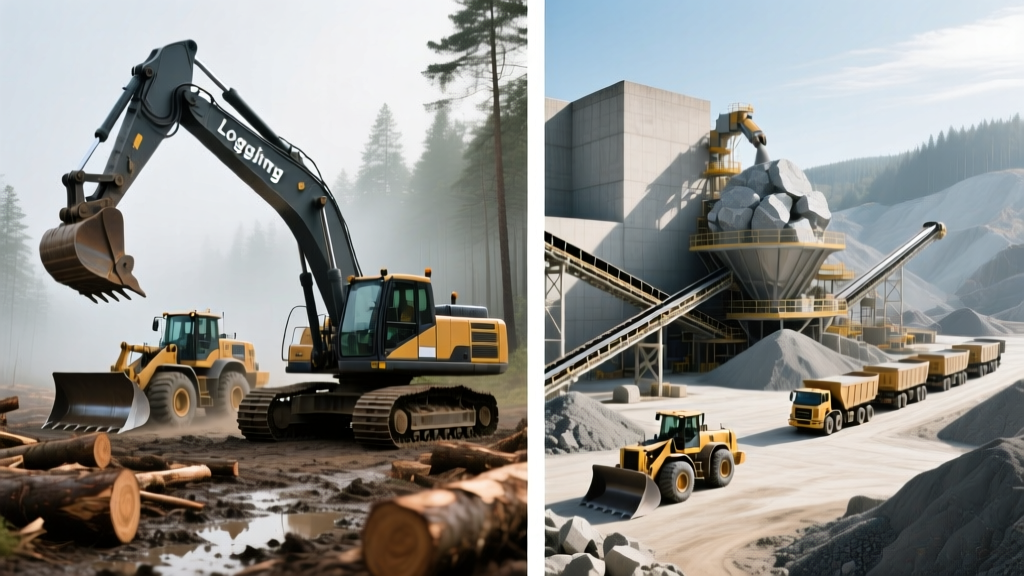
Logging Heavy Equipment vs Quarry Processing Maintenance
Compare maintenance schedules for logging heavy equipment and quarry aggregate processing machinery. Expert intervals, fluid specs, and downtime costs.
The Core Divergence: Organic Debris vs. Silica Dust
While both logging heavy equipment and quarry aggregate processing machinery operate in severe off-highway environments, their maintenance paradigms are fundamentally opposed. Fleet managers who attempt to apply a universal preventative maintenance (PM) schedule across both asset classes inevitably face premature component failure. The divergence stems from the primary environmental contaminants: logging sites introduce hygroscopic organic matter (wood fiber, sap, moisture) that emulsifies hydraulic fluid, whereas quarry sites introduce abrasive silica dust that acts as a lapping compound inside gearboxes and hydraulic pumps.
⚠️ Environmental Contaminant Warning: Never swap air filtration media between these environments. Logging heavy equipment requires moisture-resistant, cellulose-synthetic blend filters to prevent sap-clogging, while quarry crushers demand nanofiber media with a 99.99% efficiency rating at 1 micron to block respirable crystalline silica, aligning with OSHA's Respirable Crystalline Silica standard.Logging Heavy Equipment: Shock Loads and Hydraulic Integrity
Machines like the Tigercat H845D knuckleboom loader and John Deere 1910E forwarder are subjected to extreme, high-frequency shock loads. The primary maintenance focus is on structural pivot integrity and hydraulic hose fatigue. Because logging operations frequently occur in wet, muddy conditions, water ingress into hydraulic reservoirs is a constant threat.
Critical Service Intervals for Forestry Assets
- Daily (10-12 hours): Manual greasing of all boom pivot points and grapple linkages using NLGI #2 Molybdenum Disulfide (Moly) EP grease. Standard lithium-complex grease will wash out under high-pressure water exposure common in Pacific Northwest or Southeastern US logging sites.
- 250 Hours: Track tensioning and undercarriage inspection. Mud packing in sprockets can increase track tension by up to 40%, leading to premature chain stretching and idler failure.
- 500 Hours: Hydraulic return filter replacement and fluid sampling. Target ISO 4406 cleanliness code is 18/16/13. Water content must remain below 500 ppm; if emulsification is detected, immediate centrifugal purification is required.
- 2,000 Hours: Complete hydraulic hose replacement on the boom circuit. Constant flexing under shock loads causes internal wire braid fatigue that is invisible during external walkarounds.
Quarry and Aggregate Processing: Abrasion and Continuous Vibration
Quarry equipment, such as the Metso Lokotrack LT106 jaw crusher or Sandvik CH430 cone crusher, operates under continuous, high-amplitude vibration and extreme abrasion. According to the National Stone, Sand & Gravel Association (NSSGA), maximizing uptime in aggregate processing requires a shift from time-based maintenance to condition-based monitoring, specifically focusing on wear parts and drive alignment.
Crusher and Screen Deck Maintenance Specifics
Unlike the shock loads of forestry, crushers suffer from continuous compressive stress. The maintenance schedule revolves around manganese steel wear parts and vibration isolation.
- Daily: Check V-belt deflection on crusher drives. Proper tension requires exactly 1/2 inch of deflection per foot of span under moderate thumb pressure. Overtightening destroys the main shaft bearings; undertightening causes belt slip and sheave wear.
- Weekly: Inspect jaw dies and mantle/concave liners. Measure wear profiles using ultrasonic thickness gauges. Rotate jaw dies top-to-bottom when the lower 30% of the corrugation profile is worn flat to maximize manganese steel ROI.
- 500 Hours: Gearbox oil analysis. In aggregate processing, a spike in Silicon (Si) ppm indicates air intake seal failure or dust ingress through the breather cap. If Silicon exceeds 15 ppm over baseline, the gearbox oil must be flushed and filtered through an offline kidney-loop system.
- 1,000 Hours: Vibration analysis on screen decks and crusher mainframes. Check for structural cracking around the exciter mechanism and verify that rubber isolation mounts have not compressed beyond their 25% deflection limit.
Comparative Service Interval Matrix
The table below highlights the distinct maintenance priorities and financial impacts of component failure across both equipment categories.
| Component / System | Equipment Class | Service Interval | Primary Failure Mode | Est. Replacement Cost |
|---|---|---|---|---|
| Boom Pivot Bushings | Logging Heavy Equipment | 2,500 Hours | Shock-induced spalling | $3,500 - $5,200 |
| Hydraulic Return Filters | Logging Heavy Equipment | 500 Hours | Organic fiber blinding | $180 - $350 |
| Manganese Jaw Dies | Quarry Processing | Condition (800-1500 Hrs) | Abrasive corrugation wear | $12,000 - $18,500 |
| Crusher Drive V-Belts | Quarry Processing | 250 Hours (Tension Check) | Dust-induced slip and heat | $800 - $1,400 (Set) |
| DEF / SCR Filters (Tier 4F) | Both (Mobile Platforms) | 4,500 Hours | Crystallization / Ash loading | $2,200 - $3,800 |
Fluid Analysis: Interpreting the Spectrographic Data
Oil analysis is the cornerstone of condition-based maintenance, but the interpretation of spectrographic data must be contextualized by the machine's operating environment.
💡 Expert Insight: The Silicon/Potassium RatioIn quarry aggregate processing, a rising Silicon (Si) trend alongside stable Iron (Fe) indicates external dirt ingestion—usually a failing air filter or compromised gearbox seal. Conversely, in logging heavy equipment, high Potassium (K) and Sodium (Na) paired with elevated water content often points to coolant ingress or environmental water submersion of the undercarriage, requiring immediate investigation of the engine oil cooler or hydraulic tank breather.
Furthermore, viscosity selection differs drastically. Quarry crushers operating in high-ambient-heat environments (such as Southwest US limestone quarries) typically require ISO VG 68 or even VG 100 gear oils to maintain hydrodynamic film thickness under continuous vibratory stress. In contrast, logging heavy equipment operating in northern climates or experiencing rapid temperature swings relies on multi-grade hydraulic fluids or ISO VG 46 to ensure cold-start pump cavitation protection.
Downtime Economics and Preventative ROI
The financial penalty for missed maintenance intervals scales differently across these sectors. A hydraulic pump failure on a logging forwarder might cost $350 to $500 per hour in lost timber extraction productivity. However, an unplanned bearing failure on a primary jaw crusher in an aggregate plant creates a cascading bottleneck. The NIOSH guidelines on silica exposure also mandate strict containment during crusher maintenance, adding specialized labor and engineering controls to the downtime cost.
Consequently, aggregate processing downtime frequently exceeds $1,200 to $2,500 per hour when factoring in lost downstream paving material sales and idle secondary screening crews. This economic reality dictates that quarry maintenance schedules must heavily prioritize redundant offline filtration systems and continuous vibration telemetry, whereas logging fleet managers must invest heavily in operator-driven daily walkarounds, structural NDT (Non-Destructive Testing) inspections, and aggressive moisture-control protocols for hydraulic reservoirs.