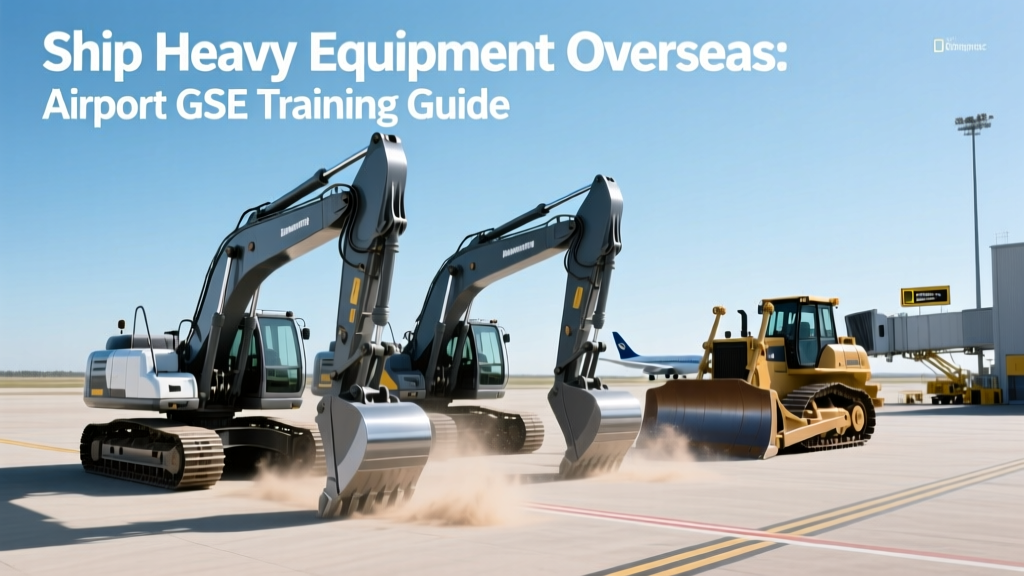
Ship Heavy Equipment Overseas: Airport GSE Training Guide
Learn operator training protocols and best practices to safely ship heavy equipment overseas, focusing on airport ground support equipment logistics.
The Operational Reality of Exporting Airport Ground Support Equipment
Moving airport ground support equipment (GSE) across international borders is not standard freight logistics. When an airline, ground handling company, or leasing firm needs to ship heavy equipment overseas—such as a 35,000-lb Goldhofer AST-3 towbarless tractor or a fleet of Charlatte TT450 baggage tugs—the preparation falls on specialized heavy equipment operators. Improper lashing, incorrect fluid levels, or ignored lithium-ion battery protocols can result in catastrophic vessel fires, rejected port entries, or multi-million-dollar cargo losses.
As the global aviation industry accelerates its transition to zero-emission ground operations in 2026, operators are now tasked with managing the export of massive lithium-ion-powered GSE alongside traditional Tier 4 Final diesel units. This guide details the exact operator training protocols, engineering constraints, and best practices required to prepare, secure, and load airport GSE for international ocean freight.
Pre-Shipment Fluid and Battery Protocols
The most common reason for GSE rejection at the Roll-on/Roll-off (RoRo) terminal gate is improper fluid management. Port stevedores and maritime safety regulations enforce strict limits on hazardous materials inside cargo transport units.
Diesel GSE: Fuel and Hydraulic Limits
For diesel-powered equipment like the TLD AS-350 pushback tractor, operators must reduce the fuel tank level to a maximum of 1/4 capacity or 50 liters (whichever is less). This minimizes the risk of fuel sloshing, venting, and ignition during ocean transit. Additionally, hydraulic systems must be inspected for weeping seals. A pushback tractor with a slow leak in its steering cylinder will stain the vessel deck, resulting in severe environmental fines levied against the shipper under the IMO/ILO/UNECE Code of Practice for Packing of Cargo Transport Units (CTU Code).
Electric GSE: Lithium-Ion Transport Mode
Modern electric GSE, such as the Mototok SP 8000 or Goldhofer eFleet, present unique maritime hazards. Operators must be trained to engage the Battery Management System (BMS) 'Transport Mode' or physically disconnect the main high-voltage contactors. Under UN3481 regulations (Lithium-ion batteries contained in equipment), the state of charge (SoC) for certain standalone battery modules may need to be reduced to 30% prior to loading, though equipment-integrated batteries generally require documented proof that the power circuit is physically isolated to prevent thermal runaway.
⚠️ Operator Warning: Never rely solely on the dashboard ignition key to isolate power on electric GSE. Vibrations from ship engines and ocean swells can trigger relay faults. Always use a physical lockout/tagout (LOTO) procedure on the main battery disconnect switch and document it on the Bill of Lading.RoRo vs. Flat Rack: Loading Decision Matrix
Operators must understand the dimensional and operational thresholds that dictate whether GSE is driven onto a RoRo vessel or lifted onto a Flat Rack container. Misjudging this leads to massive demurrage charges at the port.
| GSE Category | Example Model | Typical Weight / Dimensions | Recommended Shipping Method | Operator Action Required |
|---|---|---|---|---|
| Pushback Tractors | TLD AS-350 | ~14,000 lbs / Low Profile | RoRo (Roll-on/Roll-off) | Drive onto vessel; secure using deck lashing points. |
| Towbarless Tractors | Goldhofer AST-3 | ~35,000 lbs / Wide Stance | RoRo or Breakbulk | Requires heavy-duty ramp capacity verification; escort driving. |
| Belt Loaders | JBT Commander 15 | ~9,500 lbs / High Clearance | Flat Rack (40ft) | Lower conveyor boom to travel position; crane lift via corner castings. |
| Baggage Tractors | Charlatte TT450 | ~4,500 lbs / Compact | Standard Container (if crated) | Block and brace inside 20ft/40ft dry van; ISPM 15 wood dunnage. |
Heavy-Duty Tie-Down and Lashing Best Practices
Securing a 15,000-lb aircraft tow tractor to a ship's deck requires an understanding of dynamic maritime forces. Unlike over-the-road transport, where the primary force is forward deceleration, ocean freight subjects GSE to severe lateral rolling (up to 30 degrees) and longitudinal pitching in 60-knot swells.
Chain Grades and WLL Calculations
Operators must exclusively use Grade 80 or Grade 100 alloy steel transport chains. Ratchet straps are strictly prohibited for primary securing of heavy GSE on ocean vessels due to UV degradation, edge fraying, and dynamic snap-back risks. According to maritime lashing standards, the aggregate Working Load Limit (WLL) of the tie-downs must equal at least 50% of the cargo's weight for forward restraint, but for ocean transit, best practice dictates an aggregate WLL matching 100% of the equipment's weight to account for multi-directional wave forces.
Lashing Geometry and Anchor Points
The angle of the chain is critical. Operators should aim for a lashing angle between 30 and 60 degrees relative to the deck.
- Too Steep (>60 degrees): The chain pulls the GSE upward, reducing tire friction and potentially lifting the equipment off the deck during a heavy roll.
- Too Shallow (<30 degrees): The chain provides excellent lateral restraint but fails to prevent vertical bouncing, which can snap the binders.
Furthermore, chains must only be attached to factory-installed lashing rings, reinforced tow eyes, or primary structural axle housings. Never wrap chains around steering linkages, hydraulic cylinders, or plastic fenders, as the immense tension will crush these components.
ISPM 15 Compliance and Wood Dunnage Training
When shipping GSE via Flat Rack or inside standard intermodal containers, operators frequently use timber blocking and bracing to prevent lateral shift. All wood dunnage used in international shipping must comply with ISPM 15 (International Standards for Phytosanitary Measures No. 15).
Operators must be trained to identify the official IPPC stamp on all timber. Using untreated, raw wood to chock the wheels of a belt loader will result in the entire container being quarantined, fumigated, or rejected by the destination country's agricultural authority at the shipper's expense. For heavy GSE, operators should utilize 4x4 or 6x6 kiln-dried, heat-treated (HT) timber, secured with 16d galvanized spiral nails driven at a 45-degree angle into the deck to prevent the chocks from vibrating loose.
Terminal Handoff and VGM Documentation
The final phase of operator training involves the administrative handoff at the port terminal. Under the Safety of Life at Sea (SOLAS) convention, every piece of heavy equipment shipped via container or Flat Rack must have a Verified Gross Mass (VGM) declaration. Operators cannot simply rely on the manufacturer's brochure weight. The VGM must account for the base machine, attached ballast, full hydraulic fluid, residual fuel, and all dunnage/chains.
For RoRo shipments, operators driving the GSE onto the vessel must adhere to strict IATA Airport and Ground Operations safety principles adapted for maritime stevedoring. This includes maintaining a strict 5 mph speed limit on the ramp, keeping headlights on, and ensuring the parking brake is engaged and tested immediately upon reaching the designated deck coordinates before the operator exits the cab.
Pre-Departure Operator Checklist
- Fluid Audit: Fuel reduced to < 50L; hydraulic lines wiped clean and inspected for weeping.
- Power Isolation: Battery disconnects engaged; LOTO tags applied and photographed.
- Dimensional Verification: Height measured to the highest point (e.g., rolled-over protection structure or lowered conveyor boom) to ensure RoRo deck clearance.
- Lashing Execution: Grade 80/100 chains applied at 30-60 degree angles; lever binders replaced with ratchet binders to prevent snap-back injuries.
- Dunnage Stamp Check: All wood wheel chocks verified for ISPM 15 heat-treatment stamps.
- VGM Submission: Scale ticket obtained and VGM certificate submitted to the freight forwarder prior to the terminal cut-off time.
Mastering these protocols transforms a high-risk logistical challenge into a repeatable, secure operation. Proper training ensures that critical airport infrastructure arrives at its international destination ready for immediate deployment on the tarmac, avoiding costly port delays and equipment damage.