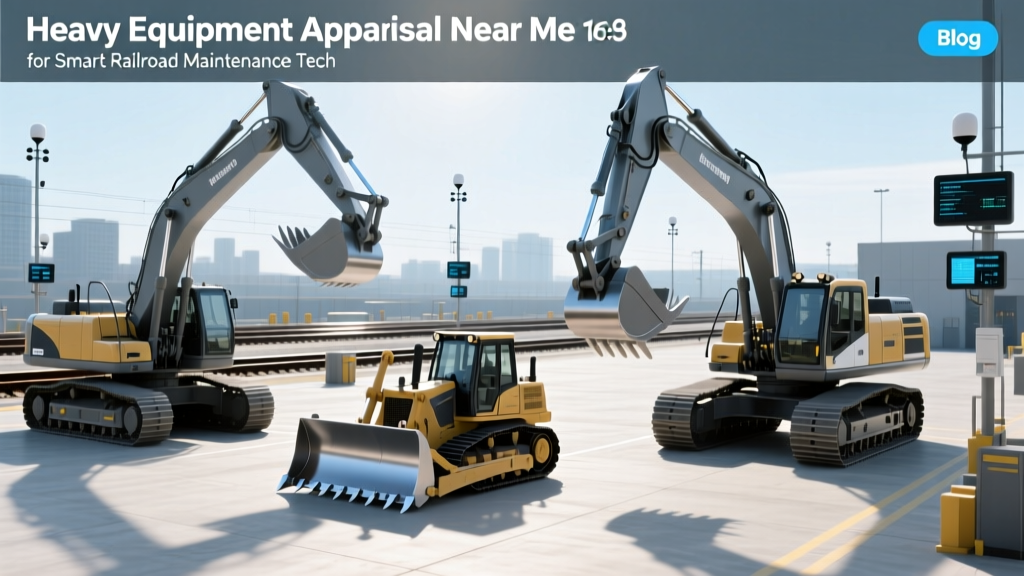
Heavy Equipment Appraisal Near Me for Smart Railroad Maintenance Tech
Discover how 2026 tech trends impact railroad maintenance equipment valuation and what to expect when seeking a heavy equipment appraisal near me.
The Intersection of Rail Tech and Asset Valuation
The Maintenance of Way (MoW) sector has undergone a radical transformation over the last five years. What was once a domain of purely mechanical, diesel-hydraulic brute force is now governed by LiDAR, machine vision, and predictive AI. As Class I railroads and regional shortlines upgrade their fleets to meet stringent 2026 safety mandates, the financial valuation of these assets has become exponentially more complex. When fleet managers or liquidators type 'heavy equipment appraisal near me' into a search engine, they are often met with local generalists who excel at valuing standard excavators and bulldozers, but lack the technical literacy to appraise a $3.5 million automated track tamping machine.
Understanding the specific technology trends in railroad maintenance equipment is no longer optional for appraisers; it is a strict requirement for USPAP (Uniform Standards of Professional Appraisal Practice) compliance. The integration of proprietary software, telematics, and automated geometry sensors means that a rail asset's value is now split between its physical chassis and its digital brain.
Core Railroad Maintenance Equipment & 2026 Tech Upgrades
To accurately appraise MoW equipment, one must understand the baseline models and the specific technological premiums attached to their 2026 configurations.
Automated Track Tamping Machines
The Plasser & Theurer 09-3X Tamping Express remains the industry benchmark for continuous action tamping. In 2026, these units are equipped with the ALC (Automatic Guiding Computer) system and 3D machine control, eliminating the need for traditional stringlines.
- Base Mechanical Value: $1.8M - $2.2M
- 2026 Tech Premium (AI Vision & 3D Control): $850,000 - $1.1M
- Appraisal Gotcha: If the proprietary 3D control software subscription is lapsed, the machine's operational efficiency drops by 40%, necessitating a severe downward adjustment in the appraisal's 'Fair Market Value' calculation.
Smart Rail Grinders
Rail grinding prevents rolling contact fatigue and extends rail life. The Loram RG400 Series utilizes advanced laser profiling and closed-loop control systems to adjust grinding stone pressure in real-time based on metallurgical feedback.
- Base Mechanical Value: $2.5M - $3.0M
- 2026 Tech Premium (Predictive Wear Analytics): $1.2M - $1.5M
- Appraisal Gotcha: The grinding stones and carriage mechanics depreciate rapidly (15-20% annually), but the onboard data-logging servers hold immense residual value if the historical rail profile data is transferred to the buyer.
Autonomous Track Geometry Inspection Vehicles
Companies like ENSCO and MRX Technologies have pushed autonomous inspection cars to the forefront of FRA compliance. These vehicles use phased-array ultrasonic testing and machine vision to detect internal rail flaws at speeds up to 125 mph.
- Turnkey 2026 Cost: $4.5M - $6.0M
- Appraisal Gotcha: Over 60% of the asset's value is tied to the sensor arrays and the Federal Railroad Administration (FRA) certification of the automated track inspection software. An uncertified or decertified sensor suite renders the vehicle nearly worthless for Class I compliance.
Valuation Warning: The 'Ghost in the Machine' Depreciation
Traditional heavy equipment appraisers apply a standard 10% to 15% annual straight-line depreciation to construction machinery. Applying this to smart railroad maintenance equipment is a critical error. While the steel and diesel engines depreciate at standard rates, the software and sensor suites experience accelerated obsolescence (25% to 35% annually). An appraiser who fails to bifurcate the hardware and software valuation will drastically overstate the asset's Fair Market Value (FMV), exposing lenders and insurers to massive risk.
Why Searching for a 'Heavy Equipment Appraisal Near Me' Requires Tech Expertise
The localization implied by the search phrase 'heavy equipment appraisal near me' often traps railroad contractors into hiring generalist valuation firms. While local presence is valuable for physical inspections, the appraiser's credentials must supersede their geography. When vetting a local appraiser for MoW equipment, demand proof of the following:
- ASA Certification in Machinery & Technical Specialties: General real estate or business appraisers cannot legally or ethically value specialized rail tech. Look for accreditations specifically from the American Society of Appraisers (ASA) within the MTS discipline.
- FRA Regulatory Knowledge: The appraiser must understand how FRA Track Safety Standards (49 CFR Part 213) dictate equipment utility. A tamper that cannot meet 2026 FRA tolerance thresholds for cross-level and alignment is essentially scrap metal, regardless of its engine hours.
- OEM Software Transfer Literacy: Manufacturers like Harsco Track Technologies and Plasser & Theurer often lock diagnostic and operational software to the original purchaser. The appraiser must factor in the $40,000 to $85,000 OEM 're-flashing' and license transfer fees required to make the machine operational for a secondary buyer.
2026 Valuation Benchmarks for Smart Railroad Maintenance Assets
The following matrix provides baseline valuation metrics for specialized MoW equipment in the current market. These figures assume average utilization (800-1,200 operating hours annually) and active software maintenance agreements.
| Equipment Type | 2026 New Cost (Avg) | Hardware Depreciation | Software/Tech Depreciation | 5-Year Residual Value |
|---|---|---|---|---|
| Continuous Action Tamper | $2,950,000 | 12% / year | 28% / year | 42% |
| Production Rail Grinder | $4,200,000 | 15% / year | 30% / year | 35% |
| Autonomous Geometry Car | $5,100,000 | 8% / year | 35% / year | 28% |
| Smart Ballast Regulator | $850,000 | 14% / year | 25% / year | 48% |
Step-by-Step: Preparing Your High-Tech Rail Fleet for Appraisal
If you are preparing to finance, insure, or liquidate MoW equipment, do not wait for the appraiser to arrive on-site. Execute this preparation protocol to ensure maximum valuation accuracy and prevent forced downward adjustments.
Step 1: Compile the Digital Pedigree
Gather all OEM software license agreements, API access keys, and telematics dashboard login credentials. An appraiser cannot verify the status of a Loram grinder's predictive analytics module without access to the cloud portal. Print the last 12 months of automated fault-code logs.
Step 2: Calibrate and Certify Sensors
For inspection vehicles and 3D tamping machines, ensure that all LiDAR, ultrasonic, and laser sensors have been calibrated within the last 90 days. Provide the ISO 17025 calibration certificates. Uncertified sensors are appraised as 'non-functional' and will deduct $150,000+ from the final valuation.
Step 3: Document OEM Re-flashing Eligibility
Contact the manufacturer (e.g., Harsco, Plasser) to obtain a written statement confirming that the machine's proprietary operating system can be legally transferred and re-flashed to a secondary owner, and note the exact fee for this service. This documentation protects the 'Orderly Liquidation Value' (OLV) metric.
Step 4: Isolate the Chassis from the Payload
For modular equipment, such as hi-rail excavators with specialized rail-guidance attachments, separate the base carrier (e.g., Caterpillar M323F) from the specialized MoW attachments (e.g., ZEPHIR shunting gear, specialized rail clamps). Appraising them as a single unit often results in the specialized tech being entirely overlooked in the depreciation schedule.
Frequently Asked Questions
How much does a specialized railroad equipment appraisal cost?
While a standard excavator appraisal might cost $400 to $600, a comprehensive USPAP-compliant appraisal for a smart MoW machine (like an automated tamper or grinder) typically ranges from $1,200 to $2,500 per unit. This higher fee accounts for the appraiser's time spent analyzing software licenses, sensor calibration logs, and FRA compliance history.
Does 'heavy equipment appraisal near me' guarantee a faster physical inspection?
Geographic proximity speeds up the physical walk-around, but the bulk of a modern MoW appraisal is digital. The appraiser must spend hours verifying software versions and OEM transferability. It is vastly superior to hire a specialized rail appraiser who will fly to your site than to hire a local generalist who misunderstands the technology.
How do telematics and IoT data affect the resale value of MoW equipment?
In 2026, IoT data is a tangible asset. A track tamper with 5,000 hours of verified, cloud-backed telematics data proving it was operated within OEM temperature and vibration parameters will command a 12% to 18% premium over an identical machine with 'dead' or wiped telematics modules. Buyers use this historical data to forecast remaining useful life (RUL) on hydraulic pumps and tamping banks.