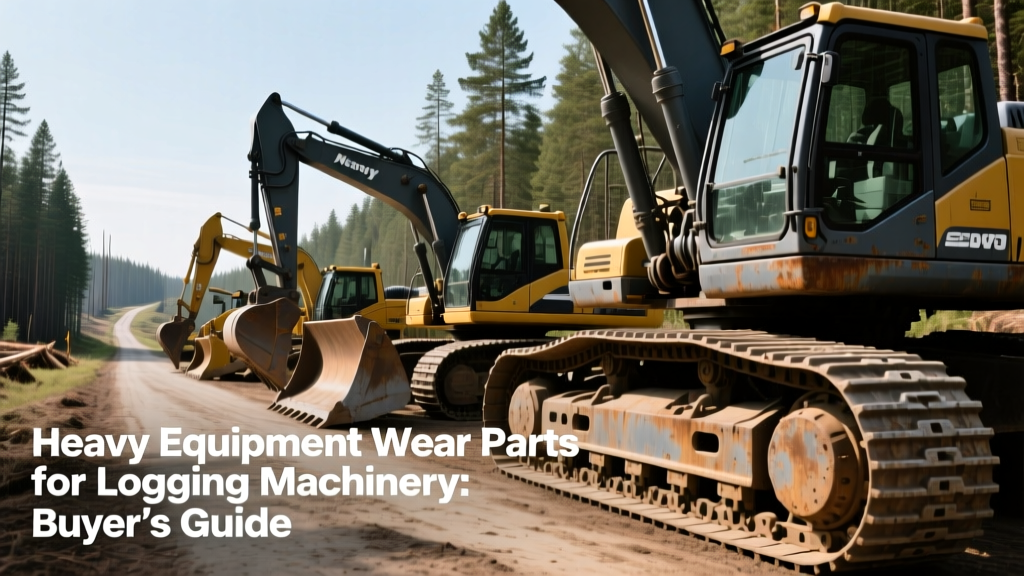
Heavy Equipment Wear Parts for Logging Machinery: Buyer Guide
Discover how to select heavy equipment wear parts for logging machinery. Compare materials, costs, and failure modes for harvesters, skidders, and feller bunchers.
The Forestry Crucible: Why Standard Wear Parts Fail in Logging
Selecting heavy equipment wear parts for logging machinery requires abandoning standard earthmoving assumptions. In forestry, equipment operates in a high-abrasion, high-impact environment where silica-laden bark, acidic pine pitch, and hidden glacial erratics destroy standard ground engaging tools (GET) and structural components. A standard AR400 steel bucket lip that lasts 2,000 hours in a clay quarry may fail in under 400 hours when dragging slash and rocks across a granite outcrop in a northern hardwood timber tract.
Fleet managers and procurement specialists must evaluate wear parts based on specific tribological failure modes unique to timber harvesting. According to the OSHA Logging Operations standard (1910.266), rigorous maintenance and the use of appropriate, structurally sound equipment components are not just operational necessities but strict regulatory requirements to prevent catastrophic failures in remote, high-risk environments.
⚠ Operational Warning: The Remote Downtime MultiplierIn remote timber camps, the cost of a $150 wear part is negligible compared to the $2,500+ per day cost of a stalled feller buncher. Never substitute a specified high-impact forestry component with a general-purpose construction equivalent simply to save on initial procurement costs. The logistics of flying or winching a replacement part into a steep, muddy tract will erase any upfront savings tenfold.
Material Metallurgy: Matching Steel to the Timber Tract
Understanding the metallurgy of heavy equipment wear parts is the foundation of forestry procurement. The industry relies on three primary material categories, each with distinct advantages depending on the logging application.
1. Abrasion Resistant (AR) Steel: AR400 vs. AR500
AR steel is hardened through quenching and tempering. AR400 (Brinell hardness ~400) offers a balance of wear resistance and ductility, making it ideal for structural wear liners inside grapple rotators and skidder winch housings where some flex is required. AR500 (Brinell hardness ~500) is significantly harder and resists sliding abrasion from bark and dirt, but it is brittle. Using AR500 for high-impact components like harvester head feed roller arms will result in micro-fracturing and sudden catastrophic snapping when the head strikes a dense hardwood knot.
2. Boron Steel Alloys
Boron steel provides exceptional through-hardening and impact resistance without the extreme brittleness of high-carbon AR steels. Premium forestry OEMs utilize boron-alloyed steel for knuckleboom loader grapple tines and feller buncher accumulation arms. When a 30-inch diameter white oak limb drops onto a boron steel tine, the material yields slightly and bounces back, whereas standard high-tensile steel might permanently deform or snap at the weld joint.
3. Tungsten Carbide Impregnation and Stellite Tipping
For pure cutting and extreme sliding abrasion, steel alone is insufficient. Harvester saw chains and disc saw teeth utilize Tungsten Carbide inserts. For operations involving 'dirty wood' (salvage logging, root-harvesting, or timber grown in sandy coastal soils), Stellite-tipped saw teeth are mandatory. Stellite (a cobalt-chromium alloy) costs roughly 35% more than standard carbide but maintains a sharp cutting edge up to three times longer when encountering embedded grit and silica.
Component-Specific Selection Matrix (2026 Pricing & Specs)
The following matrix outlines critical heavy equipment wear parts for primary logging machinery, detailing recommended specifications and current market pricing for OEM and premium aftermarket equivalents.
| Component | Primary Wear Mechanism | Recommended Material / Spec | Est. Unit Cost (2026) | Target Replacement Interval |
|---|---|---|---|---|
| Harvester Feed Roller Rings | Sliding abrasion, sap adhesion | Hardox 450 with 20mm aggressive spike pattern | $140 - $210 / ring | 800 - 1,200 hours |
| Feller Buncher Saw Teeth | Impact fracture, edge dulling | Stellite-tipped carbide (for sandy/dirty tracts) | $65 - $110 / tooth | 60 - 90 hours (sharpening cycle) |
| Skidder Track Shoes (Pads) | High-impact rock strikes, mud suction | Double-grouser, boron-alloy steel (34-inch width) | $310 - $450 / shoe | 2,500 - 3,500 hours |
| Knuckleboom Grapple Tines | Bending stress, abrasive log friction | Quenched and tempered Boron steel, tapered tip | $1,400 - $2,800 / tine | 4,000 - 6,000 hours |
Failure Mode Analysis in Forestry Applications
Procurement teams must understand why parts fail to select the correct replacement. The National Institute for Occupational Safety and Health (NIOSH) highlights that equipment failure in logging frequently leads to severe safety hazards, making predictive wear analysis a critical safety protocol.
The 'Silica Factor' and Bark Abrasion
Trees grown in sandy, coastal, or glacial outwash plains draw up silica into their outer bark layers. When a harvester head processes this timber, the feed rollers and delimbing knives act like a grinding wheel. Standard manganese steel delimbing knives will roll their edges within 40 hours. Solution: Specify knives with a tungsten carbide overlay weld on the leading edge, or switch to disposable, indexed carbide-insert knife systems that allow operators to rotate the cutting edge on-site in under five minutes.
Pine Pitch and Acidic Sap Seizure
In southern pine and spruce operations, acidic sap mixes with fine sawdust and atmospheric dust to create a highly adhesive, grinding paste. This paste infiltrates the pin and bushing joints of excavator-based log loaders and grapple rotators. Standard grease-flushed bushings fail rapidly as the paste blocks the grease zerks. Solution: Mandate the use of sealed, oil-bathed linkage systems or heavy-duty polyurethane lip seals (like those from Trelleborg or SKF) specifically rated for forestry sap environments, rather than standard earthmoving labyrinth seals.
Thermal Shock and Micro-Fracturing
In northern winter logging operations (temperatures dropping below -20°F), high-carbon wear steels become highly susceptible to thermal shock. Striking a frozen, dense hardwood log with an AR500 grapple tine can cause immediate brittle fracture. Solution: Transition fleet inventory to low-temperature impact-rated steels (Charpy V-Notch tested at -40°F) for all structural GET during Q4 and Q1.
💡 Expert Insight: The Hidden Cost of Skidder Undercarriage MismatchRunning single-grouser track pads on a steep, muddy slope to 'save money' on undercarriage wear is a false economy. Single-grousers lack lateral traction, causing the machine to side-slip. This side-slip induces severe lateral scrubbing on the track chain links and idler flanges, accelerating chain stretch and idler wear by up to 40%. Always spec double-grouser pads for slopes exceeding 20% grade, despite the higher initial per-shoe cost.
Step-by-Step Procurement Framework for Remote Fleet Managers
Managing heavy equipment wear parts inventory for a remote logging camp requires a rigid, mathematics-driven approach to prevent stockouts without over-capitalizing on idle steel.
- Establish the 'Rule of Thirds' Inventory Model: For high-wear consumables (saw teeth, feed roller rings, hydraulic hoses), maintain 30% of your annual projected usage mounted on the machines, 30% in the on-site camp tool crib, and 30% currently on order with the distributor. This buffers against the 10-14 day supply chain delays common in remote forestry logistics.
- Standardize Across the Fleet: If you run a mixed fleet of Tigercat and John Deere harvesters, work with aftermarket manufacturers (like Quadco or Hultdins) to find universal feed roller geometries and saw motor splines that allow you to stock one SKU for both machines. Reducing SKU count by 15% typically reduces camp inventory holding costs by 22%.
- Implement Core-Return Tracking: Many premium forestry wear parts (especially hydraulic rotators and saw motors) carry a 20% to 30% core charge. In remote camps, cores are frequently lost in the slash pile or abandoned. Assign a specific 'core bin' on the service truck and tie core-return bonuses to the service technician's monthly KPIs.
- Audit the 'Grinding Paste' Interval: Do not rely on OEM hour-based greasing intervals for pins and bushings. Conduct a physical grease-purge audit every 500 hours. If the purged grease contains more than 5% visible grit or sap sludge, reduce the greasing interval by 30% and evaluate upgrading to sealed bushing technology.
OEM vs. Premium Aftermarket: Where to Spend and Where to Save
The debate between Original Equipment Manufacturer (OEM) and aftermarket wear parts is highly nuanced in forestry. Blanket policies (e.g., 'always buy OEM') will unnecessarily inflate operational costs.
When to Mandate OEM Parts
- Harvester Head Control Systems & Sensors: The proportional valves and measuring wheels inside a Waratah or Logset head require OEM-spec tolerances. Aftermarket sensors frequently suffer from calibration drift when exposed to the extreme vibration of processing hardwood, leading to miscut log lengths and severe financial penalties at the sawmill.
- Hydraulic Rotators: The rotator is the heart of the knuckleboom loader. Stick to OEM or Tier-1 specialized manufacturers (like Indexator or Kinshofer). The cost of a dropped load due to a rotator brake failure poses an unacceptable safety risk.
When to Leverage Premium Aftermarket
- Ground Engaging Tools (GET) & Undercarriage: Track chains, shoes, and bucket teeth are prime candidates for premium aftermarket brands (e.g., Berco for undercarriage, ESCO for GET). These manufacturers often use identical or superior metallurgy compared to the tractor OEM, at a 20% to 40% cost reduction.
- Hydraulic Cylinders & Hoses: Custom-fabricated, high-pressure forestry hoses with Kevlar-reinforced outer wraps (to resist branch snags and abrasion) can be sourced from local hydraulic specialists, drastically reducing downtime waiting for OEM hose assemblies to ship from a distant dealer.
'In forestry, the cheapest wear part is rarely the most economical. A $40 aftermarket saw tooth that shatters inside the feller buncher housing doesn't just cost you the tooth; it costs you the $3,000 saw blade it damages and the four hours of downtime required to extract the shrapnel. Buy for the failure mode, not the invoice price.' — Fleet Maintenance Director, Pacific Northwest Timber Cooperative.
Final Procurement Checklist
Before signing off on your next heavy equipment wear parts order for the logging division, verify the following:
- Have you matched the steel hardness (Brinell) to the specific impact vs. abrasion ratio of your current timber tract?
- Are all exposed linkage pins specified with heavy-duty polyurethane sap seals rather than standard dirt labyrinth seals?
- Does your on-site camp inventory meet the 'Rule of Thirds' for critical path consumables like saw teeth and feed rollers?
- Have you evaluated Stellite or Tungsten Carbide overlays for any operation involving salvage logging or sandy-soil timber?
By aligning your procurement strategy with the specific metallurgical and operational demands of the timber tract, you transform wear parts from a reactive expense into a predictable, optimized component of your harvesting cost-per-ton.