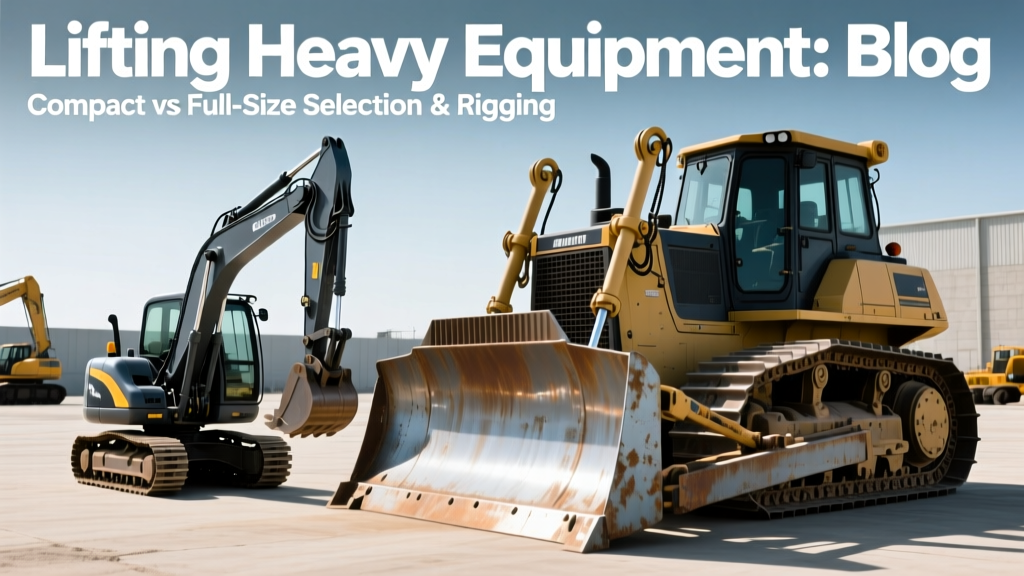
Lifting Heavy Equipment: Compact vs Full-Size Selection & Rigging
Master best practices for lifting heavy equipment. Compare compact vs full-size construction machinery selection, rigging limits, and operator training.
Selecting between compact and full-size construction equipment requires a rigorous analysis of site constraints, material weights, and the complex logistics of lifting heavy equipment. This dual challenge encompasses both the operational lifting capacity of the machine (using an excavator or loader as a crane) and the transport rigging required to move the iron between job sites. For fleet managers and lead operators in 2026, understanding the physical and regulatory distinctions between compact platforms (e.g., mini excavators, compact track loaders) and full-size heavy machinery is critical for maintaining safety margins and project profitability.
OSHA Compliance Alert: Under OSHA standard 1926 Subpart CC, any construction equipment used to hoist, lower, or horizontally move a suspended load is classified as a crane or derrick. Operators utilizing excavators or loaders for lifting heavy equipment must possess specific certifications and adhere strictly to manufacturer load charts, regardless of machine size.Transport Rigging: Moving the Iron Safely
The process of lifting heavy equipment onto lowboy and flatbed trailers introduces severe kinetic and static forces. The rigging protocols differ drastically between compact and full-size machines, directly impacting your logistics budget and CDL requirements.
Compact Equipment: The CDL Advantage
Compact machinery, such as the Bobcat E35 Mini Excavator (operating weight: 7,714 lbs) or the Caterpillar 299D3 XE Compact Track Loader (10,746 lbs), falls under standard commercial towing limits when paired with the correct trailer. Operators typically use 3/8-inch Grade 70 transport chains with a Working Load Limit (WLL) of 6,600 lbs per chain. The primary training focus for compact rigging is identifying the manufacturer-stamped tow points and ensuring the machine's center of gravity (CG) is centered over the trailer's tandem axles to prevent fishtailing at highway speeds.
Full-Size Equipment: Oversize Permits and Heavy Rigging
Deploying a full-size machine like the Caterpillar 336 Excavator (operating weight: 81,900 lbs) requires specialized heavy-haul logistics. Lifting this equipment onto a multi-axle lowboy trailer requires a loading dock or an engineered earthen ramp; it cannot be winched up standard aluminum ramps. Rigging requires 5/8-inch Grade 80 or Grade 100 alloy chains and heavy-duty binders. Furthermore, because the Cat 336 exceeds the standard 8.5-foot width limit, transport requires state-by-state oversize permits (averaging $50 to $250 per jurisdiction) and pilot escort vehicles, adding roughly $1.50 to $2.00 per mile to transport costs.
| Specification | Compact (e.g., Bobcat E35) | Full-Size (e.g., Cat 336) |
|---|---|---|
| Operating Weight | 7,714 lbs | 81,900 lbs |
| Transport Width | 5 ft 9 in (No permit required) | 10 ft 6 in (Oversize permit required) |
| Minimum Tie-Down Grade | Grade 70 Transport Chain | Grade 80/100 Alloy Chain |
| Avg. Transport Cost | $3.50 - $4.50 / mile | $9.00 - $14.00 / mile (inc. escorts) |
| Loading Method | Winch or standard aluminum ramps | Engineered earthen ramp or loading dock |
Operational Lifting: Machine as a Crane
When the machine arrives on site, the second phase of lifting heavy equipment begins: using the machinery to hoist materials like precast concrete manholes, steel pipes, or HVAC units. The physics of the lift dictate whether a compact or full-size machine is viable.
Swing Torque and Side-Lifting Dangers
A common and catastrophic operator error is side-lifting a load—swinging the boom laterally while the load is suspended. Full-size excavators like the Cat 336 generate massive swing torque (up to 105,000 ft-lbs), which can easily snap a sling or overturn the machine if the load snags on an obstacle. Compact excavators have significantly lower swing torque but are highly susceptible to tipping if the load exceeds the over-the-front or over-the-side capacity limits.
'The load chart is not a suggestion; it is the physical limit of the machine's structural integrity. An operator lifting a 4,000 lb pipe with a compact excavator must account for the weight of the rigging, the quick coupler, and the dynamic force of the load swinging, which can momentarily double the static weight on the boom cylinder.'
— NCCCO Certified Rigger & Heavy Equipment Safety Auditor
Ground Bearing Pressure (GBP) Considerations
Lifting heavy equipment requires a stable base. A compact track loader (CTL) distributes its weight over a large rubber track footprint, exerting a GBP of roughly 4.5 to 5.5 psi. This allows CTLs to lift and place materials in soft, muddy, or sensitive terrain without sinking or shifting the load's elevation. Conversely, a full-size wheel loader like the Cat 966 GC concentrates its weight on four pneumatic tires, generating over 35 psi. When a wheel loader lifts a heavy pallet of pavers or bricks, tire deflection and ground compression can cause the load to drop unexpectedly, making track-based or outrigger-stabilized full-size excavators the superior choice for precision hoisting.
The 2026 Selection Framework: Compact vs. Full-Size
Fleet managers should utilize the following step-by-step decision matrix to determine the correct equipment class for jobs requiring heavy lifting:
- Calculate the Total Suspended Load: Add the weight of the material, the quick-attach coupler, the slings, and the Crosby shackles. If the total exceeds 3,500 lbs at your required reach radius, eliminate most compact mini excavators.
- Assess the Lift Radius: Lifting capacity degrades exponentially as the boom extends. A machine that can lift 5,000 lbs at a 10-foot radius may only safely lift 1,500 lbs at a 20-foot radius. Consult the specific OEM load chart for the exact boom and stick configuration.
- Evaluate Site Access and Ground Conditions: If the lift occurs in a confined urban footprint or on finished landscaping, deploy a compact machine with rubber tracks or a full-size excavator with specialized low-GBP pads. Avoid full-size wheel loaders on soft substrates.
- Factor in Mobilization Costs: If the project requires moving the machine daily between micro-sites, the $800+ daily cost of heavy-haul transport and pilot cars for full-size equipment will destroy margins. Select the largest compact machine that meets the lift requirement.
Operator Training and Rigging Mandates
Proper selection of machinery is useless without certified operators. According to the OSHA 1926.251 rigging standards, all slings, chains, and shackles used for lifting heavy equipment must be inspected by a competent person prior to every shift. Operators must be trained to identify reject criteria, such as a 10% reduction in chain link diameter or visible stretching in synthetic web slings.
Furthermore, when utilizing full-size excavators for crane-like hoisting, employers must comply with OSHA 1926 Subpart CC. This requires the operator to be certified by an accredited testing organization, such as the National Commission for the Certification of Crane Operators (NCCCO), specifically for the type and capacity of the equipment being used. Training programs in 2026 increasingly utilize virtual reality (VR) simulators to teach operators how to read load charts and react to dynamic wind loads and ground shifts before they ever touch a physical joystick.
Hardware Inspection Checklist for Operators
- Synthetic Slings: Check for UV degradation, chemical burns, and cut edges. Ensure the WLL tag is legible.
- Alloy Chains: Measure for elongation. Grade 80/100 chains must be removed from service if they stretch beyond 5% of their original length.
- Shackles: Inspect the pin threads for stripping and ensure the pin is fully seated and secured with a cotter pin if required by the manufacturer.
- Machine Hardware: Verify the excavator's lifting eye is free of micro-fractures and the quick-coupler locking mechanism is fully engaged before taking the load off the ground.
By aligning the physical capabilities of compact and full-size machinery with rigorous operator training and precise transport logistics, contractors can execute heavy lifts safely, legally, and profitably.