Leasing Heavy Equipment for Solar Farms: Operator Training Guide
Master operator training protocols when leasing heavy equipment for solar and wind projects. Avoid lease penalties and ensure site safety.
The Financial and Operational Reality of Leased Renewable Energy Assets
Utility-scale solar and wind construction demand highly specialized earthmoving and lifting equipment. Because project durations are finite and machine technology evolves rapidly, general contractors increasingly rely on leasing heavy equipment to preserve capital and avoid long-term depreciation risks. However, operating leased machinery introduces unique liabilities. When a contractor rents a Cat D6 XE dozer or a Liebherr LR 1400/2 crawler crane, the lease agreement strictly delineates 'normal wear and tear' from 'operator negligence.'
A single training oversight can result in catastrophic financial penalties. For example, snapping a GPS machine-control mast on a leased Komatsu PC210LC-11 excavator due to improper transport clearance can cost the lessee upwards of $6,500 in replacement fees and recalibration costs. According to the American Rental Association, equipment damage claims frequently stem from operators who are certified on older machine generations but lack familiarity with the advanced telematics and automated safety interlocks found on 2025 and 2026 rental fleet models.
Lease Liability Warning: Most heavy equipment lease agreements contain a 'Damage Waiver' clause that becomes void if the operator cannot produce documented, machine-specific training logs. Always maintain digital training certificates on-site via fleet management software to protect your firm from strict liability claims.Solar Farm Earthmoving: Precision Grading and Pile Driving Protocols
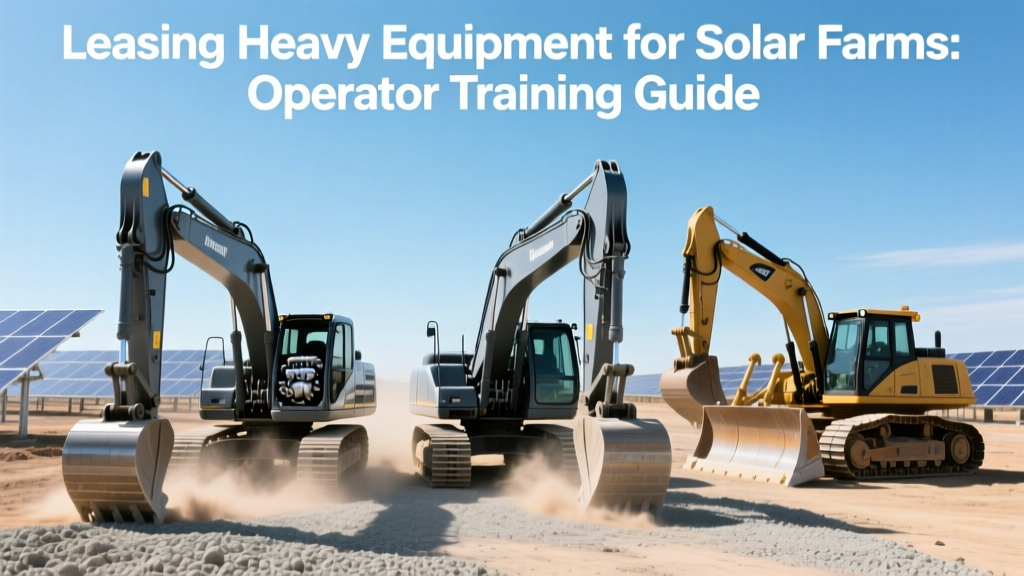
Solar farm construction is not standard commercial site preparation. Utility-scale photovoltaic arrays utilizing single-axis trackers (such as Nextracker or Arctech systems) require exacting topographical tolerances to prevent structural binding and optimize solar yield. Operators assigned to leased motor graders and excavators must be trained specifically on GPS-guided machine control systems like Trimble Earthworks or Topcon X-53i.
Tolerance Requirements: Standard vs. Solar Construction
| Site Preparation Metric | Standard Commercial Pad | Utility-Scale Solar Tracker | Leased Machine Requirement |
|---|---|---|---|
| Grade Tolerance (100 ft span) | +/- 4.0 inches | +/- 1.5 inches | 3D Machine Control GPS |
| Pile Driving Plumbness | +/- 2 degrees | +/- 0.5 degrees | Hydraulic Mast Guidance |
| Topsoil Stripping Depth | Variable (Bulk removal) | Exact 3-5 inch preservation | Laser-guided Scraper Blade |
When operators transition to a leased Cat 14M3 motor grader equipped with 3D machine control, training must focus on the system's 'auto-blade' features. A common failure mode occurs when operators override the automated blade lift to manually correct a perceived grade error, inadvertently corrupting the digital terrain model (DTM) file. Best practice dictates that site supervisors lock the DTM file permissions, allowing operators to monitor the cut/fill indicators without the ability to alter the baseline grading parameters.
Wind Turbine Erection: Crane Operations and Safety Interlocks
Wind turbine construction relies heavily on heavy-lift crawler cranes. Leasing a 400-ton class crane, such as the Manitowoc MLC300, often costs between $45,000 and $65,000 per month, excluding mobilization. The OSHA Cranes and Derricks standard (29 CFR 1926 Subpart CC) mandates rigorous operator certification and daily inspection protocols, but leased cranes require an additional layer of familiarization regarding proprietary Load Moment Indicator (LMI) systems.
Modern leased cranes feature advanced anemometers and wind-speed interlocks that automatically restrict boom hoisting when gusts exceed specific thresholds (typically 22 mph for large surface-area nacelle lifts). Operators accustomed to older machines often attempt to bypass these software interlocks, assuming they possess the 'feel' to manage the load safely. This is a severe violation of both OSHA regulations and the lease agreement.
'The most expensive component on a leased wind turbine crane is not the main boom; it is the LMI sensor suite. An operator who forces a hoist limit switch during a high-wind gust can fry the main PLC board, resulting in a $25,000 repair bill and a two-week project delay while the lessor sources proprietary replacement parts.' — Heavy Lift Safety Director, Midwest Wind Contractors
Pre-Shift Leased Crane Familiarization Checklist
- LMI Boot Sequence Verification: Confirm the LMI screen initializes without fault codes. Check that the wind speed sensor on the boom tip matches the base anemometer within a 1 mph variance.
- Anti-Two-Block Testing: Physically test the limit switch with an empty hook block. Leased machines frequently have worn limit switch cables from previous job sites; operators must verify the physical cutoff engages before the software alarm sounds.
- Counterweight Pin Inspection: Verify that the hydraulic counterweight stacking pins are fully seated and that the proximity sensors register a 'locked' status on the operator display.
- Track Tension and Travel Alarms: Review the travel speed parameters. Leased cranes often arrive with travel alarms disabled or set to non-standard decibel levels to comply with previous municipal noise ordinances.
Battery Energy Storage Systems (BESS): Pad Compaction Standards
The rapid expansion of Battery Energy Storage Systems (BESS) requires heavily reinforced concrete pads capable of supporting immense static loads from lithium-ion container banks. Soil compaction is critical. Contractors leasing vibratory soil compactors, such as the Bomag BW 213 DH, must train operators on the integration of continuous compaction control (CCC) technology.
Unlike traditional nuclear density gauge testing, which provides spot-checks, CCC uses accelerometers mounted on the compactor drum to measure soil stiffness in real-time. Operators must be trained to read the compaction meter value (CMV) displays inside the cab. A common mistake on leased equipment is failing to calibrate the CCC system to the specific soil moisture content of the current site, leading to false 'over-compaction' warnings that halt production unnecessarily. The OSHA Renewable Energy safety guidelines emphasize that proper ground preparation directly mitigates the risk of heavy equipment rollovers during the transport of massive BESS transformer units onto the pads.
The F.A.M.E. Operator Onboarding Framework for Leased Gear
To standardize training and mitigate lease liabilities, site managers should implement the F.A.M.E. framework whenever new equipment arrives on a renewable energy site:
- F - Familiarization (Hours 1-2): The operator spends two hours in the cab with the engine off, mapping out all digital menus, camera blind spots, and emergency shut-off locations. Leased machines often feature updated UI layouts compared to owned fleet models.
- A - Assessment (Hours 3-4): A supervised practical test in a designated 'dummy zone' of the site. The operator must demonstrate proficiency in engaging machine-control overrides, testing backup alarms, and executing a safe shutdown sequence.
- M - Monitoring (Week 1): Utilize the machine's built-in telematics (e.g., Cat VisionLink or Komatsu KOMTRAX) to monitor idle times, hydraulic pressure spikes, and harsh braking events. Review this data daily with the operator to correct bad habits before they trigger lease damage clauses.
- E - Evaluation (End of Month 1): Conduct a joint walk-around inspection with the leasing company's regional representative to document the machine's condition, ensuring baseline wear is officially recorded and protecting the contractor from end-of-lease dispute charges.
Strategic Takeaways for Renewable Energy Contractors
Leasing heavy equipment for solar, wind, and BESS construction provides the flexibility required to scale operations in a booming market. However, the financial benefits are quickly erased by damage penalties and safety violations caused by inadequate operator training. By enforcing strict machine-control tolerances, respecting proprietary software interlocks on heavy lift cranes, and utilizing telematics for continuous operator monitoring, contractors can maximize the productivity of their leased fleet while maintaining an unblemished safety and liability record.