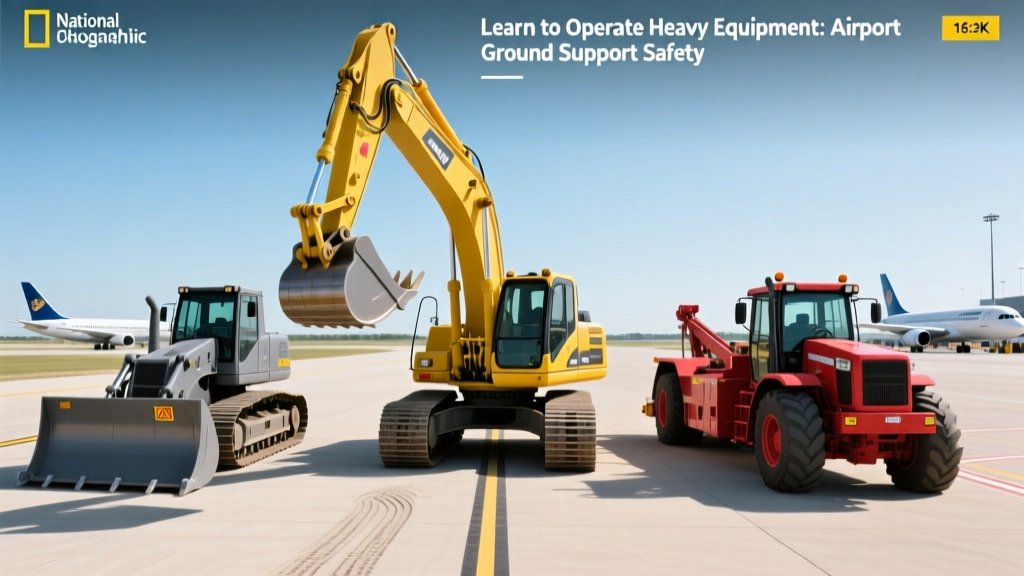
Learn to Operate Heavy Equipment: Airport Ground Support Safety
Master safety standards and compliance when you learn to operate heavy equipment for airport ground support. Explore GSE training and FAA regulations.
The airport apron is one of the most highly regulated and unforgiving industrial environments on earth. When new personnel learn to operate heavy equipment designed for airport ground support, the margin for error is measured in inches and seconds. Unlike standard construction or earthmoving machinery, Ground Support Equipment (GSE) operates in close proximity to multi-million-dollar aircraft, volatile jet fuel, and high-velocity jet blast zones. Compliance is not optional; it is enforced through a rigid matrix of FAA, OSHA, and IATA regulations.
The Regulatory Framework: FAA, IATA, and OSHA Intersections
Operating heavy machinery airside requires navigating overlapping jurisdictions. The Federal Aviation Administration (FAA) governs the movement and safety of aircraft and the immediate ramp environment, while the Occupational Safety and Health Administration (OSHA) dictates operator safety and mechanical standards for the equipment itself.
- FAA Advisory Circular 150/5210-20: Dictates the baseline requirements for Airport Safety Training Programs, including the mandatory Airside Driving Permit (ADP) required before an operator can even turn the key on a piece of motorized GSE.
- FAA AC 00-34D: Provides the definitive guidelines for aircraft ground handling and servicing, outlining exact clearance distances, chocking procedures, and communication protocols between ground crews and flight decks.
- OSHA Powered Industrial Trucks (29 CFR 1910.178): Applies to cargo loaders, forklifts, and belt loaders, mandating specific load capacity placarding, daily pre-shift inspections, and triennial operator recertification.
Core GSE Categories and Specific Training Requirements
To safely navigate the ramp, operators must master distinct classes of heavy equipment, each with unique mechanical profiles and compliance hazards.
1. Towbarless Pushback Tractors (e.g., Goldhofer AST-1X, TLD TPX-200)
Towbarless tractors cradle the aircraft's NLG and push it back from the gate. Modern 2026 models are increasingly electric, such as the TLD E-Series, which offer instant torque but require specific training on battery thermal management during high-load pushes.
- Compliance Focus: Operators must be trained to read and respect the aircraft-specific NLG shear pin and electronic torque limits. Pushing an Airbus A350 requires entirely different cradle pressure settings than a Boeing 737 MAX.
- Clearance Rule: Maintain a strict 10-foot safety radius around the tractor during the cradle engagement phase to prevent crush injuries from the articulating hitch.
2. Belt Loaders and Cargo Transporters (e.g., JBT AeroTech Commander)
Belt loaders bridge the gap between the tarmac and the aircraft cargo bin door. The primary hazard is fuselage contact.
- The 2-to-4 Inch Rule: FAA and IATA standards mandate that the leading edge of the belt loader must be positioned exactly 2 to 4 inches away from the aircraft fuselage. Closer risks scraping the aluminum/composite skin; further away risks cargo handlers falling through the gap.
- Approach Speed: GSE must not exceed 5 MPH on the apron, and must come to a complete stop 10 feet from the aircraft before creeping forward at idle speed for final positioning.
3. De-Icing Rigs (e.g., Vestergaard Elephant E-Series)
De-icing rigs combine a heavy truck chassis with a 65-foot articulating boom and high-pressure fluid pumps.
- Environmental & Safety Compliance: Operators must monitor wind thresholds. If crosswinds exceed 25 knots, operations must halt to prevent glycol drift onto adjacent taxiways, which creates a severe slip hazard and violates EPA stormwater runoff regulations.
- Hot Fluid Hazards: Type IV de-icing fluid is heated to 180°F (82°C). Operators must wear specialized thermal PPE and maintain a minimum 15-foot distance from the aircraft's engine intakes and pitot tubes to prevent sensor damage.
Step-by-Step: The Airside Certification Pathway
How do professionals actually learn to operate heavy equipment in this highly restricted sector? The pathway from novice to certified ramp agent follows a strict, multi-phase progression.
- Phase 1: Classroom and Airside Driving Permit (ADP) Acquisition. Before touching GSE, operators must pass the airport-specific ADP test. This covers FOD (Foreign Object Debris) awareness, runway incursion prevention, and airside signage recognition. Cost: ~$250 per employee.
- Phase 2: Simulator and Shadowing. Modern training facilities use VR simulators to practice belt loader approaches and pushback communications. This is followed by 40 hours of shadowing a certified Lead Ramp Agent.
- Phase 3: Live Apron Evaluation. An FAA-certified evaluator observes the operator performing a complete pre-shift inspection (checking hydraulic lines, shear pins, and beacon lights), executing a mock pushback, and properly chocking an aircraft.
2026 GSE Training Cost & Certification Matrix
| GSE Category | Example Model | Avg. Training Cost (2026) | Recertification Cycle | Primary Compliance Hazard |
|---|---|---|---|---|
| Towbarless Tractor | Goldhofer AST-1X | $3,500 - $4,500 | Annual | NLG Torsion / Shear Pin Bypass |
| Belt Loader | JBT Commander 15 | $1,200 - $1,800 | Triennial (OSHA) | Fuselage Strike / Gap Fall |
| De-Icing Rig | Vestergaard Elephant | $4,000 - $5,500 | Annual (Seasonal) | Glycol Drift / Pitot Tube Damage |
| Aircraft Tug (Conventional) | Eagle Tugs ET-12 | $2,000 - $2,800 | Annual | Towbar Snap / Personnel Crush |
Real-World Failure Modes and Prevention Checklists
Understanding why accidents happen is critical for compliance officers and lead operators. Here are two of the most common, high-cost failure modes on the modern apron.
Failure Mode A: The Towbar Shear Pin Bypass
The Scenario: A ground crew attempts to push back a fully loaded Boeing 777 using a tractor rated slightly below the aircraft's maximum gross takeoff weight. The electronic limiter engages, stopping the push. The operator manually overrides the software limit to force the push.
The Result: The sheer force transfers directly into the aircraft's NLG, twisting the steering collar. The flight crew discovers the fault during the pre-flight steering check. The aircraft is grounded, requiring a $150,000 NLG replacement and triggering an FAA incident investigation.
Compliance Fix: Implement biometric or dual-key software overrides that require a Ramp Supervisor's physical presence and logged justification to bypass torque limits.
Failure Mode B: Belt Loader Ramp Angle Miscalculation
The Scenario: An operator positions a belt loader for a narrow-body aircraft but fails to adjust the hydraulic ramp angle to match the specific cargo door sill height, which varies based on the aircraft's current fuel and payload weight.
The Result: As heavy cargo pallets are loaded, the aircraft's suspension compresses. The belt loader's leading edge, initially 3 inches away, is driven directly into the fuselage, puncturing the pressurized skin.
Compliance Fix: Mandate the use of auto-leveling belt loaders equipped with sonic proximity sensors that dynamically adjust the ramp height as the aircraft suspension compresses during loading.
Foreign Object Debris (FOD) is a leading cause of jet engine destruction. Compliance isn't just about driving the machinery; it's about the environment. Every GSE operator must perform a 360-degree FOD walk-around of their equipment before approaching the aircraft. A single 10mm socket dropped from a maintenance truck and ingested by a GE9X engine can cause $20 million in damages and severe loss of life. According to IATA Ground Operations Safety guidelines, continuous FOD mitigation is a core competency evaluated during every annual recertification.
Frequently Asked Questions: Airside Heavy Equipment Compliance
Do I need a standard CDL to operate airport pushback tractors?
No. Pushback tractors and most GSE do not operate on public highways, so a Commercial Driver's License (CDL) is generally not required. However, you must possess a valid state driver's license and pass the airport-specific Airside Driving Permit (ADP) examination, which focuses on taxiway markings, ATC light gun signals, and right-of-way rules.
How often must GSE undergo mechanical compliance inspections?
Operators must perform a documented pre-shift inspection (brakes, steering, hydraulics, beacon lights, fire extinguisher pressure) before every single shift. Additionally, FAA and OSHA mandates require certified mechanics to perform deep-dive structural and hydraulic load testing on equipment like belt loaders and passenger boarding bridges every 12 months.
What happens if I violate an airside safety rule?
Violations are handled on a tiered system. Minor infractions (e.g., failing to wear a high-visibility vest) may result in a suspended ADP and mandatory retraining. Major infractions (e.g., speeding on the apron, bypassing safety interlocks, or causing a runway incursion) result in immediate and permanent revocation of airside privileges, termination of employment, and potential federal prosecution if aircraft or personnel are endangered. For comprehensive federal guidelines, operators and management should regularly consult the FAA Airport Safety Training resources.