How a Heavy Equipment Manufacturer Innovates Landscaping Tech (2026)
Explore how a heavy equipment manufacturer is transforming landscaping categories with electrification, telematics, and automated grade control in 2026.
The Electrification Mandate in Compact Landscaping Categories
The landscaping sector—dominated by compact track loaders (CTLs), mini excavators, and skid steers—is undergoing a radical powertrain transformation. Driven by municipal zero-emission mandates and strict noise ordinances in residential zones, every major heavy equipment manufacturer is pivoting toward battery-electric architectures. However, the transition is not merely about swapping a diesel block for an electric motor; it requires a complete redesign of electro-hydraulic systems to minimize parasitic power loss.
Take the compact excavator category. Models like the Bobcat E10e and Volvo ECR25 Electric have redefined urban landscaping. Instead of traditional pilot-operated hydraulic controls, these machines utilize electro-hydraulic proportional valves. This architecture reduces hydraulic parasitic loss by 12% to 15%, directly extending runtime on a single charge. For a landscaping contractor working an 8-hour shift, this efficiency translates to roughly 45 additional minutes of active digging or trenching time before requiring a midday opportunity charge.
Battery Chemistry: LFP vs. NMC in Landscaping Rigs
A critical differentiator among OEMs in 2026 is the choice of lithium-ion cell chemistry. While Nickel Manganese Cobalt (NMC) offers higher energy density, Lithium Iron Phosphate (LFP) has become the standard for heavy landscaping equipment due to its superior thermal stability and cycle life.
| Battery Metric | LFP (Lithium Iron Phosphate) | NMC (Nickel Manganese Cobalt) |
|---|---|---|
| Typical Cycle Life | 3,000 - 4,500 cycles | 1,500 - 2,000 cycles |
| Energy Density | 160 Wh/kg (Lower) | 220 Wh/kg (Higher) |
| Thermal Runaway Risk | Extremely Low | Moderate (Requires active cooling) |
| Best Landscaping Application | Daily-cycle CTLs and Skid Steers | Space-constrained Mini Excavators |
Telematics and Fleet Uptime: The OEM Data Advantage
Beyond powertrains, the modern heavy equipment manufacturer leverages Internet of Things (IoT) telematics to turn landscaping machinery into connected data nodes. For fleet managers overseeing 15+ machines across scattered residential and commercial sites, idle time and unauthorized attachment usage destroy profit margins. Platforms like John Deere JDLink and Cat Connect now offer granular, attachment-level telemetry.
By monitoring hydraulic flow rates and pressure spikes at the auxiliary couplers, these systems can identify when a hydraulic breaker or auger is being used outside of designated geofences. According to John Deere's JDLink specifications, fleet managers can set automated alerts for PTO (Power Take-Off) engagement in restricted zones, reducing unauthorized equipment wear and liability.
Calculating the Telematics ROI for Landscapers
- Subscription Costs: Average OEM telematics packages range from $35 to $60 per machine/month.
- Fuel/Energy Savings: Identifying and correcting excessive idle times (over 15% of engine-on time) yields a 7% to 9% reduction in annual energy/fuel costs.
- Maintenance Avoidance: Predictive fault codes for hydraulic filter degradation allow contractors to schedule servicing during weekend downtime, avoiding $400+ per-day emergency field repairs.
Automated Grade Control: Eliminating the String Line
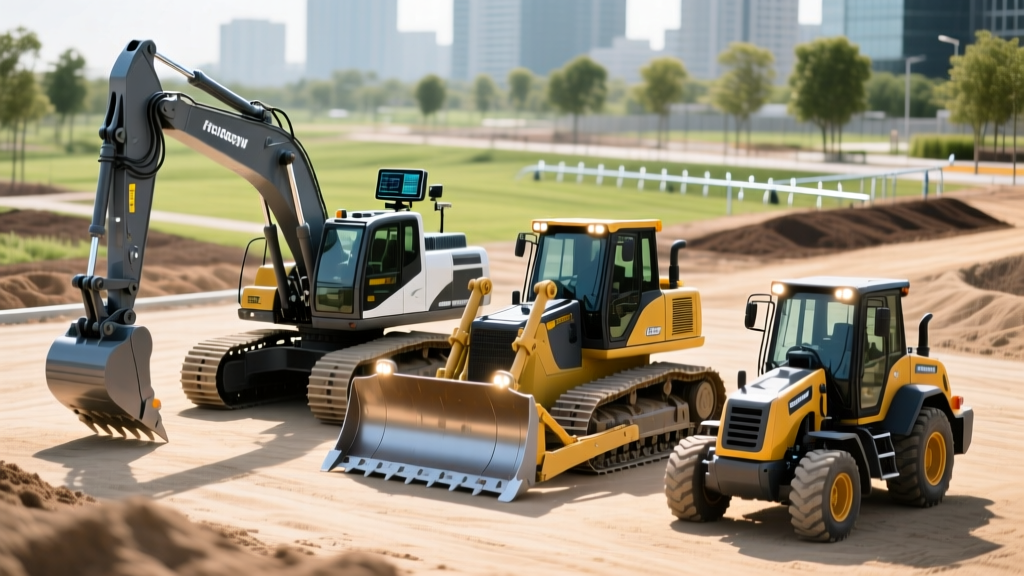
Finish grading for patios, retaining walls, and French drains historically required extensive manual labor, string lines, and laser levels. Today, integrated 2D and 3D machine control systems have migrated from heavy highway bulldozers down to compact landscaping skid steers and CTLs. By integrating Topcon or Spectra Precision sensors directly into the machine's CAN bus network, the heavy equipment manufacturer enables the blade to automatically adjust pitch and tilt to match a digital terrain model (DTM).
The financial impact is substantial. A fully equipped RTK (Real-Time Kinematic) base station and rover setup for a landscaping fleet costs approximately $18,500 in 2026. However, this investment reduces finish-grading labor by up to 40% and cuts base material overage (gravel and sand) by 15%, paying for itself within 8 to 14 months for a mid-sized hardscaping contractor.
Overcoming GPS Multipath Errors in Mature Landscapes
A common failure mode when using GNSS-based grade control in residential landscaping is 'multipath error.' When operating under heavy tree canopies or near two-story structures, satellite signals bounce off leaves and walls, causing the blade to deviate by 1 to 3 inches—enough to ruin a paver base slope.
The Expert Fix: For heavily wooded sites, bypass GNSS entirely. Utilize a Robotic Total Station (RTS) paired with a 360-degree prism mounted to the machine's mast. The RTS tracks the prism optically, maintaining sub-millimeter accuracy (within 0.05 inches) regardless of overhead canopy interference.
Procurement Framework: Spec'ing Tech for Landscaping Fleets
Choosing the right technology stack depends entirely on the scale and scope of your landscaping operations. Over-spec'ing technology leads to unrecouped capital expenses, while under-spec'ing results in lost bids against more efficient competitors. Use the following matrix to guide your 2026 equipment purchases.
| Business Profile | Primary Categories Needed | Recommended Tech Spec Level | Estimated Capital Outlay |
|---|---|---|---|
| Residential Maintenance (Mowing, Mulch, Planting) | Compact Track Loaders, Stand-on Skid Steers | Basic Telematics (Geofencing), Standard Auxiliary Hydraulics | $45,000 - $65,000 per unit |
| Hardscaping & Patios (Pavers, Retaining Walls) | Skid Steers, Compact Wheel Loaders | 2D Laser Grade Control, High-Flow Hydraulics for Cold Planers | $75,000 - $95,000 per unit |
| Commercial Site Prep (Drainage, Grading, Earthmoving) | Compact Excavators, Large CTLs | 3D RTK Machine Control, Electric Powertrain (for noise ordinances) | $110,000 - $145,000 per unit |
Navigating Emission Regulations in 2026
When purchasing diesel-powered landscaping equipment, contractors must ensure compliance with the latest EPA Tier 4 Final and EU Stage V emission standards. The EPA's nonroad diesel engine guidelines mandate advanced aftertreatment systems, including Diesel Particulate Filters (DPF) and Selective Catalytic Reduction (SCR). For compact landscaping rigs operating in low-load, high-idle conditions (such as running a hydraulic auger intermittently), DPF clogging is a primary failure mode. To prevent this, specify machines with automated high-idle regeneration routines, or mandate that operators run the machine at 80%+ load for 20 minutes at the end of each shift to burn off accumulated soot.
The Future of Autonomous Landscaping Rigs
While fully autonomous earthmoving is still maturing, remote-controlled operation has become a staple in hazardous landscaping applications. For trenching near unstable slopes or operating brush cutters on steep embankments, OEMs now offer factory-installed remote-operation kits. These systems utilize dual-joystick transmitters with a 300-foot line-of-sight range and sub-50-millisecond latency, ensuring precise hydraulic control while keeping the operator safely away from the machine's tipping axis. As battery density improves and 5G private networks expand across commercial job sites, the heavy equipment manufacturer will continue to push the boundaries of what compact landscaping machinery can achieve without a human in the cab.